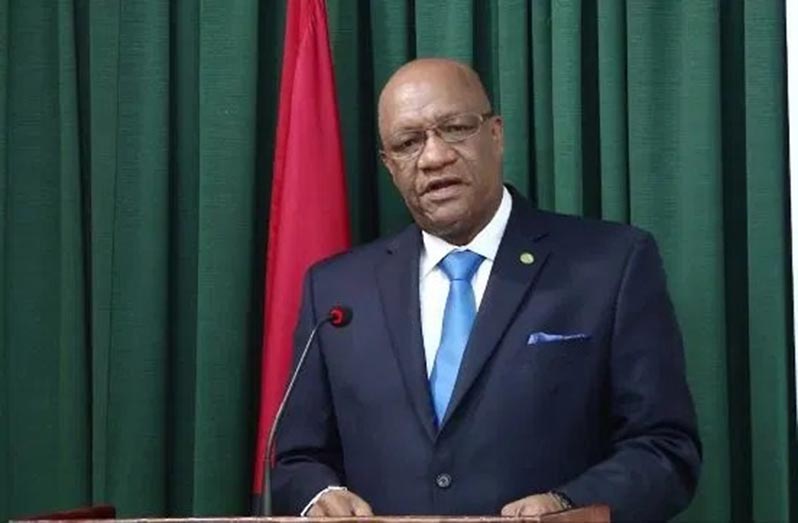
Declaring that Guyana is slipping backwards into inequality and injustice, political activist and co-leader of the Working People’s Alliance ( WPA), Dr. David Hinds issued a fiery call for “revolution,” urging citizens to rise up, organise, and resist what he described as deepening marginalisation and state excesses.
Speaking on his “Politics 101” programme Tuesday evening, Dr. Hinds delivered a blistering critique of governance, race relations, and public complacency, warning that silence and inaction will enable a dangerous regression in the country’s social and political landscape.
“We are the children of the revolution… we fought so that you don’t have to be this way today, but yet here we are today, facing the same conditions all over again,” Hinds declared.
Dr. Hinds’ criticisms came on the heels of reports that residents and farmers of Friendship Village, East Bank Demerara, had their homes bulldozed Tuesday, following a court order.
Residents clashed with police and court marshals, who insisted that they needed to remove from the land on which they have been living, some for decades.
Dr. Hinds was particularly scathing in his criticism of what he described as the ongoing targeting of vulnerable communities.
“They can’t continue breaking down people homes… you have to stand up like men and women and stop this nonsense. Nothing changes unless people demand that it changes,” he said.
Drawing on the legacy of the 1970s Caribbean Black Power movement, the political activist pointed to figures such as Dr. Walter Rodney and Michael Manley, arguing that their struggles broke down systems that once excluded black and working-class people from economic and social advancement.
According to him, those gains are now slipping away.
“Revolution is a process… the things we take for granted today, we had to fight for them. If you don’t protect them, you will lose them, and that is exactly what is happening now,” he warned.
Dr. Hinds contended that sections of the population are abandoning collective responsibility in favour of individual survival.
“You have succeeded in getting us to believe that our salvation doesn’t lie with us anymore… we are no longer thinking about the collective, and that is a dangerous place for any society.”
He argued that both political leaders and citizens must share blame for the country’s direction, insisting that passive support and political loyalty without accountability have weakened resistance.
“The opposition cannot fight by themselves… leaders need people, and people must demand from leaders. Nothing comes without sacrifice-nothing ever did and nothing ever will,” he stated.
While distancing himself from any call to violence, Dr. Hinds made it clear that confrontation through organised resistance was necessary.
“I am not talking about picking up arms… but I am preaching resistance. You have to decide whether you will allow yourselves to be pushed back or whether you will stand up and fight for what is yours,” he stressed.
Entering the contentious territory of race, Dr. Hinds defended his advocacy for black empowerment while rejecting accusations of division.
“I am standing on the side of black people… that does not mean I am against anyone else. Every group has a right to love and uplift their own people,” he said.
At the same time, he warned that racial divisions are being manipulated, leaving communities fractured and easier to control.
Turning to the country’s growing oil wealth, Dr. Hinds argued that ordinary citizens are not seeing meaningful benefits, particularly those at the lower end of the economic ladder.
“There is enough wealth in this country to wipe out poverty… but the question is whether those in power are willing to distribute it fairly and ensure people live with dignity,” he said.
He insisted that pressure, not promises, has historically driven change, and that Guyanese must once again adopt that approach.
“Do you think any government will concede anything without pressure? It has never happened and it will never happen. People must organise, mobilise, and demand what belongs to them,” he declared.
The political activist was adamant that fear, silence, and division are allowing conditions to deteriorate unchecked.
“I’m tired of crying and mourning… tired of watching bulldozers tearing down poor people homes. It will stop when we stop it—that is the only way it will stop,” he said. (Release)