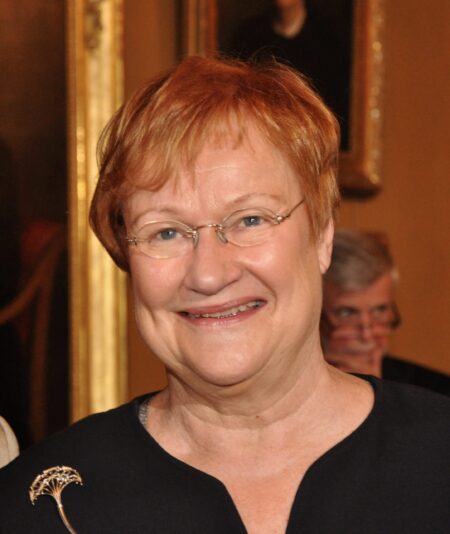
(United Nations) Tarja Halonen is the first female Finnish president and so far, the only woman in Finland’s history in this position. She is and has been deeply involved in the United Nations, specifically in initiatives promoting gender equality as human rights, sustainability and climate.
Throughout her political career, Tarja Halonen has described herself as a supporter of international solidarity. In 2009, Forbes named her among the 100 most powerful women in the world. Gender equality is in special focus at the UN now that the Commission on the status of women is holding its annual meeting and we have just observed the International women’s day.
In an interview with UNRIC on these occasions President Tarja Halonen emphasizes the fact that the world is in a state where we have a record number of armed conflicts since World War II, and the UN has a strong role regarding protecting human rights. When discussing the UN’s role in protecting women’s rights amid rising political tensions, President Halonen says she is both sad and worried about the state of the world.
– Especially the bigger countries underestimate the United Nations role to mediate, President Halonen says. Some of these countries and leaders have a very strong belief in power, military power, and are trying to press down the role and mandates of the UN which does not help peace negotiations.
We already have evidence pointing at the fact that participation by women in peace negotiations and conflict resolution would lead to a more sustainable peace, but this is not necessarily what the parties of the conflict consider, Halonen suspects.
– The opinion of the leaders and the opinion of the people is not exactly always the same, to negotiate successfully you have to create a positive atmosphere to see some change.
A woman as the next Secretary-General
During her presidency from 2000 to 2012, President Halonen chaired the ILO World Commission on the Social Dimension of Globalization. She also served on the Panel of Eminent Persons of the UN Conference on Trade and Development. She co-chaired the United Nations Millennium Summit and the UN High-Level Panel on Global Sustainability, among other key roles.
Currently, President Halonen is a member of the UN’s Secretary-General’s High-Level Advisory Board on Mediation and a UNCCD Land Ambassador. She is also a member of the Council of Women World Leaders, a network of current and former women prime ministers and presidents whose primary goal is to draw on the experience of its members to support women’s full participation and representation in the political process at the highest levels.
You have said you would like to see a woman as the next UN Secretary-General? What would this mean for the organisation?
– Women are even a little bit more than 50 percent of the population, for the UN it would be a fantastic thing to have a female leader and I do not believe women are less capable. Different types of leaders focus on different issues, and the state of the world is already so difficult right now there might be people who think it is time to take a risk to make a different choice this time.
President Halonen says she thinks those who have been critical about the United Nations as an organization and its efficiency mostly have focused on the Security Council and their ability to create consensus when it is needed for countries in conflict and the discussion of the veto.
– I don’t expect the choice of the next Secretary-General to be easy, but there are several good candidates, and I hope nobody already has made the decision that the position should not be filled with a woman and will work against it. The time for that kind of cynical thinking has already passed.
Looking back, what achievement related to women’s rights is closest to your heart?
– Education, President Halonen states without hesitation. When you have your basis in education no one can steal that from you. They cannot silence you.
When asked about what strong women have made an impact on Tarja Halonen’s career she immediately highlights Eleonor Roosevelt, a driving force behind the Universal Declaration of Human Rights serving as the first Chair of the UN Commission on Human Rights.
Tarja Halonen says she has been working with a lot of men, for instance when co-chairing the United Nations Millennium Summit. She says “I was the lady from the North and they were the gentlemen from the South”. President Halonen has always paid special attention to gender equality. She brings forward the question of male oppression and gender-based violence and says legislation is a good basis, but it is not enough.
– We have legislation, we have the Istanbul Convention preventing gender-based violence to clearly safeguard the system, but we need countries to be committed when the party is over. Countries should not be allowed to leave and say they will do things in other ways.
Regarding female role models on a national level Halonen mentions Helvi Sipilä, a Finnish diplomat, lawyer and politician. Helvi Sipilä (1915–2009) became the first female Assistant Secretary-General of the United Nations in 1972. As a champion for gender equality, she organized the first World Conference on Women in 1975, initiated the UN Decade for Women, and helped establish UNIFEM. In 1982, Sipilä made history as the first female presidential candidate in Finland.
President Tarja Halonen has a special memory from when her own father heard about Sipilä saying yes to being a candidate for being the next Finnish President in 1982: “But she is a woman!” President Tarja Halonen’s father exclaimed and then added: “Why not? The legislation is not against it!”