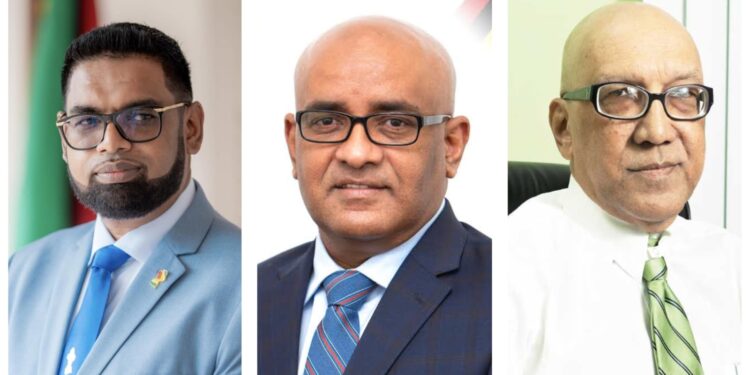
By Mark DaCosta-Leader of the Opposition, Azruddin Mohamed, has turned to Washington’s influence network, signing a US$250,000 advance contract with a United States lobbying firm to cultivate ties with American lawmakers and business leaders. The arrangement, disclosed in filings with the U.S. Department of Justice, shows that the We Invest in Nationhood (WIN) party he leads has retained LGS LLC — a Wyoming-based firm headed by Stephen Payne, a former aide to President George W. Bush, along with associate Logan Somera — to engage U.S. government officials and private sector interests on Mohamed’s behalf.
The firm’s mandate is to advise WIN on building connections within the US government and private sector, and to prepare and disseminate information to lawmakers. Lobbying, in essence, is the professional practice of influencing government decisions by providing targeted advocacy, intelligence, and persuasion on behalf of clients. While it is a recognised feature of American democracy, its use by Guyana’s opposition party led by individuals facing serious criminal allegations raises profound questions about credibility, accountability, and the integrity of our nation’s political discourse, says an analyst.
The public filings reveal that WIN has already paid US$250,000 upfront, with no clear budget established for the dissemination of materials. The firm insists it will not involve public relations agents or external publicity firms, suggesting that Payne and Somera themselves will directly handle the advocacy. Their connections to the energy sector in Texas are notable, given Guyana’s oil wealth and the fierce competition over its exploitation.
For WIN, the hiring of lobbyists is a calculated move to counterbalance the stigma of US sanctions against its leader and his father, Nazar Mohamed, both of whom face extradition proceedings in Guyana after being indicted in Florida on charges of fraud, money laundering, and tax evasion linked to gold exports.
The optics are troubling: a sanctioned opposition leader, newly elevated to constitutional office as Opposition Leader, now seeks to polish his image abroad through paid intermediaries while simultaneously contesting extradition at home, says a WIN critic. On the other hand, another commentator has pointed out that the practice of employing professional communications experts to mediate issues is nothing new, unusual, nor questionable, particularly when powerful forces such as a government is targeting a victim.
Lobbying firms such as LGS exist to bridge the gap between private interests and public policy. They arrange meetings, monitor legislation, provide technical data, and craft persuasive campaigns to secure favourable outcomes for their clients. Their advantage lies in their access and expertise, qualities that ordinary citizens and even diplomats may lack. For WIN, the objective is clear: to persuade US policymakers and businesses to view the party as a legitimate actor despite the cloud of criminal allegations.
The background of lobbying highlights its dual nature. On one hand, it is a legitimate democratic tool, allowing diverse voices to inform policymakers. On the other, it is often criticised for privileging wealthy clients who can afford professional advocates. Lobbyists employ methods ranging from direct advocacy to orchestrated campaigns, and their functions include policy monitoring, strategic advisory, and expert intelligence. The advantages of hiring such professionals are undeniable: they can open doors, shape narratives, and secure outcomes that might otherwise be unattainable.
According to the analyst, the People’s Progressive Party (PPP) government has long been accused of prioritising image over substance, and WIN’s decision to hire lobbyists mirrors this same approach to perception management. Both ruling and opposition parties appear more concerned with how they are viewed in Washington than with how they serve citizens in Georgetown, Linden, or Berbice, says another commentator. This fixation on external validation betrays a lack of confidence in domestic legitimacy.
For WIN, the irony is stark: while its leaders fight extradition in local courts, they simultaneously pay handsomely to lobbyists to cultivate relationships with the very government seeking their prosecution. For other analysts, the political playing field must have an equal gradient, and anyone who employs the same tactics employed by the PPP government is simply acknowledging the current political reality