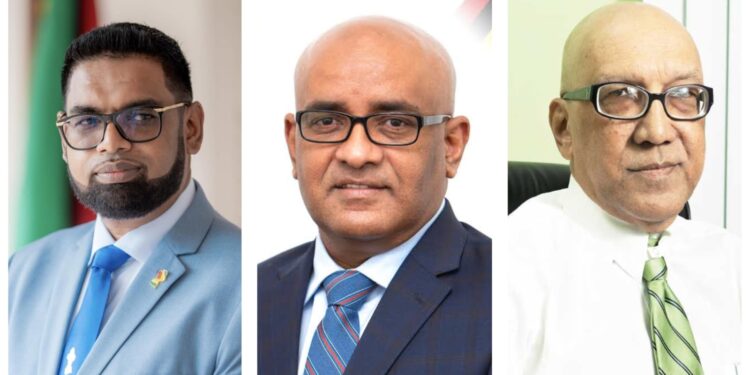
Businessman-turned-politician Azruddin Mohamed and his father, Nazar Mohamed, have been indicted in the United States District Court for the Southern District of Florida on 11 criminal charges, including wire fraud, gold smuggling, and money laundering.
Each charge carries a potential maximum sentence of 20 years in prison, and the case represents a deepening of legal troubles for the Mohamed family—one of the most prominent and wealthy in Guyana.
Azruddin Mohamed, leader of the newly formed We Invest in Nationhood (WIN) party, emerged as the leading opposition figure in Guyana’s most recent general elections. According to the Guyana Elections Commission (GECOM), WIN secured 109,066 votes, translating to 16 seats in the 13th Parliament—making Mohamed the likely Leader of the Opposition.
U.S. Sanctions and Allegations of Corruption
The criminal charges are closely tied to sanctions announced last year. On June 11, 2024, the U.S. Department of the Treasury’s Office of Foreign Assets Control (OFAC) issued sanctions against the Mohameds and associated entities under Executive Order 13818, which builds upon and implements the Global Magnitsky Human Rights Accountability Act.
In its press release, the Treasury stated:
“Today, the Department of the Treasury’s Office of Foreign Assets Control (OFAC) sanctioned members of one of Guyana’s wealthiest families, Nazar Mohamed and his son, Azruddin Mohamed, their company, Mohamed’s Enterprise, and a Guyanese government official, Mae Thomas, for their roles in public corruption in Guyana. Additionally, OFAC designated two other entities, Hadi’s World and Team Mohamed’s Racing Team, for being owned or controlled by Mohamed’s Enterprise and Azruddin, respectively.”
The U.S. government accused the Mohameds of conducting large-scale gold smuggling operations and systematic tax evasion, alleging they underreported over 10,000 kilograms of gold exports between 2019 and 2023—evading more than US$50 million in taxes.
Former Permanent Secretary of the Ministry of Home Affairs, Mae Toussaint Jr. Thomas, was accused of using her public office to grant preferential treatment and government favors to Mohamed’s Enterprise in exchange for cash payments and luxury gifts.
The sanctions freeze all U.S.-linked assets belonging to the sanctioned individuals and entities, and prohibit American citizens and companies from engaging in business with them. OFAC further warned that non-U.S. persons found providing support could face secondary sanctions.
U.S. Will “Work Around” Sanctioned Officials in Office
Despite the growing legal and diplomatic controversy, U.S. Ambassador to Guyana Nicole Theriot confirmed that the United States would maintain cooperation with the Guyanese administration even if Azruddin Mohamed assumes a seat in Parliament.
Speaking on September 3 at a European Union Electoral Observer Mission press conference, Theriot said:
“We have had OFAC-sanctioned individuals in governments in other places of the world—several, in fact—and we find ways to work around that.”
There has been no formal U.S. statement regarding whether Mae Thomas will also face criminal charges beyond the existing sanctions.
U.S. Political Context
The Mohamed case comes at a time of heightened political and legal scrutiny in the United States itself. In May 2024, former President Donald Trump was convicted on 34 felony counts, though sentencing was postponed pending the outcome of the November 2024 presidential election, which he won. The charges were later dismissed following his re-election.
Ongoing Investigation
The indictments against the Mohameds are part of a broader crackdown on international corruption and financial crimes by U.S. authorities. Both the criminal case and the sanctions are expected to have wide-reaching implications, not only for the Mohameds and their associates but also for Guyana’s political and business landscape.
This is a developing story.