Saturday, April 18, 2026
Village Voice News
ADVERTISEMENT
  • Home
  • News
  • Sports
  • Editorial
  • Letters
  • Global
  • Columns
    • Eye On Guyana
    • Hindsight
    • Lincoln Lewis Speaks
    • Future Notes
    • Blackout
    • From The Desk of Roysdale Forde SC
    • Diplomatic Speak
    • Mark’s Take
    • In the village
    • Mind Your Business
    • Bad & Bold
    • The Voice of Labour
    • The Herbal Section
    • Politics 101 with Dr. David Hinds
    • Talking Dollars & Making Sense
    • Book Review 
  • Education & Technology
  • E-Paper
  • Contact Us
No Result
View All Result
  • Home
  • News
  • Sports
  • Editorial
  • Letters
  • Global
  • Columns
    • Eye On Guyana
    • Hindsight
    • Lincoln Lewis Speaks
    • Future Notes
    • Blackout
    • From The Desk of Roysdale Forde SC
    • Diplomatic Speak
    • Mark’s Take
    • In the village
    • Mind Your Business
    • Bad & Bold
    • The Voice of Labour
    • The Herbal Section
    • Politics 101 with Dr. David Hinds
    • Talking Dollars & Making Sense
    • Book Review 
  • Education & Technology
  • E-Paper
  • Contact Us
No Result
View All Result
Village Voice News
No Result
View All Result
Home Global

CUBA | “Independence or Death”: Díaz-Canel Fires Back as Trump Floats a “Friendly Takeover” of Cuba

Washington’s empire-speak meets Havana’s revolutionary resolve — and the Caribbean is caught in the crossfire

Admin by Admin
February 28, 2026
in Global
(FILES) In this file photo taken on November 09, 2018 Cuba's President Miguel Diaz-Canel Bermudez (C) speaks during a meeting with Vietnamese Prime Minister Nguyen Xuan Phuc (not pictured) at the Government Office in Hanoi. - Born after the victory of the 1959 revolution, Miguel Diaz-Canel, president and now first secretary of the Communist Party, embodies the new generation in power in Cuba, more connected but not necessarily more flexible. (Photo by LUONG THAI LINH / POOL / AFP)

(FILES) In this file photo taken on November 09, 2018 Cuba's President Miguel Diaz-Canel Bermudez (C) speaks during a meeting with Vietnamese Prime Minister Nguyen Xuan Phuc (not pictured) at the Government Office in Hanoi. - Born after the victory of the 1959 revolution, Miguel Diaz-Canel, president and now first secretary of the Communist Party, embodies the new generation in power in Cuba, more connected but not necessarily more flexible. (Photo by LUONG THAI LINH / POOL / AFP)

0
SHARES
0
VIEWS
Share on FacebookShare on Twitter

“We will fight, we will struggle, we will resist, we will transform — and above all adversity and imperial threats, we will rise and triumph.”— President Miguel Díaz-Canel, Havana, February 24, 2026

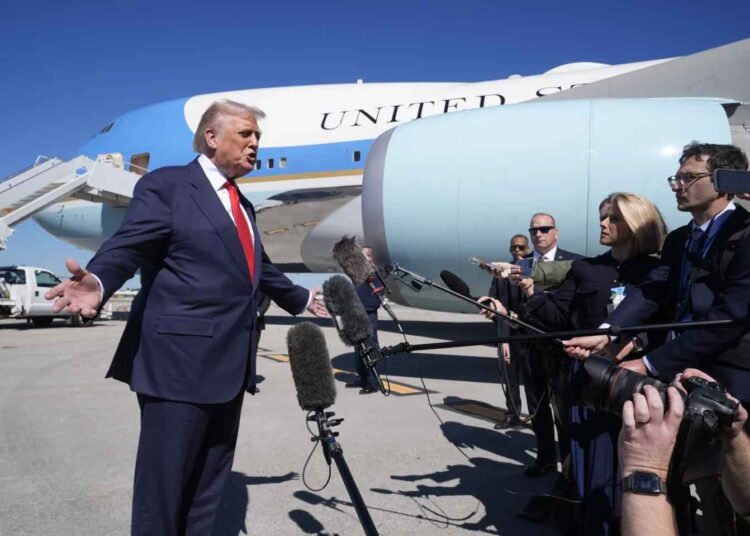
(WiredJA) – The audacity was breathtaking, even by Donald Trump’s standards. Standing on the South Lawn of the White House on Friday, minutes before boarding Marine One for a Texas trip, the American president casually mused about absorbing a sovereign Caribbean nation as though he were negotiating a real estate deal. “Maybe we’ll have a friendly takeover of Cuba,” Trump told reporters, adding for emphasis: “We could very well end up having a friendly takeover of Cuba.” He did not elaborate. He rarely does.
READ ALSO

About 15 Latin American deportees from the US arrive in Congo

Iran reopens Strait of Hormuz, but Trump says blockade on Iranian ships and ports will stay in force

But thousands of miles away in Havana, President Miguel Díaz-Canel had already answered — not with diplomatic ambiguity, but with the thunder of revolutionary history.

Three days before Trump’s remarkable statement, on February 24th — a date etched into Cuba’s national consciousness as the anniversary of the 1895 independence war launched by José Martí — Díaz-Canel stood before Cuba’s National Assembly and delivered what may be his most defiant address in recent memory. His words were unmistakably directed at Washington, even before Trump made his intentions plain.

“We will fight, we will struggle, we will resist, we will transform,” Díaz-Canel declared, “and above all adversity and imperial threats, we will rise and triumph.” He invoked Martí’s original cry of “Independence or Death” — not as nostalgia, but as living doctrine. The message was clear: Cuba was not for sale, not for takeover, friendly or otherwise.

The timing of Trump’s statement makes Díaz-Canel’s speech read less like a ceremonial address and more like a prophetic counter-offensive.

The “Deal” That Wasn’t Asked For

What exactly is Washington seeking? Trump’s comments were characteristically vague, yet revealing in their assumption. Secretary of State Marco Rubio — Cuban-American, hawkish, and deeply invested in regime change on the island — has reportedly been conducting discussions with Cuban officials “at a very high level.”

Cuba’s government acknowledged the communications, framing them as related to an incident involving a U.S. vessel. But Trump’s language suggests Washington views the island’s economic distress as the opening it has long sought.

The pressure campaign has been relentless. An executive order signed in late January targets countries providing oil to Cuba with tariffs. With Venezuela’s Nicolás Maduro ousted by U.S. forces, Havana has lost its most critical energy lifeline.

Cuba’s deputy foreign minister, Carlos Fernández de Cossío, posted — then hastily deleted — that Washington’s fuel embargo remains “in full force” and that nothing in recent announcements changes that reality. The deletion itself speaks volumes about the precariousness of Cuba’s position.

Defiance Rooted in History

Yet Díaz-Canel’s February 24th speech refused to perform weakness. Speaking with remarkable candour, he acknowledged Cuba’s “accumulated suffering,” its energy crisis, its economic hardship — while squarely blaming the “intensified criminal blockade” and what he called Washington’s “genocidal Executive Order.”

Rather than obscure his nation’s difficulties, he named them and framed them as evidence not of failure, but of resistance against calculated collective punishment.

Crucially, Díaz-Canel chose the symbolism of his date deliberately. February 24th, 1895 marked the moment Cuba refused, at enormous cost, to remain someone else’s property. He invoked that history to signal that the revolutionary memory encoded in that date is more durable than Washington’s patience — or its leverage.

A Caribbean Warning, Not Just a Cuban One

From a Caribbean perspective, the stakes extend far beyond Cuba’s shores. Trump’s casual deployment of the phrase “friendly takeover” — applied to a sovereign Caribbean nation that achieved independence through revolution — is a conceptual colonialism that should alarm every small island state in the region.

If the economic strangulation of Cuba is normalised as legitimate statecraft, what precedent does that set for the rest of the Caribbean’s smaller, resource-dependent economies?

More than 40 U.S. civil society organisations evidently share that alarm. In a letter to Congress on the same day as Trump’s remarks, they warned that cutting oil supplies to Cuba would trigger “humanitarian collapse,” constituting what they called a grave violation of international humanitarian law.

The irony is sharp: while Washington speaks of “friendly” takeovers, it simultaneously enforces an embargo that denies ordinary Cubans fuel, medicine, and economic oxygen.

Díaz-Canel is betting that the fire of 1895 burns longer than any Washington administration. Whether history proves him right may be the defining Caribbean story of 2026.
ShareTweetSendShareSend

Related Posts

FILE -The Congo airport terminal building before its opening by Congo president Joseph Kabila in Kinshasa, Democratic Republic of Congo, June 25, 2015. (AP Photo/John Bompengo, File)
Global

About 15 Latin American deportees from the US arrive in Congo

by Admin
April 17, 2026

KINSHASA, Congo (AP) — Around 15 people deported from the United States landed in Congo’s capital Kinshasa in the early...

Read moreDetails
President Donald Trump 
Evelyn Hockstein/Reuters
Global

Iran reopens Strait of Hormuz, but Trump says blockade on Iranian ships and ports will stay in force

by Admin
April 17, 2026

BEIRUT (AP) — Iran said Friday it fully reopened the Strait of Hormuz to commercial vessels, but President Donald Trump...

Read moreDetails
Global

France, UK to cohost talks on Hormuz

by Admin
April 16, 2026

French President Emmanuel Macron and the United Kingdom's Prime Minister Keir Starmer will cohost a video-conference with international leaders on...

Read moreDetails
Next Post
M. Hackette's Facebook photo

Saharan Dust Plume: A Growing Health Crisis


EDITOR'S PICK

Ghana's President Nana Akufo-Addo speaks to members of the media as Ivory Coast's President Alassane Ouattara, and Guinea's Special forces commander Mamady Doumbouya, who ousted President Alpha Conde, stand next to him after their meeting to discuss ways to return Guinea to constitutional order, in Conakry, Guinea, September 17, 2021. REUTERS/ Souleymane Camara

Defiant junta rejects pressure to let Conde leave Guinea

September 18, 2021
google photo

Let’s Honour Past by Fighting for Justice Today-IFAAD

August 1, 2025
Dr. Lorraine Sobers

Prioritizing Guyana’s Oil Revenue Spending: A Common Sense Approach September 29, 2022

September 30, 2022

Opposition to IRI-led electoral reform project grows  

May 15, 2021

© 2024 Village Voice

No Result
View All Result
  • Home
  • News
  • Sports
  • Editorial
  • Letters
  • Global
  • Columns
    • Eye On Guyana
    • Hindsight
    • Lincoln Lewis Speaks
    • Future Notes
    • Blackout
    • From The Desk of Roysdale Forde SC
    • Diplomatic Speak
    • Mark’s Take
    • In the village
    • Mind Your Business
    • Bad & Bold
    • The Voice of Labour
    • The Herbal Section
    • Politics 101 with Dr. David Hinds
    • Talking Dollars & Making Sense
    • Book Review 
  • Education & Technology
  • E-Paper
  • Contact Us

© 2024 Village Voice