By Romona Baxter- Black History Month (Guyana) offers a sacred space to honour the voices that shaped our cultural consciousness and affirmed our identity. For young Guyanese especially, these tributes are more than remembrance — they are inheritance. They introduce us to the thinkers, creators, and storytellers whose work continues to illuminate who we are as a people. Among these towering figures stands a poet whose words echo with memory, migration, womanhood, and belonging.
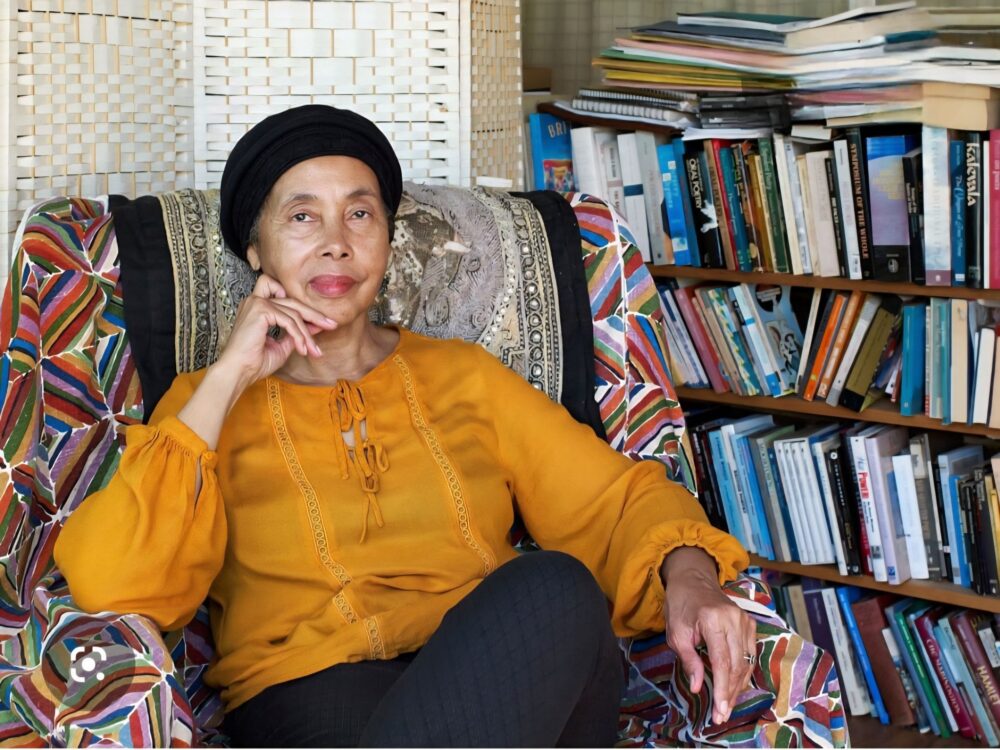
Today’s Black History Month (Guyana) tribute celebrates that extraordinary literary voice — Grace Nichols.
I cannot express to young Guyanese enough that these tributes are a gift to you. A gift that will keep on giving as you become fully aware of the geniuses, the architects, the legends that lived and are still with us.
Today’s Black History Month (Guyana) tribute honours a poet, a Guyana Prize-winning author, and a recipient of the Queen’s Gold Medal for Poetry. A voice shaped by memory. A poet carried on Caribbean winds. A daughter of Guyana whose words gave language to identity, womanhood, and belonging.
Her work traveled beyond Guyana’s shores. She’s a literary force whose work traveled far beyond Guyana’s shores. She grew up surrounded by the rhythms of our speech, folklore, and rich history — influences that would later breathe unmistakable life into her poetry.
Before migrating to the UK in 1977, she served as a teacher and journalist and traveled the remote regions of Guyana hinterland as part of a Diploma in Communications at the University of Guyana. The indigenous stories and culture of that region left an enduring imprint on her literary imagination.
When she migrated to the United Kingdom, she made a geographical shift, but never a cultural departure. Guyana remained embedded in her voice, her imagery, and her poetic consciousness. Wherever her work travelled, it carried with it the tonal warmth, humour, resilience, and memory of Guyana and the wider Caribbean. She has become one of the most distinguished Caribbean poets of her generation.
I is a Long-Memoried Woman. Let us announce this boldly on her behalf. It tells a story — all our story captured in the voice of one woman. I is a Long-Memoried Woman is her breakthrough collection. It confronts the historical memory of slavery while affirming the enduring strength of Caribbean womanhood.
With The Fat Black Woman’s Poems, she further expanded the literary landscape, offering a confident, celebratory, and unapologetically human portrayal of the Black female body at a time when such representations were rare. She understood then what we’re embracing now. Lady, I see myself in this boldness.
Her poetry is marked by musical Creole rhythms, emotional intelligence, and a fearless exploration of migration, memory, race, and identity. She possesses that rare literary gift — the ability to make the deeply personal resonate universally and to transform cultural specificity into global relevance. She is the recipient of the Commonwealth Poetry Prize in 1983 and was later honoured as an Officer of the Order of the British Empire (OBE) for her services to literature.
Beyond the awards and titles, her true achievement lies in how profoundly she reshaped the space for Caribbean voices, especially Caribbean women. Through her work, Grace Nichols did more than write poems. She preserved memory. She dignified language. She expanded how the world hears our voice.
On this day of Black History Month (Guyana), I present Grace Nichols — poet, cultural voice, and global daughter of Guyana.
Grace Nichols stands as a testament to the enduring power of language rooted in identity. Her poetry bridges homeland and diaspora, memory and modernity, personal story and collective history. For young Guyanese and Caribbean people everywhere, her work remains both mirror and compass — reflecting our journey while guiding our voice forward. As Black History Month (Guyana) continues, may her legacy remind us that our stories matter, our language carries history, and our cultural memory, once spoken, can travel the world.
———–