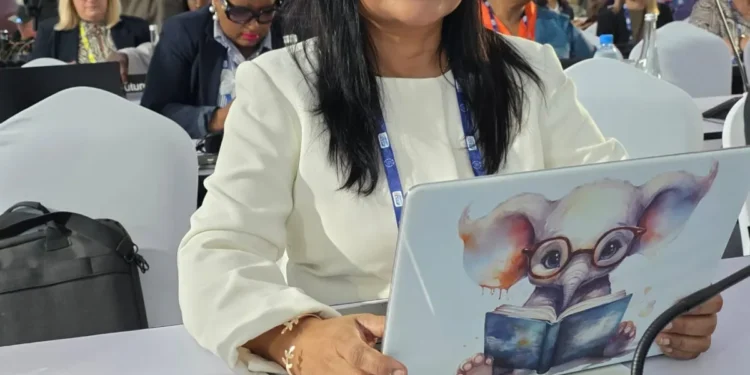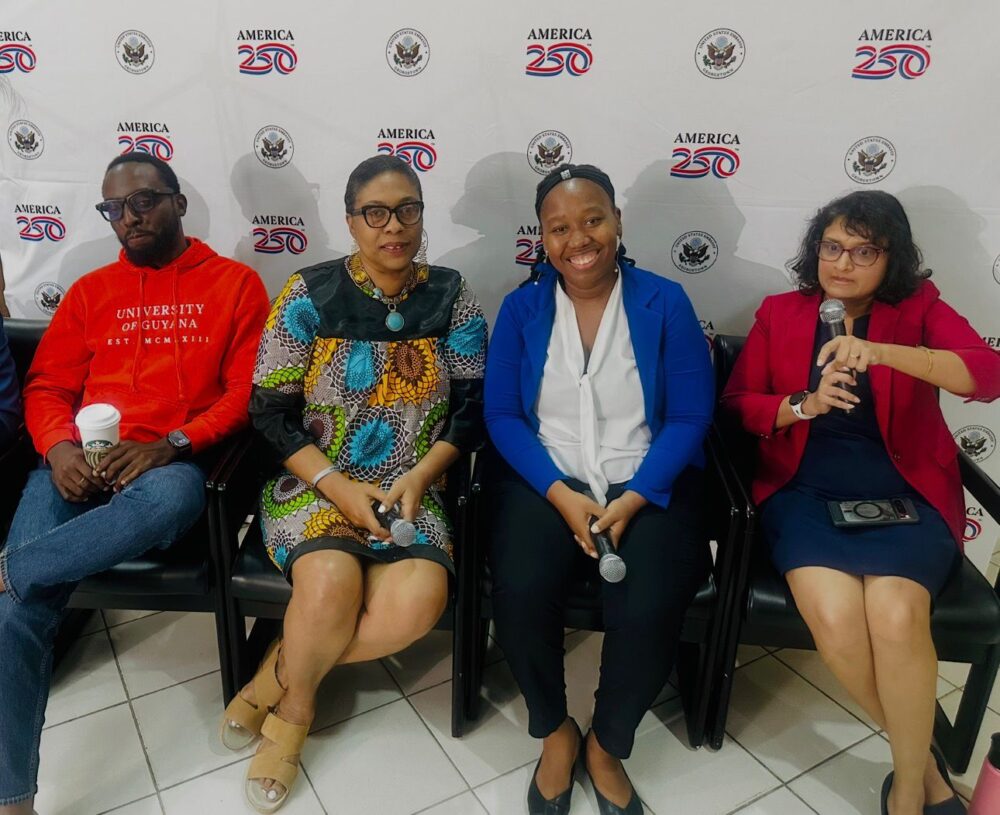
At a recent University of Guyana forum inspired by the acclaimed film Hidden Figures and sponsored by the United States Embassy in Guyana, educator and technology advocate Dr. Karen Abrams delivered a provocative and intellectually challenging contributions, urging Guyanese students and innovators to rethink the way society frames innovation, recognition, and institutional power.
The event brought together leading voices in science, technology, and innovation, including Dr. Andreasa Morris-Martin, Dr. Gyanpriya Maharaj, Brian Smith, and Dr. Karen Abrams.
Speaking before students, educators, and aspiring innovators, Abrams challenged the conventional interpretation of Hidden Figures as simply a story about perseverance.
“The lesson I take from Hidden Figures is not really about perseverance,” Abrams said. “Perseverance is the lesson we are supposed to take, and it is the lesson that lets institutions off the hook.”
She argued that the celebrated mathematicians and engineers portrayed in the film, Katherine Johnson, Dorothy Vaughan, and Mary Jackson, were already producing world-class work that institutions depended on, even while those same institutions denied them visibility, recognition, and advancement.
“The deeper lesson is about institutional capture of value from originators,” Abrams told the audience. “The women did extraordinary work. The institution took the work and minimised the workers.”
Abrams warned that similar dynamics continue to unfold today, including in Guyana’s emerging innovation sector, where young creators and developers often struggle to maintain ownership and recognition for their ideas.
“That pattern is not historical and it is not American,” she said. “It is happening in Guyana right now to young innovators whose ideas are being absorbed by larger firms, by political networks, and by people with more standing than they have.”
Her remarks shifted the discussion from individual determination to structural reform, arguing that societies must build institutions that recognise and protect innovators from the beginning rather than celebrate them decades later.
“The right frame is institutional reform,” Abrams argued, “so that the next generation of hidden figures becomes seen the first time around, not after a film is made about them forty years later.”
Abrams also offered what she described as “three pieces of advice” for young Guyanese innovators and entrepreneurs.
First, she encouraged students to build solutions aimed at global markets rather than limiting themselves to Guyana’s small domestic economy.
“Climate adaptation, agricultural technology for tropical conditions, fintech for unbanked populations, applied AI in healthcare and education and creative industries, all of these have markets the size of the world,” she said.
Second, she stressed the importance of intellectual property protection and urged innovators to document and protect their work from the earliest stages of development.
“The system in Guyana will not protect you,” Abrams cautioned, “but the systems in the markets you are building for can.”
Her third piece of advice drew strong reactions from attendees as she warned students against partnerships that appear supportive but ultimately strip innovators of ownership and control.
“Some of you will be offered ‘help’ that comes with terms that quietly transfer ownership of your work,” Abrams said. “Walk away.”
In one of the evening’s most memorable lines, she told students:
“The young Guyanese who change this country will be the ones who decline to take orders, who insist on protecting what they originate, and who build despite the delays, the denials, and the inspections.”
Abrams also used the platform to highlight systemic weaknesses in Guyana’s innovation and education ecosystem. Citing a 2024 United Nations Development Programme assessment referenced by Kaieteur News in May 2026, she noted that the average Guyanese student reportedly leaves the school system midway through Grade Nine.
“A country losing its students at fourteen cannot produce the innovation pipeline a competitive economy requires,” Abrams said.
She pointed to the absence of major institutional supports commonly found in advanced economies, including national research funding systems, venture capital infrastructure, innovation procurement policies, intellectual property support structures, and organized diaspora engagement mechanisms.
“The gaps are not mysteries,” she concluded. “They are institutional choices the country has not yet made.”
The forum formed part of ongoing efforts by the U.S. Embassy to encourage greater youth participation in STEM, innovation, and technology leadership while fostering dialogue around inclusion, opportunity, and the future of scientific advancement in Guyana.