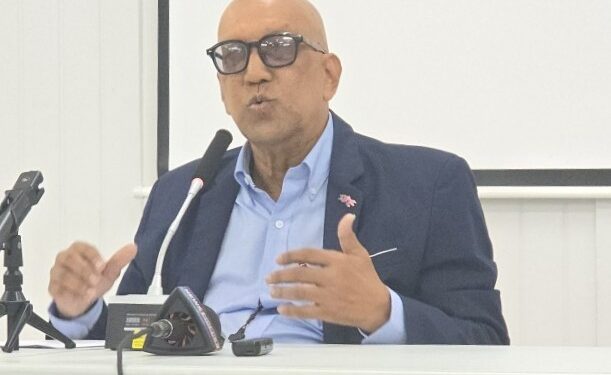
The latest report from the Inter-American Development Bank should have triggered urgent action from Guyana’s Minister of Finance, Dr. Ashni Singh. Instead, it has been met with speeches, summits, and carefully polished statements that avoid the central issue facing half the country: poverty made worse by rising food prices and government inaction.
The IDB’s findings are not ambiguous. Food prices in Guyana have risen sharply. Inflation is climbing. Import costs are eroding household purchasing power. These pressures fall hardest on the poor, precisely the group Dr. Singh claims sits “at the very centre” of government policy. If that were true, the cost of living would be the first battle fought, not an afterthought buried beneath oil production statistics and international applause.
Guyana today is the world’s fastest-growing economy. It is the largest oil producer per capita. Government revenues now exceed five billion US dollars annually. And yet, by every meaningful measure of daily life, too many Guyanese are worse off. Growth has not translated into relief at the market stall, the supermarket, or the kitchen table.
The IDB warns that Guyana’s terms of trade have deteriorated. Import prices are rising. Food inflation alone reached over eight percent. These are not abstract indicators. They are signals of stress that demand immediate fiscal response. Instead, the Minister of Finance has chosen to speak in Doha about global solidarity, multilateral cooperation, and thirty-year-old declarations, while avoiding direct accountability for what is happening at home.
Dr. Singh’s recent remarks at the social development summit in Qatar are a masterclass in deflection. He speaks of commitments to the Copenhagen Declaration, the SDGs, inclusive growth, women’s empowerment, and participatory approaches. These words sound impressive in a plenary hall. They do nothing for a household choosing between food and transportation, or for parents watching grocery bills rise faster than wages.
The IDB report makes one thing painfully clear. Guyana’s problem is not lack of resources. It is lack of prioritisation. Oil wealth is being managed as a macroeconomic success story, while inflation quietly eats away at the livelihoods of ordinary citizens. A finance minister serious about social development would treat food inflation as an emergency, not a footnote.
Even more troubling is the absence of policy response. Where is the reduction of VAT or import duties on basic foods. Where is the targeted food support for low-income households. Where is the stabilization mechanism to shield families from global price shocks. Where is the aggressive investment in local agriculture to reduce dependence on imports. Silence on these questions is not neutrality. It is negligence.
Dr. Singh assures the world that Guyana places people at the centre of development. The IDB data tells a different story. When oil accounts for nearly ninety percent of exports, when government spending expands rapidly, and when inflation rises without countermeasures, the result is predictable. The poor fall further behind while growth headlines dominate.
This is not an ideological critique. It is a practical one. Countries that manage resource booms successfully act early to protect households. They stabilise prices. They diversify food supply. They use fiscal tools to cushion shocks. Guyana has chosen delay.
If the Minister of Finance were serious about aligning rhetoric with reality, the path forward is obvious.
First, immediately remove or reduce taxes and fees on a defined basket of essential foods. Second, establish a transparent cost-of-living stabilization fund triggered automatically when food inflation spikes. Third, deploy targeted cash or food support to low-income households using existing social registries. Fourth, invest directly in small and medium-scale agriculture to reduce import dependence. Fifth, slow wasteful spending growth and redirect oil revenues toward nutrition, education, and income security.
These are not radical proposals. They are basic responsibilities of a finance minister presiding over unprecedented national wealth.
Guyana does not need more summit speeches. It needs decisive domestic action. Oil riches without relief for the poor are not a development success. They are a moral failure.
Dr. Ashni Singh can continue speaking about global cooperation abroad, or he can confront the economic reality facing Guyanese families at home. History will judge him not by the declarations he reaffirms, but by whether he acted when the evidence was unmistakable and the need was urgent.