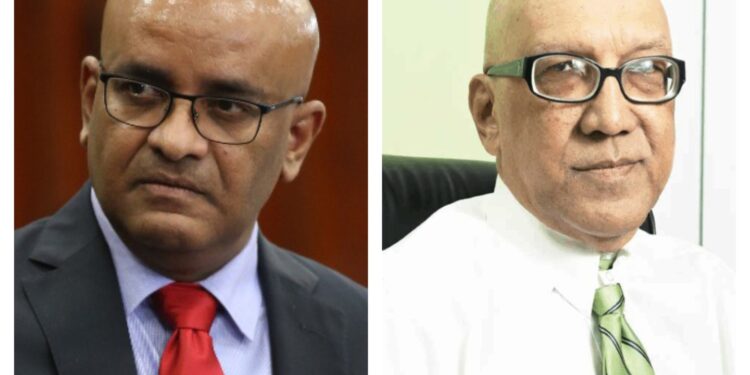
News of Bharrat Jagdeo’s grave illness has been proven, for now, to be hyperbole. The former President and de facto ruler of the PPP made a public appearance at the opening of the Christmas village, ostensibly putting to rest weeks of speculation that had swirled in the vacuum of his absence. He had missed his last three weekly press engagements, forums typically characterized by their combative tone and political cuss-outs—and in that silence, rumors took flight.
His appearance at the village, however, does not entirely close the case. The visual evidence of reported needle marks on his arm and the simple, logical fact that a person can be seriously ill and still muster the strength for a brief, staged public moment, leaves a residue of doubt. But the most telling aspect of this entire episode was not the rumor itself, nor his physical rebuttal of it. It was the profound, resonant silence that greeted the news of his potential demise.
The public response was muted to the point of indifference. No one, it seemed, really cared.
This is a man to whom is attributed a specific and enduring legacy of misery in Guyana. He is the architect of a system defined by massive, brazen corruption that has siphoned the nation’s wealth. He is the engineer of a political machinery built on rampant racial discrimination, a strategy that has poisoned the well of national unity for a generation. Most damningly, to his reign is attached the ugly stain of extrajudicial killings, the deaths of more than 400 Guyanese citizens under the shadow of state-sanctioned violence.
Today, though no longer holding the presidency, he continues to rule. He controls the ruling PPP party with an iron grip, dictates policy across every ministry, and operates the current President, Irfaan Ali, as a puppet whose strings are pulled from Freedom House.
His power is undeniable, his influence pervasive. Yet, the recent rumors revealed a truth perhaps more devastating than any political defeat; the absolute bankruptcy of his moral standing. People may yet fear the consequences of his wrath, they may navigate the corrupt system he built, but they feel no affection, no loyalty, no human concern for the man himself.
It is good, then, that in this moment, while he is still alive and presiding, he has been forced to witness this stark reality. He has seen that while his power compels obedience, it commands no love. He has been shown that a nation can hold a man in the grip of fear, yet hold no space for him in their hearts. He rules everything, it seems, except the people’s sympathy. And in the end, as the muted reaction to his rumored near death proved, no one cares whether he lives or dies.