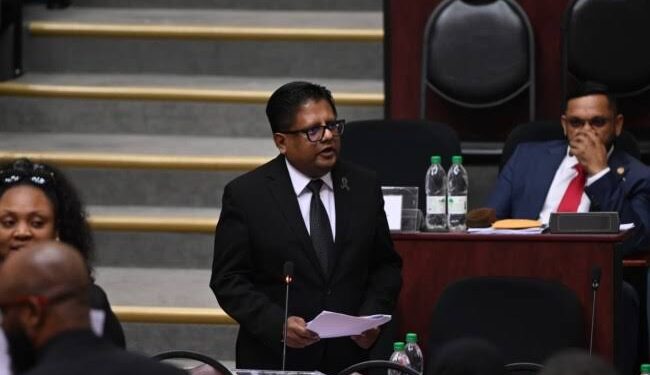
President Irfaan Ali’s recent declaration, published on May 26th, 2026, in the Kaieteur News, regarding the urgent imperative to modernize Guyana’s legislative framework for intellectual property (IP), touches upon a profound structural truth. The President is entirely correct: as Guyana experiences an unprecedented economic expansion driven by its extractive sectors, the absence of a modern, rigorous IP regime creates an unsustainable economic vacuum. A nation transforming into a global economic engine cannot run on colonial legal relics.
Yet, as we approach this legislative turning point, we must guard against a seductive illusion—the belief that passing compliance-driven legislation is the same as building a functional innovation ecosystem. If Guyana simply copies and pastes external, international models to satisfy foreign trade partners, it will miss the historic opportunity to protect its own future. The challenge before us is not a drafting exercise; it is an architectural one.
A decade ago, I anticipated this precise systemic turning point. In a book chapter titled “Copyright in International Intellectual Property Law—implications for Guyana and the Caribbean,” published by the University of the French West Indies, Guadeloupe (in E. Caraibe & R. Kiminou, Eds., L’harmonisation du droit des affaires dans la Caraïbe, Connaissances et Savoirs, 2016, pp. 465-482), I analyzed how undifferentiated international IP frameworks consistently fail small, transitioning economies if they are not aggressively adapted to local realities.
Ten years ago, the primary regional legal focus was on harmonization—aligning our domestic commerce laws with wider regional systems to grease the wheels of trade. Today, that baseline has exploded. The modern economic landscape has evolved beyond physical cargo and static copyrights. We are now thrust into a global digital economy driven by automated data collection, cross-border cloud platforms, and generative artificial intelligence.
For a booming Guyana, this economic evolution introduces an acute, invisible vulnerability: a phenomenon I define as Inniss Data Nullius. This is the structural reality where our sovereign regional data, cultural output, environmental metrics, and unique national assets are treated as unowned, legally vacant territory. Without a sophisticated framework, global platforms can freely scrape, extract, and commercialize Guyanese data and intellectual resources, leaving the state and its innovators without equitable compensation or legal recourse.
This means that updating our laws to protect standard physical goods or local broadcasts is no longer sufficient. If we merely adopt standard Western legal imports, we will inadvertently formalize this asymmetric extraction.
Guyana cannot remain a passive consumer of external legal traditions. To translate President Ali’s vision into an enduring economic reality, we must shift our posture from standard international compliance to proprietary intellectual property laws and absolute digital sovereignty.
This shift requires the deliberate cultivation of an indigenous jurisprudence—a legal philosophy born out of the Global South that recognizes our unique material conditions. Our judicial and administrative institutions, backed by the evolving regional oversight of the Caribbean Court of Justice (CCJ), must interpret intellectual property laws not as static, imported rules to be obeyed, but as dynamic levers of national development. We must build a system that specifically balances the massive capital requirements of our extractive sectors with the immense, unmonetized wealth of our cultural, scientific, and digital industries.
How do we achieve this? We must move past the academic consensus-building and political declarations that have stalled regional progress for a generation. The solution is the rapid deployment of an operational digital governance architecture—a system that treats intellectual property as a core utility, fully integrated into our national health, transport, utility, and tourism sectors.
To design a framework capable of standing up to global technology giants while simultaneously empowering a young Guyanese software developer or an indigenous artist requires more than standard legal training. It requires a rare blend of deep regional scholarship, international policy experience, and a long-standing diagnostic understanding of the structural flaws in our existing legal systems.
President Ali has laid down the challenge. Guyana possesses the resources and the political momentum to become the premier model of digital and intellectual sovereignty in the Global South. What we require now is the strategic blueprint to build it.
Dr. Abiola Inniss, Ph.D., LL.M., is a Guyanese‑born Intellectual Property and policy scholar and Executive Director of The Inniss Institute for Digital Policy and Intellectual Property. Recognized regionally as the Architect of Caribbean Intellectual Property, she is the author of multiple frameworks on digital sovereignty, data governance, and innovation policy for the Global South. Her work has informed intergovernmental bodies across CARICOM and Africa, and she continues to lead regional thinking on the intersection of law, technology, and post‑colonial development.