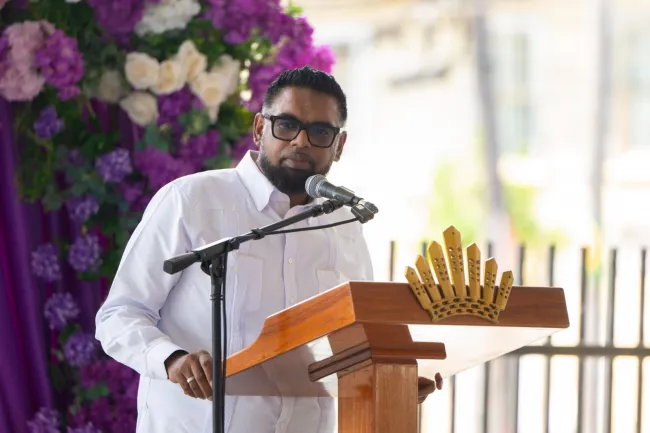
President Irfaan Ali’s announcement on Wednesday of a one-off $50,000 payout to all persons living with disabilities (PWDs) is being received with mixed reactions—not because the initiative lacks merit, but because it sharply contradicts the $200,000 per adult relief promise he repeatedly made during the General and Regional Elections campaign. Even with this latest intervention to this population, the President still falls short by $150,000 of what he pledged each adult Guyanese would receive.
The initiative, valued at $1.4 billion and targeting more than 27,000 Guyanese, was unveiled during a national observance focused on dignity and inclusion. While the event celebrated empathy and community, the selective nature of these cash grants is raising questions about equity, political fairness, and national cohesion.
Ali reminded attendees that disabilities touch families in every community and emphasised that Guyanese must “bear one another’s burdens,” adding that “true national development is measured by how well society supports those most in need.” However, many argue that these principles are being applied unevenly across society.
The $50,000 grant for PWDs follows another selective payout. Last month the President announced that 7,500 fisherfolk will each receive $150,000—a figure still $25,000 short of the promised $200,000 for every adult at Christmas.
Though the cash grants are beneficial to the groups receiving them, these targeted interventions are widely viewed as piecemeal, divisive, and politically strategic, especially as public servants, nurses, teachers, members of the disciplined services, private-sector workers, the elderly, and other vulnerable groups remain excluded. Instead of a universal programme, assistance is being rolled out sector by sector, contradicting the President’s own rhetoric about unity and equality.
The President also announced a disability-inclusive employment initiative to create 5,000 jobs for PWDs over the next five years. He said that sustainable employment promotes dignity and opportunity, reiterating that “regardless of where you sit, in public or private life, we must make it a collective responsibility to uplift those who are underserved or struggling.” Ali highlighted successful disability employment programmes in Regions Five and Six, arguing that replication across sectors could “easily turn the tide.” He further directed that all new government buildings—from parks to community centres—must allocate at least 10% of their space to serve persons with disabilities.
These efforts fall under eight policy action areas: caregiver support; education and digital access; community empowerment; transportation; health services; housing; government service accessibility; and skills training and income generation. The President also listed advances such as the Persons with Disabilities Act, a national PWD database, assistive-aid distribution, and the Empower Guyana Centre, which provides employment and training to more than 120 PWDs.
The government outlined upcoming interventions, including early identification systems, special-needs school expansion, more mobility aids, business centres for PWDs, caregiver grants, tax incentives, special housing subsidies, and interest-free, collateral-free loans for PWDs through a new National Development Bank financing window.
“Our mission is to create an environment where persons with disabilities can fully participate in all aspects of national life and contribute meaningfully to our nation’s growth,” the President said. “Let us embrace this community with love, understanding and dignity, and let us continue to build a Guyana where no one is left behind.”
But this inclusive message contrasts sharply with the exclusionary pattern emerging in the government’s cash grant strategy. While PWDs and fisherfolk are receiving assistance, the majority of Guyanese adults have received nothing close to the $200,000 they were promised. Many now question whether political considerations, rather than fairness, are driving these selective payouts.
The cost of living continues to rise, and sector-specific grants ranging from $50,000 to $150,000 risk deepening rather than healing social divides. Many fear this piecemeal, group-by-group distribution will fuel resentment, fracture society, and further weaken public trust in the government’s commitments.