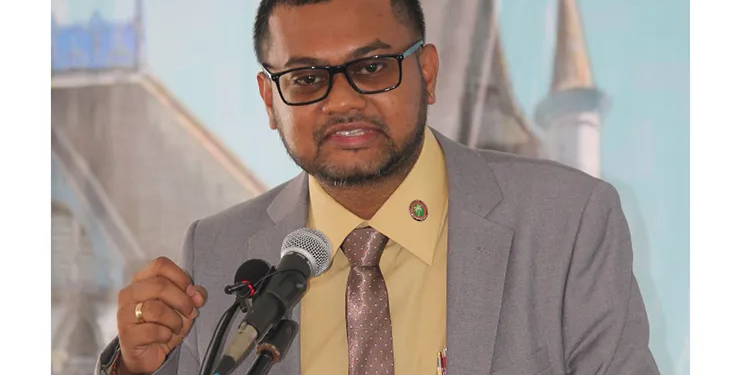
By Mark DaCosta- Azruddin Mohamed, a prominent businessman and leader of the We Invest in Nationhood (WIN) movement, is publicly decrying what he asserts is an unjust targeting by authorities in connection with US-imposed sanctions. Mohamed claims that the Financial Intelligence Unit of our nation has compelled insurance companies to sever their associations with him, effectively barring him from renewing necessary insurance for his personal vehicles. This predicament escalated when police stopped his wife for allegedly driving an uninsured vehicle, further complicating their situation. Mohamed described these developments as “pure victimisation and evil,” highlighting the distressing nature of what he sees as harassment by the state.
The incident unfolded recently when Mohamed’s wife was pulled over by police after dropping their children off at Queens College. According to him, officers followed her from the school and necessitated that she drive to the Brickdam Police Station, an unsettling encounter that lasted approximately two hours. During this time, police conducted a search of her vehicle and cited several infractions, including issues with tinted windows and an unclear license plate. However, the crux of the matter for Mohamed lies in the alleged failure to secure insurance, a consequence he attributes directly to governmental actions.
Speaking to a local news outlet, Mohamed articulated his frustration, insisting that he has been made a target without justification. He explains that the sanctions have not only stifled his business prospects but have now obstructed his personal and family life as well. As a result, he feels as though he is enduring a compounded form of punishment that is not only unfair but profoundly damaging to his reputation and livelihood.
The implications of the sanctions, which were introduced as part of broader international measures, require a critical examination in the context of our nation’s bureaucratic processes and governance. Critics of the current administration allege that these measures are being employed selectively against those who oppose or challenge the ruling government — essentially using external pressures to stifle dissent.
The government’s actions towards Mohamed might be perceived as emblematic of a larger trend, where individuals who may pose a perceived threat to established power structures find themselves unfairly targeted. Insurers, under the ambit of the Financial Intelligence Unit, face the daunting task of managing not just their business practices but also their relationship with the state—a delicate balance that could leave clients vulnerable to unintended consequences.
This unfolding saga also raises pressing questions about law enforcement practices in our country, particularly regarding the methods employed to enforce traffic regulations and the criteria used for stopping vehicles. Critics argue that at times, these operations appear more aligned with punitive measures than with public safety.
It is reported that Mohamed’s wife was charged during their two-hour encounter with the police, an outcome that further incenses the businessman. He has expressed concern that his family is being subjected to undue stress, orchestrated by a government willing to sacrifice individual rights under the guise of law enforcement. The infringement on his family’s sense of security raises alarm bells regarding civil liberties and the extent to which citizens can rely on the principles of justice when confronted by an overpowering state apparatus.
As this issue unfolds, it serves as a reminder of the challenges faced by entrepreneurs under the current regime, where the lines between civic duty and governmental power are increasingly blurred. The circumstances surrounding Mohamed’s ordeal reflect a pervasive fear of reprisals for dissent in a climate where political affiliations can significantly influence personal and professional outcomes. As citizens of our nation, we must remain vigilant against practices that undermine our values of fairness and equity.