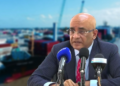
Former Trinidad and Tobago Prime Minister Dr Keith Rowley has issued a strongly worded statement condemning what he describes as his country’s “reckless” abandonment of fundamental Caribbean principles, saying the move represents a “dangerous dereliction of duty.”
In a statement released on his 76th birthday, Dr Rowley said he felt it “necessary and dutiful” to endorse the historic declaration of former CARICOM Heads, who recently reaffirmed their commitment to the region’s unity, sovereignty, and the preservation of the Caribbean as a zone of peace.
“It is with a deep sense of loss and sadness that I reflect on the leadership provided by Trinidad and Tobago, at an earlier time, within all the fundamental principles outlined and embodied in this statement,” Rowley wrote.
“It was Trinidad and Tobago’s voice, supported by all my colleagues, when we affirmed that ‘together we are stronger’. We maintained, even in the most difficult of circumstances, that we may be small but not insignificant, and our voice and our interests should be respected.”
The former Prime Minister, who served from 2015 to 2025, lamented what he called a betrayal of that legacy, accusing the current administration of discarding the very ideals that once defined the country’s regional diplomacy.
“I am today embarrassed to accept that with our proud record of leadership and accomplishments, today it is Trinidad and Tobago that recklessly subscribes to the dispensing with these principles in the expectation of plenty,” Rowley stated.
“It is a dangerous dereliction of duty, under any circumstances, to embrace the discarded colonial mantra that might is right and that the rule of law—local or international—is an inconvenience and a humbug.”
Government Defends Position
Current Prime Minister Kamla Persad-Bissessar, addressing the United Nations General Assembly last month, struck a different tone, declaring that “the notion that the Caribbean is a zone of peace has become a false ideal.”
“The reality is stark—no such peace exists today,” she told the Assembly, noting that for many in the region, peace remains “an elusive promise glimpsed, never grasped.”
She cited the ongoing struggle with violent crime, including 623 murders recorded in 2024, as evidence that the region’s peace narrative no longer reflects reality.
In subsequent comments carried by the Jamaica Gleaner, Persad-Bissessar’s government reaffirmed its “strong support for the ongoing military intervention of the United States of America in the region,” asserting that such actions are “ultimately aimed at allowing the region to be a true ‘Zone of Peace’ where all citizens can, in reality, live and work in a safe environment.”
However, Trinidad and Tobago notably declined to endorse the recent CARICOM Statement that reiterated the regional bloc’s long-held stance that the Caribbean must remain a zone of peace, emphasizing diplomacy, dialogue, and respect for international law in resolving disputes.
Regional and Diplomatic Implications
Dr Rowley’s statement underscores widening divisions within CARICOM over the balance between national security priorities and the region’s traditional commitment to peace and non-alignment.
While Persad-Bissessar argues that escalating transnational crime and instability require stronger international security partnerships, Rowley and other former leaders warn that aligning too closely with military powers undermines the sovereignty and collective strength that once defined the Caribbean community.
The contrasting positions highlight a broader debate about the region’s future—whether CARICOM will continue to stand as a unified voice on matters of peace, or fracture under competing interpretations of what “security” means in the modern era.
——————–
See Rowley’s statement below:
Today, on my 76th birthday, I find it necessary and dutiful to sign on to this historic statement of Former Heads of Caricom.
It is with a deep sense of loss and sadness that I reflect on the leadership provided by Trinidad and Tobago, at an earlier time, within all the fundamental principles outlined and embodied in this statement .
It was Trinidad and Tobago’s voice supported by all my colleagues when we affirmed that “ together we are stronger “. We maintained, even in the most difficult of circumstances, that “ we may be small but not insignificant and our voice and our interests should be respected “.
I am today embarrassed to accept that with our proud record of leadership and accomplishments, that today, it is Trinidad and Tobago that recklessly subscribes to the dispensing with these principles in the expectation of plenty. It is a dangerous dereliction of duty , under any circumstances, to embrace the discarded colonial mantra that might is right and that the rule of law, local or international is an inconvenience and a humbug.
Dr Keith Rowley
Trinidad and Tobago ,
Prime Minister
2015-2025