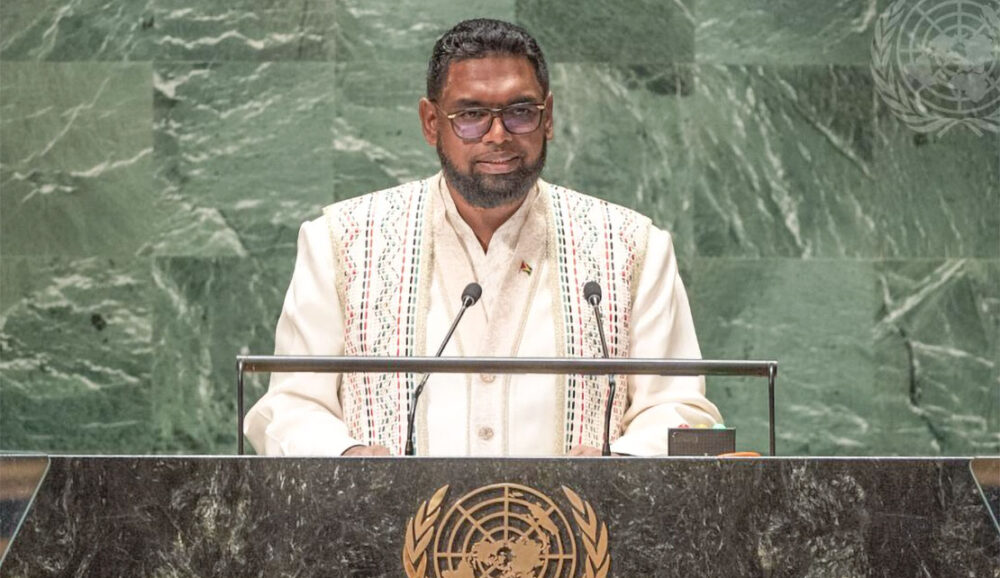
By Mark DaCosta- In the recent address to the United Nations General Assembly, President Irfaan Ali sought to position our nation as a proponent of international cooperation amidst a turbulent global backdrop. His speech touched upon pressing issues from climate change to food security, yet it resonated with an air of political opportunism that many citizens find concerning.
At the core of President Ali’s remarks was a strong call for collaboration on urgent worldwide challenges, pledging that “we are prepared to do our part.” However, while the call for unity and actionable strategies might seem commendable, it is imperative for our people to critically assess the government’s capacity to deliver on these lofty commitments.
The president highlighted the existential threat posed by climate change, arguing that it demands a “collective response.” He noted the detrimental effects witnessed in our own land – flooding, rising temperatures, and unpredictable weather patterns that threaten our agricultural output. Yet, critics within the opposition suggest that despite rhetorical commitments, there is a lack of concrete policies or a clear vision from the People’s Progressive Party (PPP) that would genuinely safeguard our natural resources.
President Ali further underscored the need for food security, an issue that strikes a chord in a country where many still grapple with the daily struggle to afford basic necessities. He proclaimed, “no one should be left behind,” but sceptics argue that the domestic policies currently implemented by the PPP have failed to translate these grand ideals into real-world benefits for the average citizen.
When addressing the ongoing geopolitical tensions in various regions, the president stated that “peace and security for all must be our universal goal.” While this is a sentiment most would support, it prompts a critical inquiry regarding the government’s approach to fostering an environment of peace within our borders. Under the current administration, tensions have only escalated, leading many to question whether the PPP can truly advocate for peace internationally while struggling to maintain harmony domestically.
Economic discussions were also prevalent in Ali’s address, as he promised to bolster cooperation between nations to create “a fairer global economy.” He posited that the world must face economic inequality head-on, particularly in the wake of the COVID-19 pandemic. Yet, many Guyanese individuals are left wondering whether the economic policies favoured by the ruling party will actually address their pressing needs. Under the PPP, the benefits of economic growth seem far removed from the working class, raising concerns about whether these promises will result in meaningful changes.
Highlighting the importance of inclusive governance, the president lamented that “no voice should go unheard.” However, amidst increasing centralised power and the dissenting outcry from sections of society, this statement rings hollow for numerous citizens in our nation. For decades, the opposition has raised alarms about the PPP’s approach to governance, implying that dissent is often silenced, and the voices of the marginalised are sidelined. How, then, can a government that likely overlooks its own populace expect to be a champion for voices worldwide?
President Ali also championed sustainable investment — a vital aspect, particularly considering our country’s promising oil reserves. He indicated that the nation is committed to “sustainable development that preserves our rich biodiversity.” While the intentions may seem noble, it is essential to challenge the narrative and ask whether the PPP is truly aligning its developmental goals with sustainable practices. Local environmental activists have voiced deep concerns about potential exploitation of our natural resources without adequate measures to protect them.
Amidst the broad strokes of his address at the UN, there was a clear subtext: the need for support from international allies. The president pointedly remarked that “no nation can tackle these great challenges in isolation,” which leads to the question of how effectively our government has communicated and engaged with the global community, especially in light of recent diplomatic blunders. Allies in the region have displayed apprehension about our government’s ability to collaborate effectively, raising doubts about the credibility of our nation on the international stage.
While President Ali’s address encapsulated a series of important global issues — ranging from climate change to peace and collaboration — one can’t help but feel scepticism about the government’s ability to navigate these complex challenges effectively. For many citizens, the heartfelt rhetoric by the president falls short of reality, given the current socio-political context in our nation. As the Ali administration seeks to establish itself as a key player on the world stage, it must first earn the trust and confidence of its own people, who have long felt the weight of unfulfilled promises. Only then can our nation genuinely find its voice in the chorus of global citizens striving for progress and peace.