

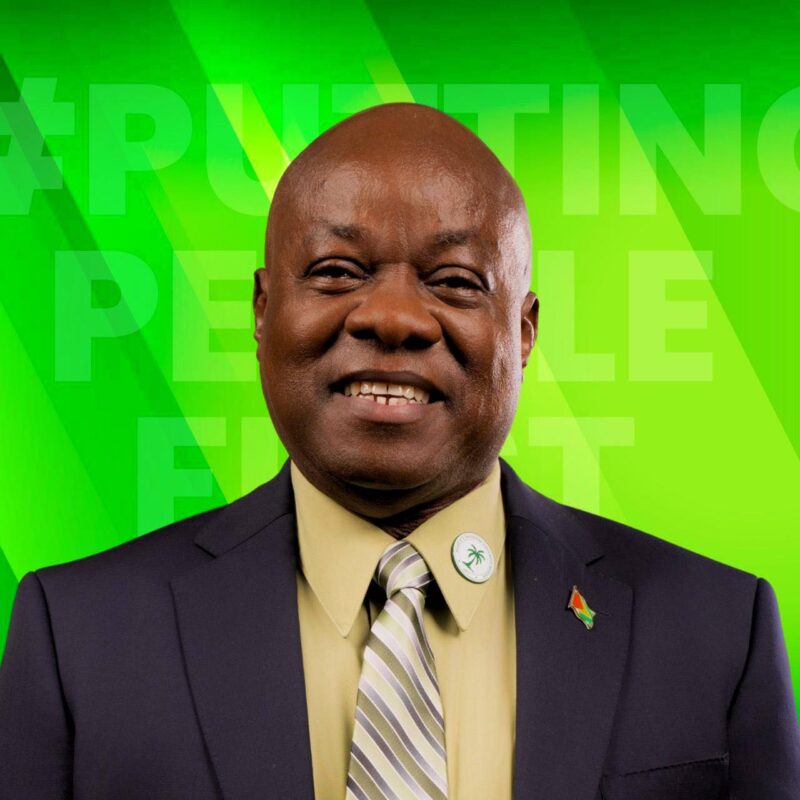
In the wake of a crushing electoral loss, A Partnership for National Unity (APNU) leader and presidential candidate, Aubrey Norton struck a defiant yet hopeful tone, urging supporters to remain steadfast despite the party’s diminished position in the National Assembly. The Guyana Elections Commission (GECOM) declared on Saturday, September 6, 2025 that APNU secured just 12 of the 65 parliamentary seats—neither enough to form government nor to lead the official opposition.
Norton, who also heads the People’s National Congress (PNC), the largest party in the APNU coalition, acknowledged the demoralisation among supporters but reminded them that political history is shaped not only by victories but by resilience in defeat.
“We are like the oak tree—we will re-emerge better and stronger,” he declared in a social media address, drawing inspiration from PNC Founder Leader, Linden Forbes Sampson Burnham’s 1961 call to supporters after a loss. Norton echoed Burnham’s historic words, urging: “Watch with us at this critical hour.”
Though APNU is now outside both government and formal opposition status, Norton insisted that the party’s continued presence in Parliament preserves vital political space to confront what he described as the “dictatorial tendencies” of the ruling People’s Progressive Party/Civic (PPP/C).
He doubled down on APNU’s long-standing claims that the elections were “not free and fair,” pointing to issues such as the absence of biometric voter identification, a bloated voters’ list, and documented irregularities in the tabulation process. Norton also referenced international observer criticism, including from the European Union, which cited concerns about the ruling party’s use of state resources to gain an electoral edge.
“The fight for social and economic justice continues,” Norton affirmed, promising supporters that APNU would not retreat or abandon its principles, even in this moment of political adversity. “By contesting the election, our party has retained occupancy of political space,” he said, describing it as essential for defending democratic values and pressuring for electoral reform.
Despite the setback, Norton painted a picture of a party in recovery, not retreat—a movement preparing for the long road ahead with the belief that, like in 1964, political momentum can be rebuilt through unity, discipline, and perseverance.






![Signing ceremony of the Letter of Intent between BioMed X and the Government of Barbados. [Left to Right standing] Ursula von der Leyen, President of the European Commission, Mia Amor Mottley, Prime Minister of Barbados, [Left to Right sitting] Dr Gerhard Ries, Co-Founder and Chairman of the Supervisory Board of BioMed X, Dr Christian Tidona, Founder and Managing Director of BioMed X, and Mark Hill, CEO of Export Barbados](https://villagevoicenews.com/wp-content/uploads/2025/02/CARICOM-120x86.jpg)
