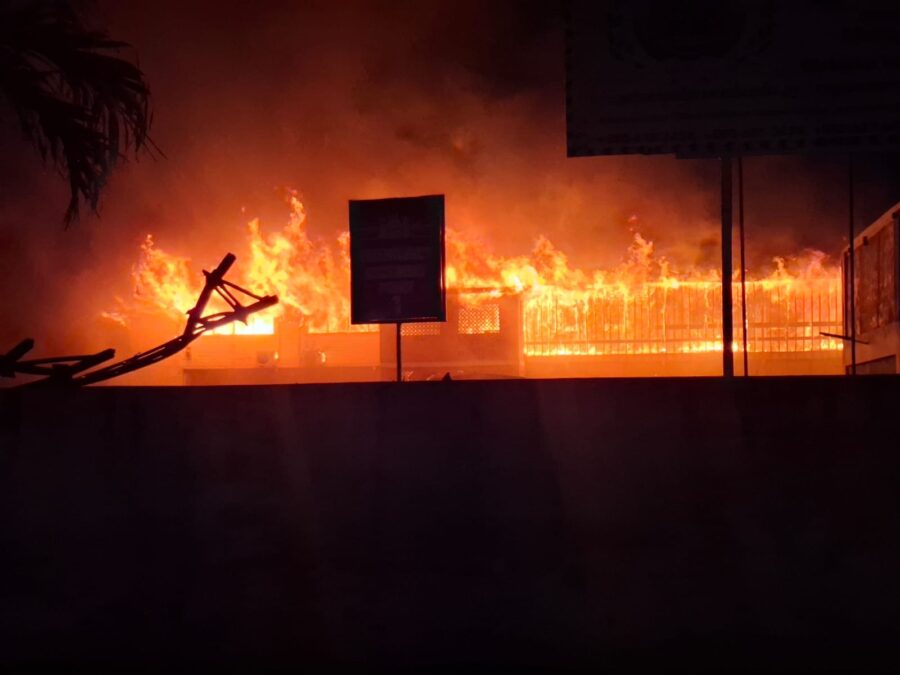
A second fire in just a few months has devastated Critchlow Labour College, this time reducing to ashes the institution’s most priceless asset, its archive of Guyana’s working-class history. Among the items lost were original documents, photographs, and records chronicling the rise of the Trade Union Congress (TUC) from its founding in 1953 to present day, effectively wiping out a large part of Guyana’s documented labor history.
Critchlow Labour College, established to honor the legacy of Hubert Nathaniel Critchlow, widely regarded as the father of trade unionism in the British Commonwealth, has long been the educational arm of the Guyana Trades Union Congress (GTUC). The college stood not just as a center for academic instruction, but as a guardian of the labor movement’s intellectual and political legacy.
The GTUC, formed in 1941 and reorganised in 1953, played a central role in Guyana’s journey to independence. It was a key force behind the rise of working-class political consciousness and the birth of Guyanese nationalism. Its archives, stored at Critchlow, included original meeting minutes, correspondence with regional and international unions, photographs of protests and strikes, and handwritten letters from labor icons like Critchlow, Forbes Burnham, Joseph Pollydore, and others.
Also lost in the fire were decades of research, student records, labour law publications, and evidence of GTUC’s role in resisting authoritarianism, advocating for free and fair elections, and standing up to government overreach across multiple administrations.
“This is more than a fire,” said GTUC General Secretary Lincoln Lewis via phone. “It is an erasure of our people’s struggle, a cultural assassination of Guyana’s working-class memory.”
As of now, no backups of the lost documents have been confirmed. Investigators are on the ground, but members of the labor community are already calling for an independent probe.
A nation’s history has been burned and it is cruel.