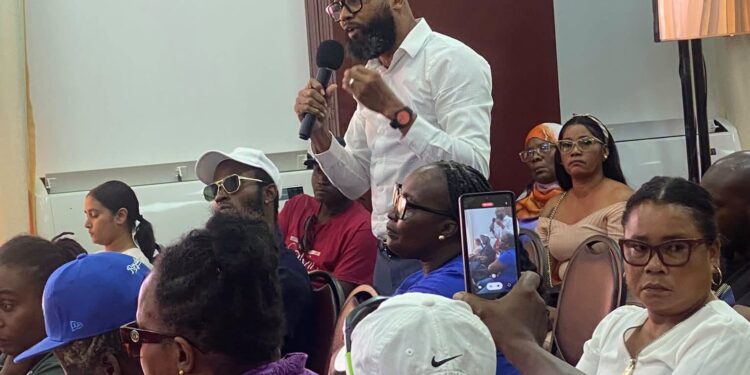
Alliance For Change (AFC) Leader and presidential candidate Nigel Hughes has launched a scathing attack on the Guyana Elections Commission (GECOM), accusing the body of granting the People’s Progressive Party (PPP) a strategic advantage on Nomination Day- Monday July 14- in clear breach of procedure and fairness.
Hughes’s outrage follows GECOM’s decision to place the PPP second in the Nomination Day line-up—despite the absence of any formal mechanism to determine party order and without any visible or documented PPP presence at the Umana Yana when AFC arrived. “How can you award a party with a position when you had no procedure in place?” Hughes asked in a Facebook post.
The AFC leader emphasised that his party arrived second at the location after APNU, and had publicly documented its presence. “Despite the complete lack of any visible PPP presence… GECOM is recognising the PPP as the second party in line.”
Hughes notes that GECOM’s directive came after the AFC called out the agency at its press conference yesterday for the absence of any procedure for the receipt of candidate lists.
The AFC leader questioning the absurdity of GECOM’s decision also questioned the implications for other parties: “What is the position of all the other contestants who were completely unaware of any procedures for the reception of lists?”
This development, he said, reaffirms the AFC’s long-held position: “We stated clearly months ago…we have no confidence in GECOM. No confidence.”
Pattern of Unequal Treatment and Partisan Control
The incident adds to a growing list of concerns among opposition parties and civil society groups over what they describe as systemic bias and partisan decision-making within GECOM. Critics have long accused the Commission of operating with a dual standard favouring the governing PPP while erecting procedural and administrative obstacles for opposition parties.
Central to these concerns is the role of GECOM Chairperson, Ret’d Justice Claudette Singh, who was appointed to the post in 2019 following a constitutional crisis. Opposition commissioners and party leaders have repeatedly accused Singh of siding with the PPP-aligned commissioners on key matters, including decisions related to the Preliminary List of Electors (PLE), voter ID measures, and the handling of election timelines.
Opposition-nominated commissioners and civil society have pointed to Singh’s refusal to implement robust voter ID measures, despite widespread calls for biometric verification to combat multiple voting, as a serious abdication of her responsibility to ensure electoral integrity.
Most recently, Singh has been criticised for allegedly allowing the PPP-aligned commissioners to unilaterally influence decisions without proper consultation, a practice many view as a violation of GECOM’s constitutional mandate to act independently and fairly.
With 22 parties having registered and a growing field of new political actors, critics argue that GECOM’s partiality undermines democratic competitiveness and risks delegitimising the September 1, 2025, General and Regional Elections.
Hughes’s forceful indictment of GECOM signals deepening mistrust in an already fragile electoral system and a call for urgent oversight and reform.