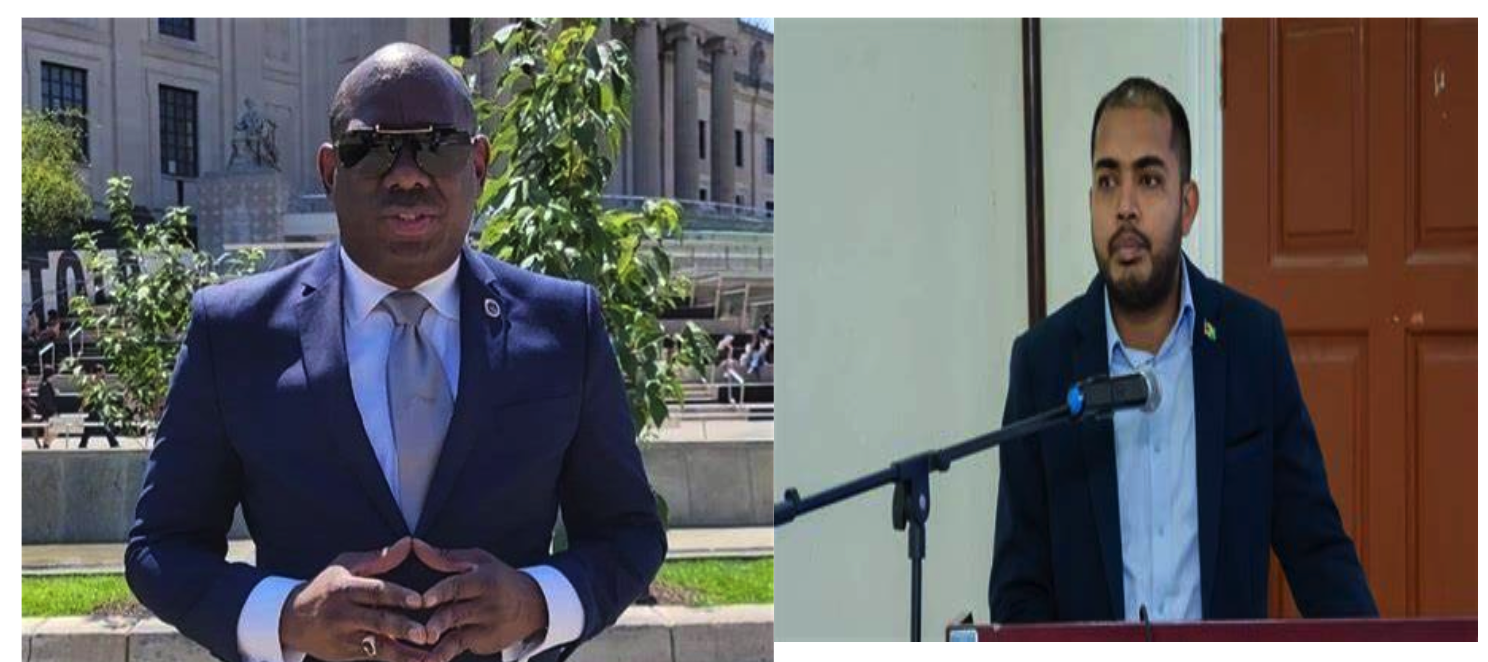
Georgetown, Guyana – June 8, 2025 Rickford Burke, President of the Caribbean Guyana Institute for Democracy (CGID), has launched a searing rebuttal to Region Four Chairman Daniel Seeram’s public explanation for crossing the political floor, from the opposition People’s National Congress Reform (PNC/R) to the governing People’s Progressive Party/Civic (PPP/C).
Seeram’s defection, announced during a podcast interview, was framed as a principled move prompted by what he described as “declining morals” and “visionless leadership” within the PNC. He claimed the party had become “repellent to progressive thinking” and failed to provide a roadmap for meaningful regional development.
But Burke, a long-time critic of the PPP, dismissed Seeram’s moral reasoning as hollow and hypocritical.
“If Daniel Seeram is so guided by high morals,” Burke asked pointedly, “why would he join the PPP, a party that has consistently covered up egregious crimes, including rape and abuse of underage girls by a sitting minister, and more recently, the cover-up surrounding the murder of Adriana Younge?”
Burke’s statement, issued Sunday night, accused Seeram of aligning with a party he says has a track record of ethnic discrimination, violence, and impunity. He referenced allegations that the PPP once formed death squads that targeted young Black men—a legacy for which there has been “no justice,” he said.
“The PPP is the only political party in Guyana where every citizen sanctioned by the U.S. for drug trafficking and money laundering belongs,” Burke stated, further slamming the party’s alleged “racism and abuse of women.”
He questioned the integrity of Seeram’s decision to shift political allegiance, implying that personal ambition, not principle, was the true motivator. “My friend must have some serious moral decay that led him to feel so comfortable joining the PPP,” Burke wrote. “Or should I apply the theory that birds of a feather stick together?”
Burke also derided Seeram’s praise of President Irfaan Ali’s leadership as disingenuous, arguing that the government’s supposed development vision is, in reality, “the imposition of PPP ethnic supremacy and the systematic cover-up of serious crimes against little girls.”
While Seeram characterized his move to the PPP as pragmatic and driven by results-based governance, Burke’s blistering retort framed the move as a betrayal, not just of the PNC, but of every Guyanese citizen who has suffered under or opposed what he sees as PPP excesses.
“Daniel Seeram’s high-sounding rhetoric falls apart under scrutiny,” Burke concluded. “He didn’t leave because the PNC lost its values. He left because he never shared them.”
As Guyana’s political temperature rises ahead of the 2025 elections, the fallout from Seeram’s defection, and Burke’s damning response, underscores the deep ideological and moral chasms between the country’s two major political forces.