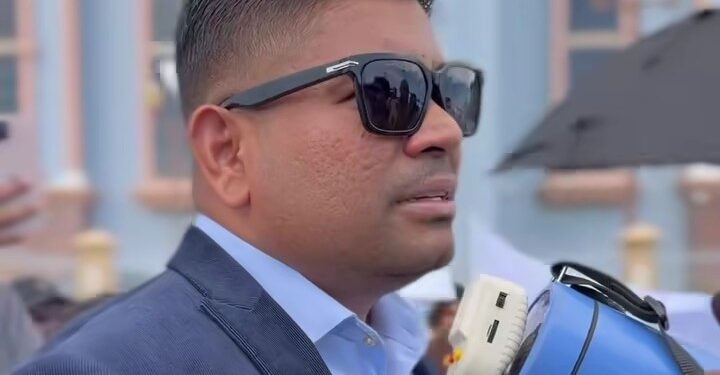
In a press conference held Thursday, the Guyana Trade Union Congress (GTUC) sharply criticised the state of the country’s voter list, revealing significant discrepancies and calling for immediate electoral reforms. With the preliminary voter list for 2025 showing 738,484 names compared to the national population estimated at 750,000 to 780,000, GTUC highlighted the urgent need for a comprehensive overhaul to ensure fairness in the upcoming General and Regional Elections.
According to the GTUC, the issue is not just the numbers on the list but the ongoing irregularities in voter registration, including reports of an inexplicable surge in registrations at a single address in Ogle.
The GTUC was referring to Polling Division #414115, Ogle Sugar Estate, East Coast Demerara. The GTUC previously pointed out that the number of voters surged from 9 in 2020 to 119 in 2025. Of these, 110 newly registered voters are listed under a single address: Lot 5A, Ogle, East Coast Demerara.

These developments have sparked concern about the credibility of the voter roll and the potential for fraud in the electoral process.
GECOM’s Responsibility Under Scrutiny
The Guyana Elections Commission (GECOM) is tasked with maintaining an accurate voter list and overseeing free and fair elections. However, GTUC, has cited the GECOM for not discharging its responsibility consistent with its constitutional mandate that would ensure free, fair and credible election.
The People’s National Congress Reform (PNCR), the Working People’s Alliance (WPA), and the Alliance for Change (AFC), have also long called for a cleaner voter list and the introduction of biometric systems to combat election fraud.
The GTUC is advocating for biometric systems—such as fingerprint, iris, or facial recognition technology—that would help eliminate any possibility of fraudulent voting, which is a position to dissimilar with the political parties, including the People’s Progressive Party (PPP) when it was in Opposition.
The trade union body asserts that the infrastructure for biometrics- fingerprint, iris, or facial recognition technology -is already in place, given that at registration fingerprints are taken.

Biometrics: Feasible and Necessary
GTUC President Norris Witter emphasised the importance of biometrics, stating that Guyana could learn valuable lessons from countries like Ghana, which have successfully integrated these systems into their elections.
Witter noted that both the governing PPP and the opposition PNCR had, at various points, supported the introduction of biometric systems when they were in opposition. He argued that any party opposing biometrics now should be viewed as working to undermine the electoral process, potentially to rig future elections.
“Any party that opposes biometrics now is signaling its intent to manipulate the system,” Norris said. “The people who suffer most in every post-election violence are the constituencies that belong to the trade unions, and we are committed to protecting their right to a fair vote.”
Cost of Implementation and Government Responsibility
During the press conference, GTUC General Secretary Lincoln Lewis revealed that GECOM Chief Executive Officer (CEO) Vishnu Persaud had indicated that a study on biometric implementation had been completed, with an estimated cost of US$27 million. However, Persaud also noted that the responsibility for approaching the government for the necessary funding lies with the Commission itself.
GTUC has raised questions about whether GECOM has formally submitted a proposal to the government for funding and was told no. The trade union body has expressed concern that the lack of progress could undermine public trust in the electoral process. The union also pointed out that biometric systems have long been demanded by citizens across the political spectrum as a means of preventing voter fraud.

Historical Precedents and Calls for Reform
GTUC also referenced the historical precedent for reforming Guyana’s electoral system, pointing to the landmark legislative changes made in the 1990s following an agreement between then-President Desmond Hoyte and Opposition Leader Dr. Cheddi Jagan. This reform established the current GECOM configuration, which was meant to ensure a more inclusive and credible electoral process.
GTUC contends that the framework established between Hoyte and Jagan was groundbreaking at the time and represented the will of the people, and GECOM must adapt to represent the current will of the people.
GTUC’s Commitment to Safeguarding Democracy
The GTUC has reiterated its commitment to securing a clean voter list and implementing biometric systems as essential steps in safeguarding the democratic principle of “one man, one vote.” It was the trade union movement in 1926 that initiated the fight for universal adult suffrage and sees this latest push for electoral reform as a continuation of that mission.
“We will continue to press for these reforms because the right to vote is fundamental to our democracy,” said Lewis. “Biometrics are achievable, and they will ensure the integrity of every vote cast.”
In the coming weeks, GTUC plans to continue its engagement with GECOM, political parties, and regional and international bodies to ensure the reforms are implemented. The federated body said it remains resolute in its stance that a fair, transparent, and credible electoral process is essential for the future of Guyana.