By Mark DaCosta- The People’s Progressive Party (PPP) government continues to face serious scrutiny over the allocation of lands in the Eccles to Great Diamond Highway area. Despite public concerns and demands for transparency, Minister of Housing and Water, Collin Croal, has yet to provide satisfactory explanations as to why lands are being allocated in the very areas from which Mocha-Arcadia residents were forcibly removed under the pretext of highway construction.
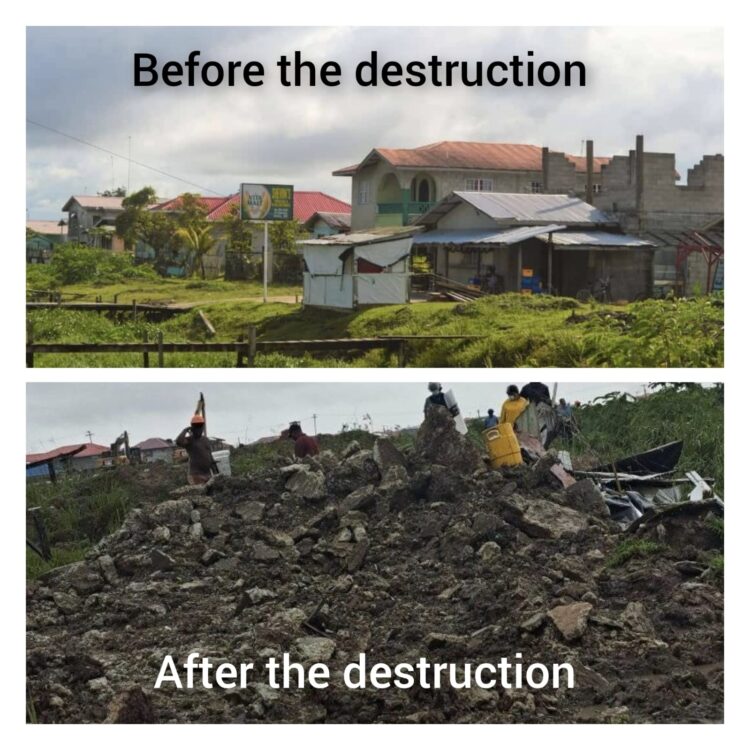
At the heart of the controversy lies the fate of the residents of Mocha-Arcadia, a predominantly Afro-Guyanese community. In January 2023, the PPP government, under the guise of national development, evicted dozens of families from their homes, claiming that their properties stood in the pathway of the planned Eccles-Great Diamond Highway.
The government, in an extensive advertising campaign, insisted that the removals were necessary to advance this key infrastructural project. Mocha-Arcadia residents were told in no uncertain terms that their homes had to be demolished to make way for progress.

However, recent revelations have cast significant doubt on the PPP’s motives. Opposition Leader Aubrey Norton, at a press conference on 9th August 2024, accused the PPP of reallocating the lands in question to their “family, friends, and favourites.” Norton highlighted the troubling fact that some of the newly allocated lands are even closer to the highway’s path than the Mocha-Arcadia homes that were destroyed. This glaring contradiction has not been adequately addressed by Minister Croal or the PPP, despite the growing outcry.
Minister Croal, in comments reported by Stabroek News on 13th August, failed to counter Norton’s accusations. His statements offered no clear refutation of the claim that lands are now being allocated in the purported pathway of the highway, raising further suspicions about the true intent behind the evictions. If the lands were indeed needed for highway construction, why are they now being parceled out to individuals with close ties to the ruling party?
The PPP’s actions have led to widespread speculation that the Mocha-Arcadia evictions were less about infrastructure and more about political and racial agendas. The residents who were removed from their homes were predominantly Afro-Guyanese, a fact that has not gone unnoticed. The new land allocations, purportedly benefiting those connected to the PPP, suggest a deeply troubling pattern of discrimination and victimisation.
This situation raises important questions about the fairness and transparency of land allocation in our country. How can the government justify displacing Afro-Guyanese families from their ancestral lands, only to later allocate those same lands to individuals with political connections? Where is the call to set aside personal and political agendas, a call that the PPP themselves made during the evictions?
The opposition has been vocal in its condemnation of these actions, predicting from the outset that the evictions were a cover for awarding lands to PPP cronies. As this prediction appears to be coming true, it further undermines the credibility of the PPP and casts a long shadow over their commitment to fairness and justice in land distribution.
Minister Croal, as the public face of the government’s housing policies, must answer for these actions. His failure to provide clear explanations only deepens the distrust among the people of Mocha-Arcadia and the wider Guyanese public. Transparency and accountability are cornerstones of good governance, and in this instance, both seem to be sorely lacking.
Collin Croal is the current Minister of Housing and Water under the PPP administration. Appointed in 2020, he has been at the forefront of the government’s housing and infrastructure projects, which have been both lauded for their ambition and criticised for their implementation. Croal’s role places him at the centre of the current land allocation controversy, as he is directly responsible for overseeing the policies that have led to the displacement of Mocha-Arcadia residents and the subsequent redistribution of their lands.
Mocha-Arcadia is a historic village located on the East Bank of Demerara. Established by freed African slaves in the post-emancipation period, it has long been a symbol of Afro-Guyanese resilience and independence. Over the years, the village has grown and evolved, but it has always maintained a strong sense of community and heritage.
The recent evictions have disrupted this community, leading to the displacement of long-standing residents and the destruction of their homes. The controversy surrounding these events continues to stir deep emotions among the people of Mocha-Arcadia and the wider Afro-Guyanese community.