MONTEGO BAY, – In the midst of the Caribbean’s tranquil blue seas and vibrant cultures, a storm brews over the Republic of Haiti, presenting a formidable challenge to the Caribbean Community (CARICOM).
As leaders and diplomats convene to navigate the troubled waters of Haiti’s political crisis, the proposed Transitional Presidential Council emerges as a beacon of hope, albeit shrouded in uncertainty. The question looms: Can this council effectively spearhead the nation towards stability by selecting an interim Prime Minister and forming an inclusive Council of Ministers?
Diving deeper into the crisis, the narrative upheld by mainstream media begins to unravel, revealing a starkly different reality. Professor Jemima Pierre, a Haitian American scholar with the Black Alliance for Peace’s Haiti/Americas Team, sheds light on the true nature of the so-called gangs terrorizing Haiti.

In a revealing conversation with Amy Goodman of Democracy Now, Pierre emphasizes that these entities are not mere gangs but highly organized, well paid, paramilitary forces. Funded and armed by Haiti’s oligarchs, who reap benefits from the chaos sown, these groups are led by skilled, trained personnel, many of whom are former military and police officers.
“The term ‘gangs’ fails to capture the complexity and organization of these paramilitary forces,” Pierre explains. “These groups, now uniting under the banner ‘Viv Ansanm’ or ‘Live Together,’ are a conglomeration of armed young men, asserting their desire to oust Ariel Henry.
Their formation and actions underscore a grave misrepresentation of the crisis by the international community, which has largely overlooked the negotiations excluding Haitian masses.”
The roots of Haiti’s turmoil extend far back, with pivotal moments casting long shadows over its present state. Professor Pierre urges a broader historical perspective, tracing the crisis not to recent events but to a more profound disruption in 2004 with the coup d’état that ousted Haiti’s first democratically elected president, Jean-Bertrand Aristide.
This intervention, sanctioned by foreign powers, including the United States, France, and Canada, marked a significant turning point, laying the groundwork for years of instability. “The crisis in Haiti is not just a matter of internal politics; it’s a crisis of imperialism,” Pierre asserts, pointing to Haiti’s role as a testing ground for U.S. imperial strategies in the region.
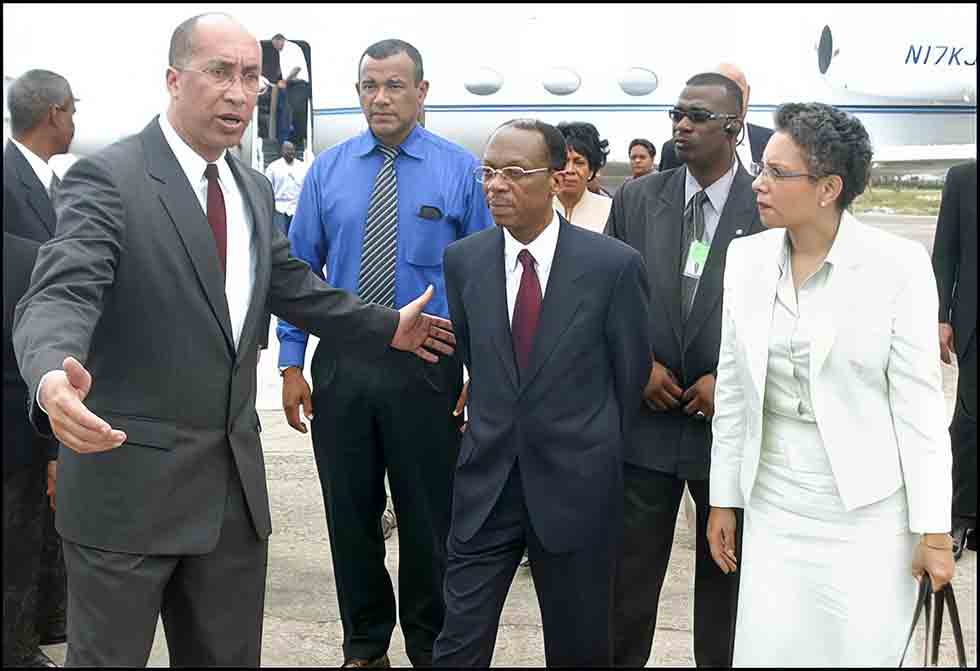
The narrative of Jean-Bertrand Aristide’s exile and the international community’s efforts to restore him highlights the complex dynamics at play. Following his forced departure, a notable rescue mission led by Jamaican Prime Minister PJ Patterson, under CARICOM’s mandate, and involving figures such as U.S. Congresswoman Maxine Waters and TransAfrica’s founder Randall Robinson, brought Aristide back from the Central African Republic to Jamaica.
This act of solidarity, however, was met with resistance from the U.S. administration, which sought to prevent Aristide’s return to the Western Hemisphere. Amy Goodman of Democracy Now reflects on this episode as a critical juncture, illustrating the international politics that have continually shaped Haiti’s path.
As Haiti navigated through the aftermath of the 2004 coup, foreign interventions continued to play a decisive role. The establishment of the PHTK political party and the controversial presidency of Michel Martelly, both heavily influenced by external forces, further complicated Haiti’s political landscape.
These developments, as Pierre lamented, set the stage for the current impasse, where the voices of the Haitian people are overshadowed by the decisions made by a select few beyond their borders.
The contemporary crisis in Haiti is not an isolated incident but a culmination of years of foreign interference and a lack of genuine democratic process. The installation of Ariel Henry as prime minister, orchestrated by an unelected group of Western officials known as the Core Group, exemplifies the external control over Haiti’s political fate.
This imposition, alongside the absence of elected officials due to a lack of elections, underscores a democracy in distress. Professor Pierre poignantly notes, “By understanding the genesis of the 2004 coup d’état, we grasp the complete dismantlement of the Haitian state, which sets the stage for the ongoing turmoil.”
Moreover, the economic backbone of the armed groups contributing to the chaos reveals a troubling collusion between the U.S. and the Haitian oligarchy. The sanctions imposed by the Canadian government on key Haitian oligarchs for their role in funding these paramilitary forces highlight the complex web of interests driving the instability.
“The appearance of these armed groups as ragtag gangs belies the organized and funded nature of their operations, primarily supported by an elite few benefiting from the country’s unrest,” Pierre emphasizes, drawing attention to the critical need for a nuanced understanding of the crisis.
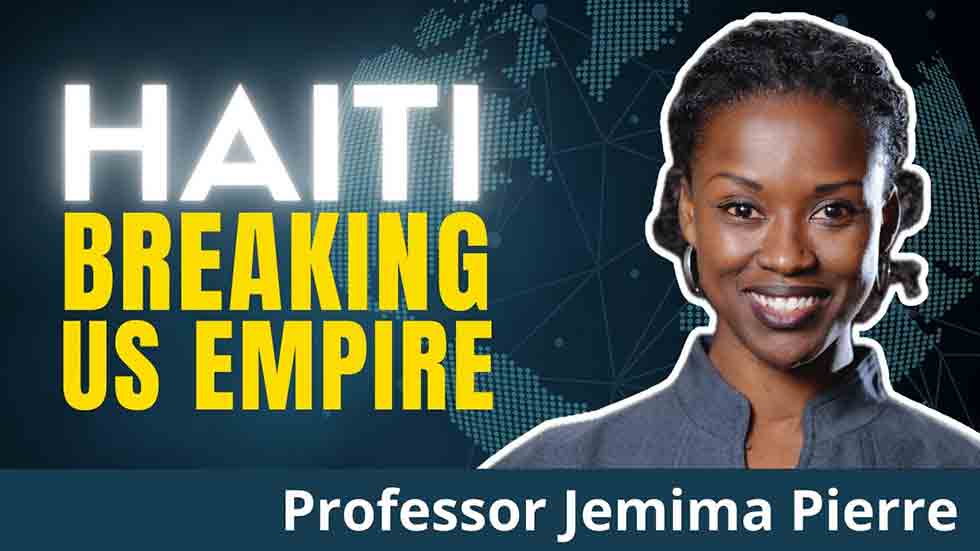
In a profound reflection on the broader implications of the situation, Professor Pierre discusses the failed aspirations of the Haitian people for democracy and self-determination. The community’s call for genuine participation in the political process and their rejection of externally imposed solutions signal a deep-seated desire for change.
“What’s happening today on the ground with CARICOM and the involvement of the U.S., France, and Canada — the architects of the original sin — illustrates a recurring pattern where the aspirations of the Haitian people are sidelined in favor of geopolitical interests,” Pierre laments.
The unfolding narrative of Haiti’s struggle against the backdrop of foreign intervention and local complicity presents a compelling case for a reevaluation of the international community’s approach to the country.
As Haiti stands at a crossroads, the global response will determine whether the nation can embark on a path toward genuine democracy and stability or remain ensnared in a cycle of external dominance and internal discord.
The situation in Haiti serves as a stark reminder of the consequences of foreign intervention and the importance of listening to the voices of the people in any solution. The Haitian people’s resilience in the face of ongoing political turmoil and their continued demands for a genuine democratic process underscore a deep-seated yearning for autonomy and self-governance.
This crisis, rooted in a history of external interference and compounded by internal challenges, calls for a reimagined approach to international solidarity—one that respects the sovereignty and agency of the Haitian people.
Moreover, the role of the international community, particularly entities such as CARICOM, the United States, France, and Canada, must evolve. The repeated cycles of imposition and the support of unpopular governments have only served to exacerbate the situation.
A shift towards supporting inclusive, locally-led processes for political and social reform is essential. The recent history of sanctions against those perpetuating the cycle of violence and instability marks a step in the right direction, but more concerted efforts are needed to address the root causes of the crisis.
In conclusion, the crisis in Haiti is a complex tapestry of historical grievances, external interventions, and the unyielding spirit of its people. The path forward must be paved with genuine dialogue, respect for Haiti’s sovereignty, and a commitment to supporting the Haitian people in their pursuit of a stable, democratic state.
The international community, guided by the lessons of the past, must work in partnership with Haiti, not as architects of its future, but as allies in the Haitian people’s quest for peace, stability, and self-determination. Only then can Haiti hope to emerge from the shadows of turmoil into a brighter, more stable future.(WiredJA)