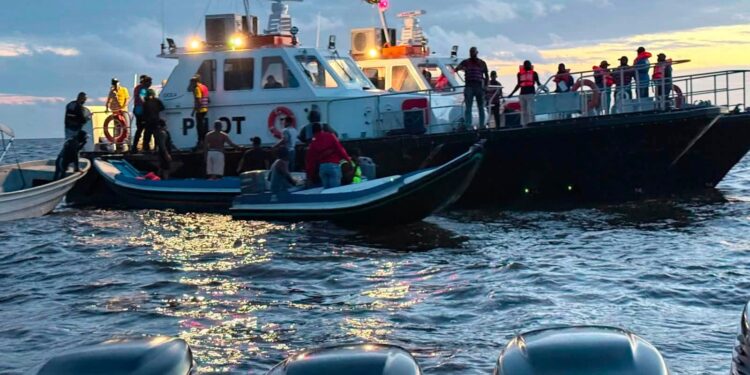
The 29 adults were hauled before the court last week by the government, without providing any legal representation or translation services for the French speaking refugees, where they pleaded guilty to illegally entering Jamaica, and were each fined J$7000 or three days of hard labour for illegal entry. Following this, Jamaica’s Passport, Immigration and Citizenship Agency started making arrangements to have them returned to Haiti.
The human rights group, Freedom Imaginaries, recognising the travesty, on the 20th wrote to Jamaica’s ministries of Foreign Affairs and National Security seeking asylum on behalf of the 37 Haitians, including eight children (three girls and five boys) now facing deportation.
International human rights lawyer and founder of Freedom Imaginaries, Malene Alleyne; urged the Jamaican Government to halt the process and comply with UN Refugee Agency and Inter-American Commission on Human Rights directives to suspend the forced return of Haitians who are being held at a shelter at Robin’s Bay St. Mary, which is being supervised by the Jamaica Red Cross.

The treaty outlining who is a refugee and how refugees ought to be protected arose in the aftermath of the Second World War, and since then,149 countries including Jamaica have agreed to be bound by its provisions.
The 1951 Refugee Convention adopted in July of that year, is the main international treaty concerning refugee protection. It was initially drafted to meet the needs of refugees in the aftermath of World War II.
It applied only to people who had been displaced as a result of events occurring before 1 January 1951, and countries could elect to confine their obligations further by applying it only to those fleeing events ‘occurring in Europe’ before 1 January 1951.
However, its successor, The 1967 Protocol removed the Refugee Convention’s temporal and geographical restrictions so that the Convention would apply universally. Article 1 of the Protocol says that countries that ratify it agree to abide by the Refugee Convention as well – even if they are not a party to it.
For instance, states like Jamaica and the United States which may not have ratified the Refugee Convention but have ratified the 1967 Protocol, are bound to apply the Convention’s provisions.
The Refugee Convention imposes several obligations on countries relating to the treatment and protection of asylum seekers and refugees.
The principle of non-refoulement is one of the most important principles in the Refugee Convention. It requires (a) that countries do not send refugees to a place where they will face a well-founded fear of persecution, nor to any other country that might send them to such a place.
(b) Providing refugees with a legal status, including rights such as access to employment, education and social security;
(c) Not punishing refugees for entering ‘illegally’ – that is, without a passport or visa.
The effect of the Protocol means that the Refugee Convention now applies universally in those States which have adopted the Protocol.
The exceptions are: Turkey, which expressly maintains the geographical restriction; Madagascar, which maintains the geographical restriction and has not adopted the Protocol; and St. Kitts and Nevis, which has not adopted the Protocol.
Under the Refugee Convention, who is a refugee?
Article 1A (2) of the Refugee Convention sets out the international legal definition of a refugee. It defines a refugee as a person who:
(a) has a ‘well-founded fear of being persecuted for reasons of race, religion, nationality, membership of a particular social group or political opinion’;
(b) ‘is outside the country of [their] nationality’; and (c) ‘is unable or, owing to such fear, is unwilling to avail [themselves] of the protection of that country’.
The idea of ‘persecution’ is not defined in the Refugee Convention, but it has been understood as involving threats to life or freedom and other serious violations of human rights.
It may also include social, political or economic discrimination, and can result from a single incident or cumulative incidents and conditions.
Refugees are given a special status in recognition of the fact that they have lost the protection of their own country.
According to the Refugee Convention, refugees ought to be afforded a range of rights as soon as they arrive in a country seeking asylum.
These rights include, but are not limited to, the right to non-discrimination (article 3), the right to work (article 17), freedom of religion (article 4), the right to housing (article 21), the right to not be penalised for illegal entry (article 31), the right not to be expelled from a country unless the refugee poses a threat to national security or public order (article 32), and the right not to be sent back to a country where their life or freedom would be threatened (i.e. the principle of non- refoulement) (article 33). Conversely, article 2 of the Refugee Convention requires that refugees abide by the law in the country that grants them protection.
While there may be no specialist international refugee court or tribunal that is responsible for monitoring whether or not countries comply with the Refugee Convention, the United Nations High Commissioner for Refugees (UNHCR) supervises how countries apply the provisions of the Refugee Convention.
This includes monitoring the situation of refugees and engaging with governments in relation to issues of concern.
The Caribbean Community, CARICOM Commits to Help

In relation to Jamaica, the Caribbean Community, CARICOM has taken responsibility to assist in crafting a solution to the deep humanitarian, security and governance crises affecting Haiti and Jamaica is considered integral to the search for a sustainable Haitian solution.
In that regard, they noted the need for the immediate creation and security stabilization under the mandate of a United Nations Security Council (UNSC) Resolution, and agreed to seek support from international partners to help finance its establishment and the strengthening of security in Haiti.
The CARICOM Heads of Government are of the view that approaches should be made to Rwanda, Kenya and other willing international partners to support the strengthening of the Haitian National Police (HNP) and the establishment of the corridor.
They welcomed the statement by the Prime Minister of Haiti that he will not seek election but will head a Transition Government to secure the arrangements to transition the country from the security and humanitarian crises until the holding of credible, free, and fair elections.
Heads of Government acknowledged that the CARICOM Eminent Persons Group (EPG) – which includes former Jamaican prime minister Bruce Golding – will continue to work with the Haitian Government and stakeholders in their efforts to find a Haitian led solution to the crisis. (WiredJA)