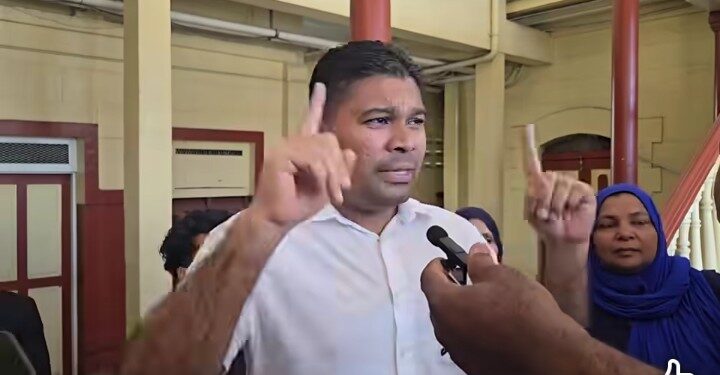
The Guyana Teachers Union (GTU) has warned that it could resort to legal action, sickouts and public demonstrations as frustration mounts over what it describes as the Government’s continued failure to address outstanding concerns affecting teachers, students and the education sector.
GTU President Coretta McDonald issued the warning during a press conference at the union’s Georgetown headquarters on November 17, where she said repeated attempts to engage the Ministry of Education and other senior government officials had failed to produce meaningful responses.
The union’s demands include the restoration of automatic deductions and remittance of membership dues, negotiations for a new multi-year collective agreement and stronger measures to protect teachers and students from violence in schools.
General Secretary Collis Nicholson said the union had written to the Minister of Education, the Chief Education Officer, the Permanent Secretary, the Chief Labour Officer and the minister responsible for labour. Correspondence was also sent to President Irfaan Ali seeking his intervention.
According to Nicholson, the union had received no response or acknowledgement to its requests for engagement.
McDonald said the GTU was consulting its membership on proposals for a new multi-year agreement, which it intends to submit to the Ministry of Education. Although she declined to disclose the full salary proposal, she indicated that the union would not seek an increase below 10 per cent, citing the rising cost of living.
The previous agreement, signed on August 21, 2024, provided for salary increases of 10 per cent in 2024, eight per cent in 2025 and nine per cent in 2026. That agreement followed approximately 75 days of industrial action by teachers in 2023, along with court proceedings, mediation and negotiations.
Another major point of contention is the suspension of automatic deductions and remittance of teachers’ union dues, which the Government discontinued in February 2024.
The GTU maintains that the arrangement should have been restored following a favourable High Court ruling and the Court of Appeal’s refusal to grant a stay of that order. The Government, however, has previously disputed allegations of non-compliance, pointing to the need for a verified membership list to facilitate the deductions.
Nicholson said the union’s contempt application is scheduled to be heard on November 26, as it seeks to have the outstanding matter addressed by the court.
The union also expressed concern over reports of bullying, physical confrontations and assaults involving teachers and students. McDonald called for a comprehensive school safety framework incorporating clear reporting procedures, timely investigations, counselling services, appropriate disciplinary measures and stronger parental involvement.
“Teachers should not be expected to maintain discipline or intervene in violent situations without adequate protection, training, and institutional support,” she said.
Constitutional Rights and Workers’ Freedom to Organise
The GTU’s dispute with the Government also raises important constitutional questions concerning the rights of workers to organise, join trade unions, engage in collective bargaining and take industrial action.
Article 147 of the Constitution of Guyana expressly protects freedom of association, peaceful demonstration and the right to strike. Article 147(1) provides that individuals have the right to associate with others and, in particular, to form or belong to trade unions and other organisations for the protection of their interests.
Article 147(2) further states:
“Except with his or her own consent no person shall be hindered in the enjoyment of his or her freedom to strike.”
Article 147(3) also provides:
“Neither an employer nor a trade union shall be deprived of the right to enter into collective agreements.”
These constitutional provisions establish important protections for organised labour and recognise the role of trade unions in representing workers’ interests.
The Trade Union Recognition Act also provides a legislative framework for collective bargaining, including negotiations between employers and recognised majority unions over employment conditions, agreements and the resolution of disputes.
Consequently, the GTU’s demands for renewed collective negotiations and recognition of its role as the representative of teachers are not simply industrial relations issues; they also engage constitutional and statutory protections afforded to organised labour.
The GTU has also approached regional and international labour organisations, including the Caribbean Union of Teachers and Education International, and indicated that it could take its concerns to the International Labour Organisation (ILO).
McDonald said the union would continue mobilising teachers and considering demonstrations outside the Ministry of Education as it presses for engagement.
The dispute raises wider questions about collective bargaining, the relationship between the Government and organised labour, and the protection of teachers’ constitutional and workplace rights. Whether the parties can resolve their differences before further industrial action becomes necessary remains to be seen.