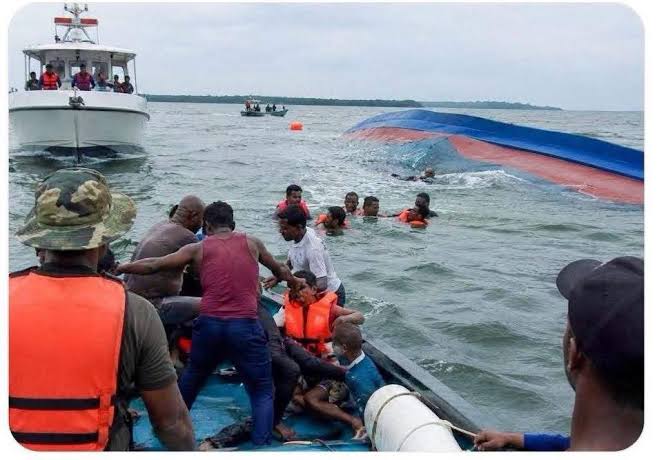
The testimony emerging from the Commission of Inquiry into the July 18 MV Barima disaster is painting a disturbing picture of a passenger vessel on which mechanical problems allegedly persisted, basic safety precautions were compromised and passengers were left fighting for their lives when the vessel sank.
Months after the tragedy claimed dozens of lives and left families searching for missing relatives, survivors are recounting warning signs that raise serious questions about the government’s oversight of the Transport and Harbours Department and the maintenance of a public vessel entrusted with transporting Guyanese.
The central question confronting the authorities is straightforward: How was the MV Barima allowed to continue operating if the mechanical and safety deficiencies described by witnesses were known or should reasonably have been identified?
One of the most troubling accounts came from Rudolph and Michelle Sam, parents of 32-year-old engineer Trevon Sam, whose body has not been recovered.
Appearing before the Commission on November 16, Rudolph Sam, a heavy-duty mechanic, testified that his son had repeatedly raised concerns about the vessel’s mechanical condition before the disaster.
He said the vessel had reportedly been operating with one engine for more than three weeks and that his son had sent him videos showing mechanical problems, including excessive back pressure affecting an engine.
“For more than three weeks, that boat been working with one engine. That boat been left Georgetown, went to Kaituma with that engine problem, came back to Georgetown with one engine down.”
The testimony raises questions about whether the vessel’s condition was properly assessed and why it was apparently permitted to continue transporting passengers.
The anguish of the Sam family is compounded by the fact that Trevon, who worked as a third engineer with the Transport and Harbours Department, remains missing.
His parents are now left relying on videos and conversations that may help establish what happened before the sinking.
Passengers allegedly denied life jackets
Equally disturbing was testimony from survivor Carletta Matabheek, who told the Commission on November 17 that she had requested a life jacket before departure because she could not swim.
She testified that a crew member wearing a Transport and Harbours Department shirt discouraged her, reportedly telling her that a life jacket would take up space.
“You don’t need a life jacket, that will take up space.”
Her husband, Adam Matabheek, subsequently attempted to retrieve a life jacket but testified that the equipment was kept inside a locked cage.
The couple survived, but four members of their family, including his sister-in-law Rachel Matabheek and her three children, Nathaniel, Natalia and Ezekiel, died.
The testimony raises fundamental questions about why life-saving equipment was reportedly inaccessible when passengers needed it most.
How could a passenger who admitted she could not swim be discouraged from obtaining a life jacket? Who was responsible for ensuring that emergency equipment was immediately accessible?
These are not minor administrative oversights. They concern the most basic responsibility of a passenger transport service: protecting human life.
Survivors fought for hours in the Atlantic
The Commission also heard from Donald Modeste, who described spending approximately seven and a half hours in the Atlantic after escaping the sinking vessel.
He testified that he had questioned the number of passengers boarding and was told that the vessel had travelled from Mabaruma with one engine.
Modeste recalled being told that the vessel should have been taken out of service months earlier, but that repairs were reportedly being undertaken before it returned to operation.
“This boat suppose to go pun dock since April and all them man doing is patching this boat and send it back.”
Without a life jacket, Modeste improvised, using two bottles to help keep himself afloat.
Another survivor, Rajwan Komar, described being trapped underwater as passengers and cargo were thrown around during the capsizing.
After reaching the surface, he secured two floating life jackets and gave one to a young girl who could not swim. He later managed to contact emergency services at approximately 10:58 p.m.
Komar also submitted videos showing the vessel being loaded, water entering its main deck and survivors clinging to floating debris.
Commission Chairman Justice Godfrey Smith praised his intervention in helping others.
“The whole country is in your debt for what you did.”
The recordings could prove important in reconstructing the events leading to the sinking.
Four grandchildren lost
Among the most heartbreaking testimony was that of Helena Moonsammy, who survived the disaster but lost four of the eight grandchildren travelling with her.
She described spending approximately nine hours in the Atlantic and desperately trying to locate the children. One of the deceased children was two years old.
Her testimony also raised concerns about overcrowding, cargo occupying passenger spaces and life jackets being kept in a locked compartment.
Behind every account is a family whose life has been permanently altered. Some are mourning children, parents and siblings. Others are still waiting for the recovery of loved ones.
Government must answer
The unfolding evidence places the government’s oversight of the Transport and Harbours Department under serious scrutiny.
The Commission must establish what the authorities knew about the vessel’s mechanical condition, whether inspections were properly conducted, who authorised its continued operation and whether passenger safety requirements were enforced.
The government cannot simply treat the disaster as an unfortunate maritime accident while witnesses describe alleged failures that may have been preventable.
If the reported mechanical problems were known, who allowed the vessel to continue operating? If life jackets were inaccessible, who was responsible? If passenger spaces were occupied by cargo, where were the inspections and enforcement measures?
The inquiry must distinguish individual negligence from institutional and governmental failures and ensure that accountability is based on evidence.
The July 18 disaster was not simply a maritime mishap. Passengers boarded a public transportation service expecting to reach their destinations safely. Many never returned.
The government owes the families answers, not assurances. If the MV Barima was allowed to operate despite serious deficiencies, Guyanese deserve to know who permitted it, why it happened and whether those responsible will face consequences.
The families have already paid an unimaginable price. The least they deserve is the truth and concrete guarantees that another public vessel will never be allowed to operate under comparable conditions.