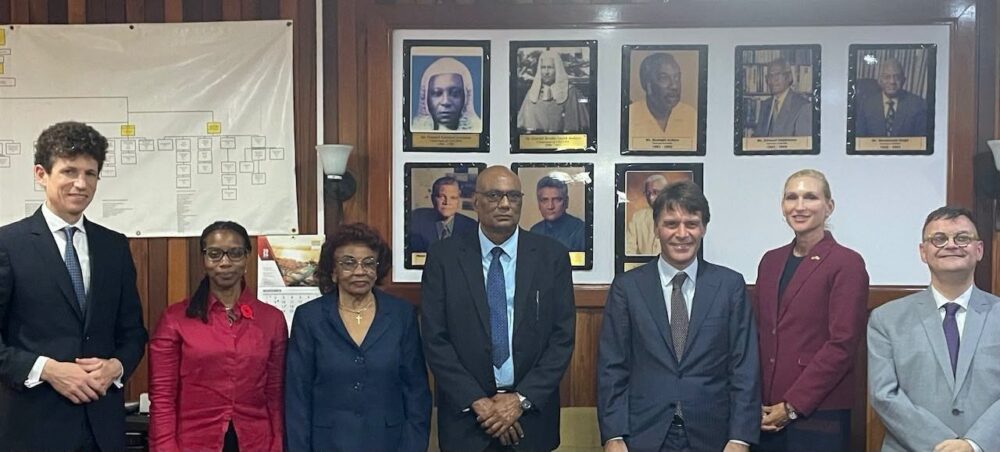
Five senior diplomats representing the United States, United Kingdom, Canada, European Union and France have met with the leadership of the Guyana Elections Commission (GECOM) to discuss electoral reforms and the implementation of recommendations arising from the September 2025 General and Regional Elections.
The November 5 meeting has renewed attention on one of Guyana’s most contentious unresolved electoral issues: biometric voter verification at polling stations, a safeguard repeatedly demanded by sections of the opposition and civil society but rejected for the 2025 elections amid political and constitutional disagreements.
The delegation comprised US Ambassador Nicole Theriot, British High Commissioner Joe Fisher, Canadian High Commissioner Deborah Gomes-Schultz, EU Ambassador Luca Pierantoni and French Ambassador Olivier Plançon. They met with GECOM Chairperson Justice (Ret’d) Claudette Singh and Chief Elections Officer Vishnu Persaud.
In a statement shared on social media following the meeting, the diplomatic representatives described the discussions as “informative and constructive”. They said the engagement covered GECOM’s consideration of recommendations from international observer missions and its priorities for strengthening electoral processes and institutions ahead of the next Local Government Elections.
The statement did not identify which specific recommendations were discussed or indicate whether biometric verification featured in the deliberations.
That omission is significant given the controversy surrounding the issue and the political positions taken over the years.
PPP once called for biometrics
The People’s Progressive Party’s position on biometric identification has evolved considerably.
In October 2015, following its defeat at the General Elections, the PPP called for electoral reforms that explicitly included “enhanced bio-metrics”, alongside a fresh voters’ list and electronic voting. The party argued that reforms were necessary to strengthen transparency and improve the electoral system.
In August 2022, however, PPP General Secretary Bharrat Jagdeo declared that his party would not support the opposition’s proposal for biometric verification if it restricted citizens’ constitutional right to vote. He argued that the technology could become a means of preventing eligible voters from exercising their franchise.
By November 2024, Jagdeo had adopted a more conditional position, saying the PPP would consider supporting and funding “enhanced biometrics” if GECOM determined that the system was necessary, provided it did not disenfranchise voters or delay elections.
But by January 2025, as pressure mounted for biometric fingerprint verification at polling stations ahead of the September elections, Jagdeo dismissed the opposition’s demands as a “storm in a teacup”. He argued that existing safeguards were adequate and warned that biometric requirements could create difficulties for voters if equipment malfunctioned or electricity failed.
The PPP’s changing position has raised questions about whether its approach to electoral safeguards is determined by principle or political circumstance. A measure the party once included among its own proposed reforms became a point of opposition when other political parties pressed for its implementation.
Observer missions recommended reconsideration
The controversy did not end with the 2025 elections.
GECOM Chairperson Justice Singh ruled in January 2025 that introducing mandatory biometric identification at polling stations was not feasible within the available time. She also raised constitutional concerns, explaining that legislation would be required if the technology imposed an additional condition on a citizen’s right to vote.
GECOM subsequently outlined technical, financial, legislative and administrative challenges, including equipment procurement, staff training, voter education, data security and the possibility that technical failures could interfere with voting.
The Commonwealth Observer Group, in its report on the September 1, 2025 elections, acknowledged that GECOM had been unable to introduce biometric verification because of technical, legislative and administrative challenges. However, it recommended that consideration be given to adopting the technology early in the new electoral cycle.
That recommendation is particularly important because it removes the argument that the matter can simply be deferred until another election is approaching. The groundwork for any reform must begin well in advance.
The November 5 diplomatic engagement therefore comes at a time when GECOM is expected to consider how it will respond to the recommendations of observer missions and address longstanding concerns about electoral confidence.
The public statement from the diplomats offered no indication of a timetable, specific commitments or decisions arising from the meeting.
Guyanese voters are entitled to know whether biometric verification will be reconsidered, what legislative changes may be necessary, how the technology would protect against impersonation without disenfranchising eligible voters, and whether GECOM intends to begin preparations early enough to avoid another last-minute controversy.
The issue also demands political consistency. Electoral safeguards should not become acceptable or unacceptable depending on which party stands to benefit politically.
International observers have made their recommendations. Sections of society have repeatedly called for stronger voter verification. The political parties have debated the issue for years.
The responsibility now rests with GECOM and the political leadership to explain what reforms will be pursued, how they will be implemented and when the electorate can expect answers.