The Caribbean Community (CARICOM) has rejected the United Kingdom’s position that reparations are not the appropriate response to the legacy of slavery, insisting that Britain must confront its historical responsibility through a structured dialogue that places reparatory justice firmly on the agenda.
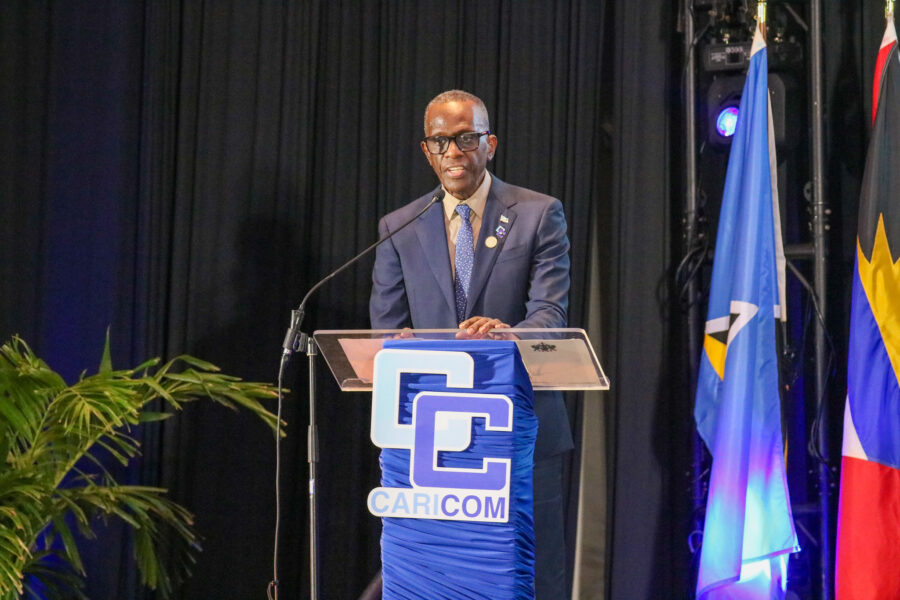
CARICOM Chair and Saint Lucia Prime Minister Philip J. Pierre, in a statement issued on October 31, welcomed remarks by British Prime Minister Andy Burnham expressing personal sorrow and regret for the suffering caused by slavery and its continuing consequences. However, Pierre made it clear that an apology and discussions on debt relief cannot replace reparations.
The statement comes ahead of the Commonwealth Heads of Government Meeting (CHOGM), which opens in Antigua and Barbuda on Sunday, where the issue of reparatory justice is expected to feature prominently in discussions.
Pierre acknowledged that Burnham’s willingness to consider a formal apology on behalf of the British state and establish structured dialogue represents a significant development, noting that no previous British Prime Minister had gone as far.
“For more than a decade, this Community has asked for exactly such a dialogue. We are ready to engage.”
However, he rejected the British position that reparations are “not the right answer”, arguing that responsibility for slavery rests with states and institutions rather than individual citizens alive today.
“Reparatory justice has never been about individual guilt. It is about the responsibility of states and institutions — and that responsibility does not expire with the passing of generations.”
Pierre argued that successive generations in Britain continue to benefit materially, socially and psychologically from the system of racialised chattel enslavement, while Caribbean societies continue to bear its consequences.
He pointed to Britain’s role in legislating, protecting and profiting from slavery, as well as the decision to compensate enslavers following emancipation while formerly enslaved people received no land, wealth or compensation.
The CARICOM Chair also highlighted the historical debt raised to compensate enslavers, which, according to the statement, British taxpayers continued repaying until February 2015.
He said the consequences of slavery remain evident across the Caribbean through chronic disease, educational and economic inequalities, fragile economies shaped by extraction and persistent national debt.
Pierre stressed that the reparations campaign was not driven by revenge or a desire to assign personal blame, but by the pursuit of historical truth and justice.
While describing a formal apology from the British state as an important first step, he insisted that it must be accompanied by practical measures to address the enduring damage.
“But an apology without repair is incomplete.”
He called for the proposed dialogue to encompass the full CARICOM Ten-Point Plan for Reparatory Justice, which includes a formal apology, public health, education and training, cultural heritage restitution and reconnection, psychological rehabilitation, technology and innovation, entrepreneurship, debt cancellation, monetary compensation and decolonisation.
Pierre also insisted that the discussions must address the genocide of Indigenous peoples and the damage caused to people brought from India and China to sustain the system of colonialism.
On the United Kingdom’s proposed initiative, to be led by former British Prime Minister Gordon Brown, to restructure the debt of the poorest Commonwealth countries, Pierre said CARICOM would examine the proposal seriously.
However, he cautioned that most CARICOM states are classified as middle- or high-income countries based on per capita income, leaving them routinely excluded from concessional financing and debt relief despite their vulnerability to climate and economic shocks.
He argued that eligibility for assistance must take vulnerability into account rather than income alone, while stressing that debt relief cannot serve as a substitute for reparatory justice.
“Any initiative that is to be meaningful for our region must measure vulnerability, not income alone. And debt relief, however welcome, cannot be offered as a substitute for reparatory justice.”
Pierre said CARICOM’s Prime Ministerial Sub-Committee on Reparations, led by Barbados Prime Minister Mia Mottley, and the CARICOM Reparations Commission, chaired by Sir Hilary Beckles, stand ready to work with the British Government on the terms, agenda and timetable for structured discussions.
He said he looked forward to meeting Burnham in St John’s, Antigua, during the Commonwealth summit.
The CARICOM Chair concluded by stressing that the region has a responsibility to pursue justice on behalf of those who endured slavery and generations yet to come.
“Our ancestors did not receive justice in their lifetime. We owe it to them, and to the generations who will come after us, to see this work through — with dignity, with patience, and with resolve.”