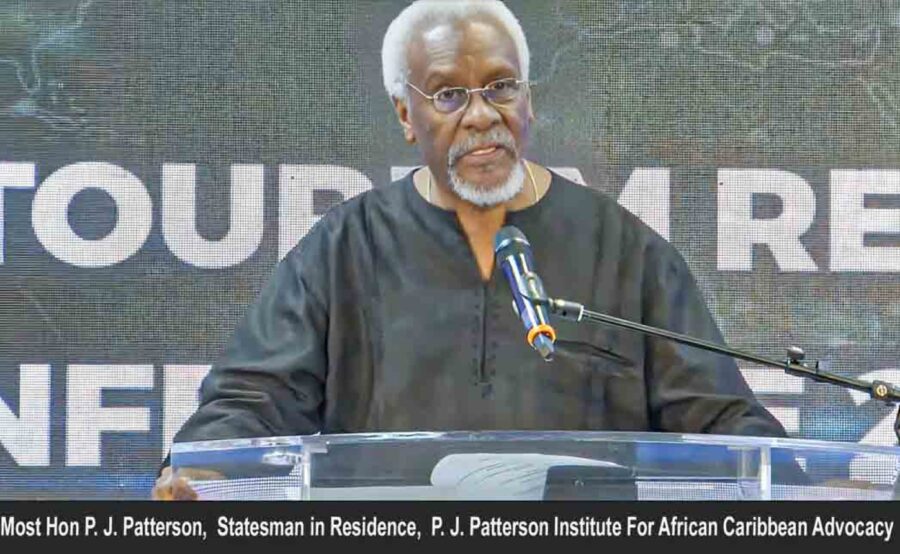
Former Jamaican Prime Minister P.J. Patterson has condemned his country’s decision to abstain from a United Nations General Assembly resolution calling for an end to the United States’ economic, commercial and financial embargo against Cuba, describing the move as a historic betrayal of Jamaica’s foreign policy principles.
In an opinion piece published in WiredJA, Patterson said the October 28 decision marked a sharp departure from more than three decades of bipartisan support for the resolution, which Jamaica had consistently backed since it was first introduced in 1992.
He argued that the abstention undermined the country’s longstanding commitment to sovereignty, non-interference and the right of nations to determine their own affairs without external coercion.
“It was a day of shame for the land of Marcus Garvey, and a stain on the record of a nation which, before we had even raised our own flag, closed its ports to trade with apartheid South Africa.”
Patterson, who served as Jamaica’s Prime Minister from 1992 to 2006, said the country’s position on Cuba had never been a partisan issue but one rooted in principle and its historical opposition to oppression.
He recalled accompanying former Prime Minister Michael Manley in December 1972 when four newly independent Caribbean countries agreed to establish diplomatic relations with Cuba, challenging the diplomatic isolation imposed on the island.
Patterson, who described himself as the last surviving participant in that decision, said Jamaica’s latest position represented a repudiation of the principles that informed the country’s foreign policy at independence.
The former Prime Minister’s strongest criticism centred on what he described as a direct contradiction between the Government’s position in Parliament and its subsequent vote at the United Nations.
On October 27, Jamaica’s House of Representatives unanimously passed a Government-sponsored resolution addressing Cuba’s economic and humanitarian circumstances. Patterson said the motion called for efforts to reduce economic restrictions and facilitate Cuba’s integration into the international economic system, rather than sustain its isolation.
However, less than 24 hours later, Jamaica abstained from the UN vote.
“Our abstention violated the unanimous decision of the Legislature. It was a deplorable flouting of Parliament’s constitutional authority, the highest expression of the will of the people in our democracy.”
Patterson described the reversal as an act of deception and a serious breach of parliamentary accountability, arguing that lawmakers on both sides of the House had been led to support one position before the Government adopted another at the international level.
He challenged the Government to explain why a fundamental change in policy was not brought before Parliament, particularly if, as the Foreign Affairs Minister indicated, the issue had been under consideration for some time.
The Government has maintained that its abstention reflected a policy shift following consideration of the broader circumstances surrounding Cuba. Foreign Affairs Minister Kamina Johnson Smith said the resolution did not provide sufficient scope to reflect the Government’s concerns and its preferred approach to dialogue, human rights and reform.
Patterson rejected that reasoning, arguing that Jamaica could have supported ending the embargo while continuing to express concerns about Cuba’s domestic affairs.
He also questioned whether external pressure influenced the decision, insisting that the Jamaican public was entitled to know whether any pressure, promises or threats were involved.
The former Prime Minister further argued that the decision weakened the protections on which small states depend, particularly the international rule of law and the United Nations system.
“Small states have no mighty army to defend us, and insufficient economic weight to shield us against the exercise of military might and power. Our security rests on the international rule of law and on a credible multilateral system with the Charter of the United Nations at its centre.”
Patterson also invoked Cuba’s longstanding assistance to Jamaica, pointing to the contribution of Cuban doctors and nurses, scholarships for Jamaican students and the Operation Miracle programme, through which he said nearly 25,000 Jamaicans had received free treatment to restore or improve their sight.
He linked the abstention to what he described as a wider pattern of departures from Jamaica’s traditional foreign policy positions, including its absence from a previous UN vote concerning Palestine, the termination of its medical cooperation programme with Cuba and the controversial third-country nationals deportation arrangement with the United States.
He called for the Government to provide Parliament, the Jamaican public and the Diaspora with a full account of how the decision was made and who was responsible.
Warning that Jamaica risked damaging an international reputation built over generations, Patterson said the country must not abandon its historic support for justice and the sovereign equality of states.
“We live in no one’s backyard. Jamaica must never accept the doctrine that might makes right.”
He concluded that while the Government had departed from the country’s longstanding position, the Jamaican people had not abandoned the principles on which that reputation was built.
Read P.J. Patterson’s full opinion piece, published in WiredJA, by clicking here.