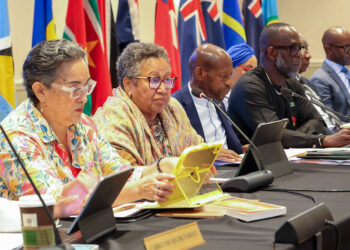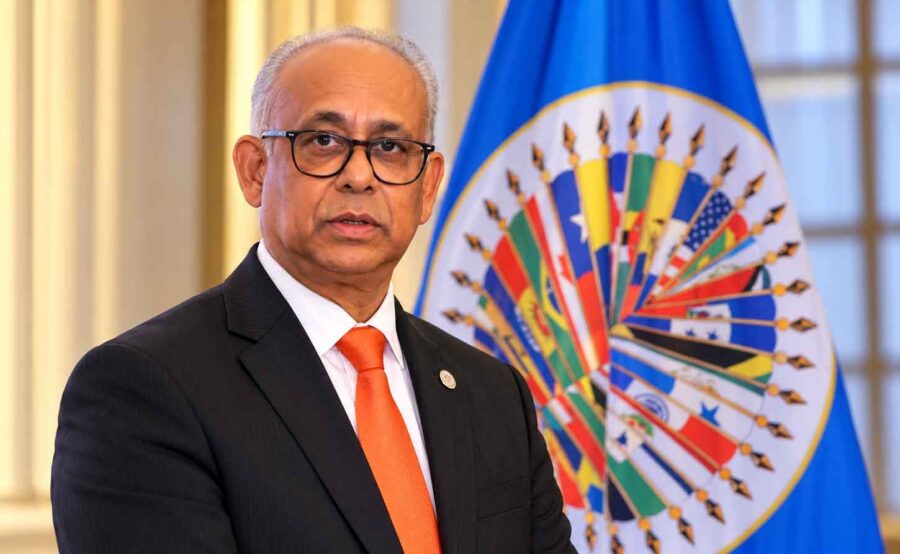
By Calvin G. Brown (WiredJA)- On Wednesday, in the Hall of the Americas at the Organization of American States’ headquarters in Washington, Secretary General Albert Ramdin addressed the opening of a regional conference titled “Corruption: A Common Threat to Societies and Development”, hosted by the Embassy of France and France’s Permanent Mission to the OAS, according to a report by Derrick Scott.
Ramdin emphasised that the true measure of progress against corruption must be tangible improvement in people’s lives, rather than simply the adoption of laws, policies or institutional commitments.
The OAS Secretary General underscored the far-reaching consequences of corruption, noting that it weakens public institutions, compromises the administration of justice and erodes public confidence in government. It also places an unequal burden on vulnerable communities by limiting their access to essential services and opportunities.
The yardstick comes from a man the OAS describes as the first Secretary General from a CARICOM member state. Ramdin, born in Suriname, took office in May 2025.
Jamaica can meet part of it. The Integrity Commission’s 2025/26 annual report, tabled in Parliament in July, records 22 prosecution matters concluded — 21 convictions and one withdrawal — with 35 financial-investigation matters recommended for prosecution.
Jamaica also came off the Financial Action Task Force’s grey list in June 2024, four years after it was placed under increased monitoring in February 2020, having completed what the Ministry of Finance describes as a 13-point action plan. That is delivery, not paper.
It is a party to the Inter-American Convention against Corruption, adopted at Caracas in 1996 — the instrument the release reports Ramdin calling a landmark.
On Transparency International’s Corruption Perceptions Index, Jamaica scored 44 out of 100 in the 2025 edition, ranking 73rd of 182 — unchanged from the year before. It has scored 44 in every edition since 2020, and in every edition since 2017 bar 2019, when it scored 43, the Gleaner reported from TI data. The climb from 38 in 2012 and 2014 was real. It stopped in 2017.
Barbados scored 68. Jamaica sits two points above a global average that TI says has fallen to a new low of 42.
On the Commission’s own numbers, the machinery produces convictions. What it has not yet produced is an outcome in the cases involving sitting parliamentarians.
In 2025/26, the report shows, 18 matters were referred to the Commission for investigation and 10 were pursued. All ten are still ongoing. Six MPs and one senator are under investigation for potential illicit enrichment or false information, the Gleaner reported from the report in July.
Of eight statutory-declaration cases sent to the Corruption Prosecution Division in the 2020/21 and 2021/22 financial years, one ended in the final quarter of the last financial year, when the person was found, brought to court and pleaded guilty. The other seven are listed as dormant because the former officials cannot be found, the Sunday Gleaner reported.
The courts are a second pressure. Executive Director Craig Beresford wrote in the annual report of rising litigation against the Commission’s work: “This trend was characterised by the increasing use of interim injunctions by external parties.” Seven legal matters involving the Commission or its predecessor bodies are before the courts.
And there is a third pressure: an argument over how much the public should be told. At a parliamentary committee, the Jamaica Observer reported on October 15, Justice Minister Delroy Chuck questioned whether publicly identifying the categories of people referred to the Commission could fuel perceptions of corruption, arguing it could create an impression of widespread corruption when investigations do not lead to charges.
He also said the Commission should be able to report what it investigated and charged. Opposition finance spokesman Julian Robinson argued that accountability requires reporting how investigations are progressing, and how many there are.
The Commission’s Director of Investigation, Kevon Stephenson, told the committee that changing what the annual report must contain would require legislative amendment.
Stephenson has made Ramdin’s argument from the other side. In July, according to the Observer, he said that measuring the Commission only by prosecutions and convictions “would be operating at a lower level”, and that the aim is for its work to “help to bring about social change in society”.
He is right. That is why the disclosure argument matters. A Commission that wants to be judged on social change needs a public that can see which investigations are moving. A perception score that has sat still for six editions is not waiting on more paper. Finished cases involving sitting parliamentarians, reported in full, might move it.
Jamaica has built the institutions Ramdin’s test assumes. On the measure the release attributes to him, the convictions are a start. The cases still open are the test.