Since September 2025 the US military has struck alleged drug boats at least 70 times by early October. Going the other way, the guns tearing Haiti apart — and killing people from Kingston to Nassau — ride from Florida in containers that are mostly not inspected. Washington has done something about that. But next to its war on drugs, WiredJA argues, it has done very little.
By Calvin Brown (WiredJA)- On 4 August Jean Robert Casimir, a 53-year-old former Haitian police officer living in Lauderhill, Florida, pleaded guilty to smuggling at least 140 firearms to Haiti between August 2020 and December 2024. Among other methods, the Justice Department said, he and his co-conspirators hid guns in industrial air compressors “that they cut open and welded back together,” and shipped them by boat from the Miami area. He awaits sentencing.
One smuggler, 140 guns. Haiti’s gangs are armed one shipment like that at a time.
“The principal source of firearms and munitions in Haiti is in the US, and in particular Florida,” the UN Office on Drugs and Crime concluded in 2023. The UN Panel of Experts on Haiti has since called the United States the main source. Across the Caribbean, the US Government Accountability Office found that about 73 per cent of crime guns traced in 2018–2022 came from the United States.
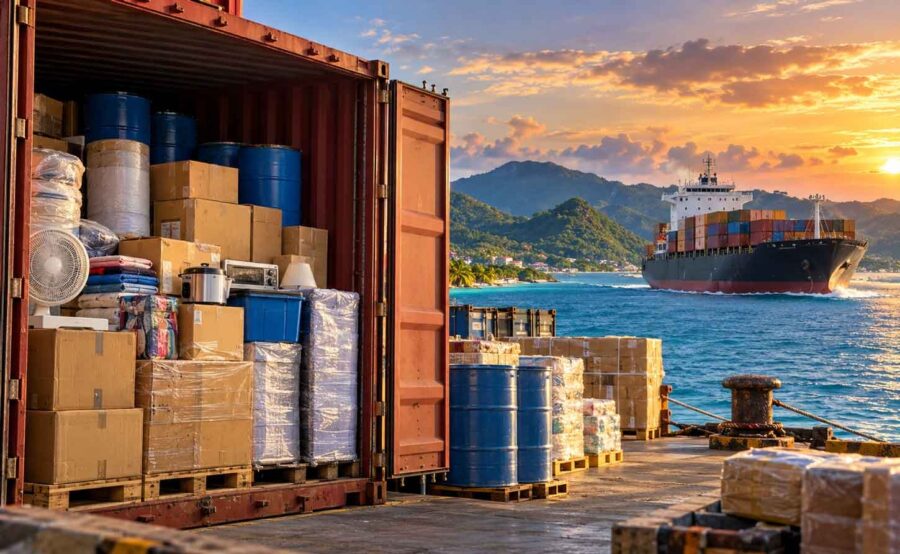
“The vast majority of the 200 containers” leaving South Florida for Haiti every week are not inspected, the UN experts reported in 2024. Guns travel in small batches, some disassembled, inside used household goods, vehicles and machinery. They land at Port-au-Prince, Cap-Haïtien and Port-de-Paix, where more than 120,000 rounds shipped from Florida were seized in July 2022. Others go through the Dominican Republic, where 23 firearms and 36,000 rounds were seized at Haina on 25 February 2025 in a Miami-to-Haiti container whose manifest listed household goods.
Haiti’s own customs barely reaches its ports. “A handful of powerful businesspeople control some ports,” the UN experts found in 2025, and “law enforcement agencies continue to have limited access to most ports of entry.”
A handgun bought for $400–500 at a US outlet can fetch as much as $10,000 in Haiti, UNODC found. In Port-au-Prince an AR-15-type rifle can sell for $4,000–9,000, according to the UN Panel.
Those convicted so far are smugglers, straw buyers and gang bosses. The longest sentence went to Joly Germine, leader of the 400 Mawozo gang: 35 years in 2024 for directing, from a Haitian prison, the purchase of guns from Florida gun shops with money laundered from ransoms. Further up the chain, UNODC points only to “a modest number of companies and private interests with access to ports and transportation logistics,” without naming them.
Haiti is the most violent case, not the only one. Of the guns US authorities traced from Caribbean crimes between 2018 and 2022, GAO data show that 98 per cent of the Bahamas’ were US-sourced, 92 per cent of Barbados’, 89 per cent of Haiti’s, 70 per cent of Jamaica’s and 57 per cent of Trinidad and Tobago’s. Across the Caribbean, UNODC reported, firearms were used in 67 per cent of homicides in 2021 — against 17 per cent in Europe.
The dead are not only gang members. Three-year-old Jace Pinnock was shot dead in Denham Town, Kingston, in February 2026. In Silver Hill, Barbados, 13-year-old Shawnaton Chase was killed in March 2025 — “an innocent child… caught in the crossfire,” Prime Minister Mia Mottley said. In La Horquetta, Trinidad, 16-year-old Ezekiel Moore was killed in February 2026 by a bullet police say was meant for his father.
Murders fell sharply in 2025 in Jamaica, to 673, the lowest in about three decades, and in Trinidad and Tobago, to 361 from 625. But more than 80 per cent of Jamaica’s homicides are committed with guns, Holness has said, and in the Bahamas firearms were used in 64 of last year’s 83 homicides. “The United States right to bear arms cannot translate or mean the right to traffic arms,” Bahamas Prime Minister Philip Davis said in November 2024.
Jamaica also sits on the Haiti route. The UN experts recorded 47 firearms with Haitian National Police markings recovered here, in a trade where a 9mm pistol goes for about 40 lb of cannabis. “Weapons have been coming from the US to Jamaica by way of Haiti,” Prime Minister Andrew Holness said in February 2025.
CARICOM leaders took the problem to US Attorney General Eric Holder in 2013. In 2023 the region’s “War on Guns” declaration called on Washington to “urgently adopt and take action to stop the illegal exportation of firearms and ammunition into the Caribbean.”
When asking failed, some tried the courts. Mexico sued US gun manufacturers, alleging they aided and abetted illegal dealer sales that armed the cartels. In March 2023 at least five Caribbean governments — Antigua and Barbuda, the Bahamas, Belize, Jamaica, and Trinidad and Tobago — joined a brief backing Mexico’s appeal. On 5 June 2025 the US Supreme Court threw the case out, 9–0, ruling that a federal law shielding the gun industry barred it.
Washington has not done nothing. Congress made straw purchasing and gun trafficking federal crimes in 2022; Customs stepped up outbound inspections of cargo to Haiti that year; the Justice Department appointed a coordinator for Caribbean firearms prosecutions in 2023. The US co-drafted the UN sanctions that grew into an arms embargo on Haiti, and prosecutions have continued under the current administration — Casimir’s among them. Ten days after the Supreme Court ruling, Holness, whose government had backed Mexico’s appeal, credited US cooperation and wrote that lasting solutions “will come through collaboration, not litigation.”
But set that effort beside the one running north. The Coast Guard seized more than 511,000 lb of narcotics in 2025, a record. Since 2 September 2025 the US military has struck alleged drug boats 70 to 79 times, according to press tallies as of early October, killing at least 235 people — most of the later strikes in the eastern Pacific — and sent the aircraft carrier USS Gerald R. Ford to US Southern Command.
Southbound, US Customs and Border Protection seized just 535 Caribbean-bound guns at US ports in the years from fiscal 2018 that the GAO reviewed. More than 95 per cent of the UN Panel’s requests to trace guns found in Haiti went to the United States and remained pending. And on 30 September 2025 the Commerce Department scrapped the “high-risk” export category that had covered Jamaica, Trinidad and Tobago, the Bahamas, Belize, the Dominican Republic, Guyana and Suriname, among others.
The UN experts’ verdict on the embargo is blunt: “trafficking networks are able to bring in new materiel on a regular basis.” Stopping them has to start on the Florida docks.
When cocaine moves north, Washington sends an aircraft carrier. When rifles move south, it sends a prosecutor — years later, for a few of them.