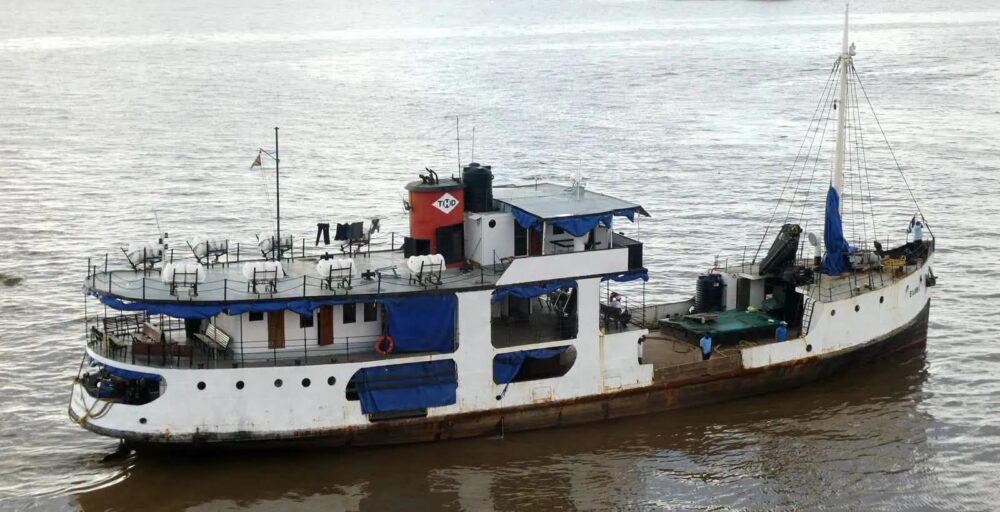
Civil society organisations are escalating pressure on President Irfaan Ali over the MV Barima disaster, demanding the resignation of five senior officials, a new and more inclusive Commission of Inquiry and the immediate withdrawal of 72 murder charges against the vessel’s captain, first mate and goods-loading supervisor.
Representatives of eight civil society organisations and other citizens are scheduled to deliver a joint statement and petition to President Ali at the Office of the President today, September 3, at 2 p.m.
The petition has been endorsed by 165 civil society organisations and individuals in Guyana, the Caribbean and the diaspora.
The groups say the July 18 capsizing and sinking of the MV Barima, which claimed more than 100 lives, was “wholly preventable” and represents one of the worst maritime disasters in Guyana and the Caribbean.
“This disaster exposes deep failures in governance, abuse of State power, weak oversight, lack of accountability, intimidation of dissent and exclusion of civil society.”
The organisations are demanding the immediate resignations of Public Works Minister Juan Edghill; Minister within the Ministry of Public Works Deodat Indar; MARAD Director General Stephen Thomas; Transport and Harbours Department (T&HD) General Manager Yolanda Hughes-Smith; and T&HD Board Chairperson Rosalinda Rasul.
They are also rejecting the Commission of Inquiry established by the President, calling instead for a transparent and representative inquiry that complies with Article 13 of the Constitution on inclusionary democracy. Article 13 – the political objective of the society- mandates the involvement of organisations and citizens in the management and decision making processes of the state that affect their well-being.

According to the petitioners, survivors, bereaved families, Indigenous leaders and organisations, civil society and opposition voices must be meaningfully consulted and included.
They are demanding public and accessible hearings, Creolese and Indigenous-language interpretation, independent press access, an independent COI secretary and comprehensive testimony from survivors and eyewitnesses.
The proposed inquiry should also examine the search, rescue and recovery operations, trauma counselling and long-term support provided to survivors and families, as well as burial arrangements in accordance with family wishes.
The groups are warning against what they describe as a repeat of the shortcomings of the 2023 Mahdia Commission of Inquiry, insisting that riverain and Indigenous communities must have a meaningful voice in the process.
They also want officials who mislead or obstruct the inquiry sanctioned and are calling for free and independent legal representation for survivors and bereaved families.
A major point of contention is the criminal case arising from the disaster.

The organisations condemned the Director of Public Prosecutions’ decision to file 72 murder charges against the captain, first mate and goods-loading supervisor, arguing that the prosecutions could obstruct a proper technical investigation and coroner’s inquest.
“We urge these charges be immediately withdrawn.”
The petitioners insist that the COI cannot substitute for an independent technical marine-safety investigation.
They are demanding a formal investigation under the IMO Casualty Investigation Code, IMO Model Regulations on Domestic Ferry Safety, SOLAS, and Part XVIII of Guyana’s Shipping Act 49:01.
They are also calling for protection of constitutional rights, demanding that the Government cease what they describe as attempts to criminalise citizens and civil society groups for exercising their freedoms of expression, assembly and association.
The delegation comprises representatives of the Amerindian Peoples Association, Guyana Trades Union Congress, Guyanese Organisation of Indigenous Peoples, Oil and Gas Governance Network, Organization for the Victory of the People, Red Thread, Crossroads Women’s Center, Transparency International Guyana and We The People (Gen Z Youth Movement).
The petition represents a direct challenge to the Government’s handling of the MV Barima tragedy, with the groups demanding that accountability extend beyond the vessel’s crew to the government agencies and officials responsible for maritime oversight, regulation and public safety.