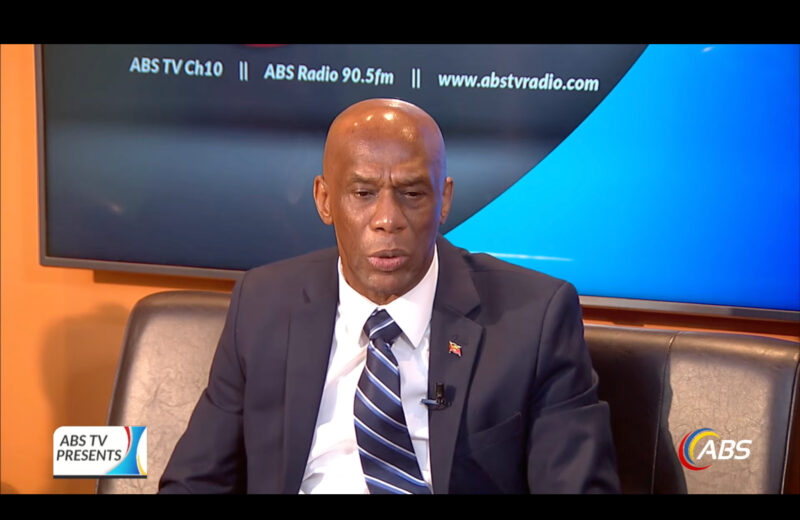
Director of Education Clare Browne says he has mixed feelings about CXC’s decision to remove school-based assessments from several subjects beginning in 2028, arguing that the move could address academic misconduct but also force students to depend more heavily on high-pressure, one-off examinations.
Browne acknowledged concerns about students misusing artificial intelligence and paying other people to complete their SBAs. However, he said properly supervised assessments remain valuable because they measure students’ performance over time.
“I kind of have mixed feelings about CXC removing the SBA component from the examination,” Browne said during an ABS Presents discussion on Antigua and Barbuda’s preliminary 2026 CXC results.
CXC Local Registrar Maritza West said the council has introduced an artificial intelligence framework as it responds to concerns about the integrity of SBAs across the region.
Schools will be allowed to decide whether to retain the affected assessments in 2027 before their planned removal in 2028. SBAs will remain in practical subjects, including the single sciences, Industrial Technology and Home Economics.
Browne said the planned change appears to conflict with efforts to reduce students’ dependence on a single final examination.
“Here it is that we are saying, OK, we want to measure what students do and what they can do over a period of time, rather than depending on this frightening — as we mentioned earlier — this frightening one-off examination,” he said.
“And now we seem to be in retreat, where we’re going back now to doing a one-off kind of examination. So I have — I really have mixed feelings about it.”
Browne said misconduct involving SBAs did not begin with the introduction of artificial intelligence. He disclosed that some people have reportedly been paid to complete projects on behalf of students.
“It’s not solely about AI. Let’s face facts,” Browne said.
“There are parents — well, I’m not knocking parents. Let me not say it that way. Let me say it this way, and I come before the nation tonight and I’m talking honestly and broadly and plain. There are people who have been buying — paying other people to do students’ SBAs as well.”
He said both AI-generated work and assignments completed by third parties undermine the purpose of school-based assessment because the finished product does not reflect the student’s own knowledge or ability.
Browne maintained, however, that the problem could be addressed through closer classroom supervision instead of removing SBAs entirely.
“If SBAs were done in the way they were supposed to be done — in classrooms, monitored by teachers — and so you’re doing it as class projects and you can see the progress and so on, then we wouldn’t be here,” he said.
His comments came after West confirmed that Antigua and Barbuda recorded no official AI-related irregularities during the 2026 CXC examination cycle.
One student attempted to use artificial intelligence while preparing an SBA but voluntarily disclosed it. The student was required to redo the assignment before its submission, preventing the matter from becoming an official infraction.
West said officials had shared CXC’s AI framework with principals, teachers and students. Candidates were required to disclose whether they used artificial intelligence and indicate the extent to which it contributed to their work.
Browne stressed that artificial intelligence itself should not be treated as the problem, describing it as an important technological tool.
“The issue is not about the use of AI because AI is an important technological tool,” he said. “It is the misuse of AI.”
He said misuse occurs when a student enters a few instructions into an AI platform and submits the resulting material without producing the work independently.
“You’re presenting information that you did not produce,” Browne said. “You had nothing — you put nothing in there basically, except keying a few things in an AI programme, on an AI platform, and then you get the results.”
Rather than attempting to exclude AI from education, Browne said schools must teach students how to use it ethically and responsibly.
“What I think needs to happen is that we need to put — because AI and other things are here to stay — those technological tools are going nowhere,” he said.
“We have to exist in a world where those technological tools are used as they should be used.”
Browne said schools are responsible for preparing students for life beyond the classroom, where artificial intelligence and other emerging technologies will remain widely available.
“Schools are microcosms of society. Schools are places where we are to be training young people for life,” he said.
“And so we have to, within our education system, train young people to use AI responsibly. That is where I think we need to go.”
Antigua Newsroom