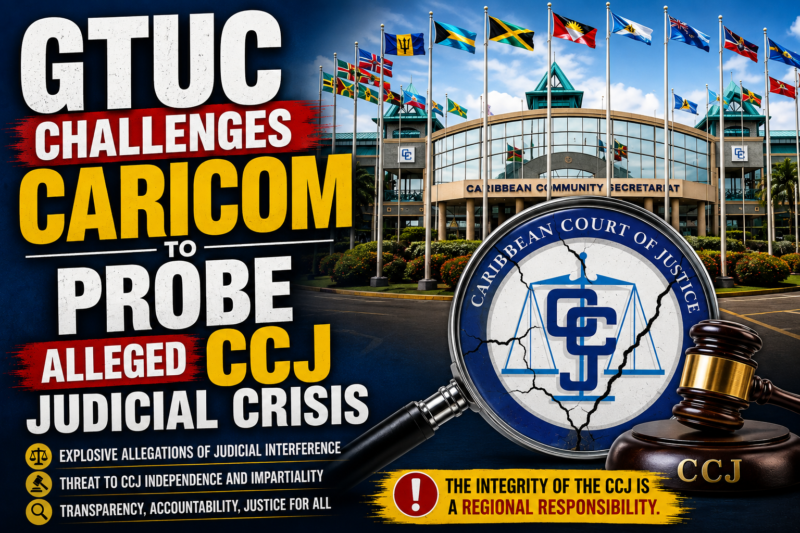
By Mark DaCosta- The Guyana Trades Union Congress (GTUC) has formally voiced its alarm regarding an escalating crisis within the Caribbean Court of Justice (CCJ). In a letter dated August 12, 2026, the GTUC reached out to key regional officials, including Dr. Carla Barnett, the Secretary-General of CARICOM, Hon. Philip J. Pierre, the Chairman of the Conference of Heads of Government, and the members of the Regional Judicial and Legal Services Commission (RJLSC). The letter calls for a thorough internal investigation following reports about disunity among the judges of the CCJ, as revealed in recent media leaks.
The heart of the correspondence from the GTUC expresses deep apprehension about the integrity of the CCJ, particularly in light of allegations that have surfaced about its leadership. Specifically, it mentions that five of the six judges have raised significant concerns about the management style of Justice Winston Anderson, the President of the Court. Allegations mentioned in the document include claims of authoritarian governance and attempts to sway judicial outcomes, which if verified, would shake the very foundation of the court’s establishment as a bastion of justice within the region.

The publication of these allegations first occurred in the Trinidad Express on August 9, prompting the GTUC’s call for action. “The GTUC is particularly concerned about reports surrounding D’Almada v Trinidad and Tobago,” the letter states, stressing conflicts arising from alleged removal of a judge from a panel due to disagreements with the Court President on legal interpretations. Such revelations pose a critical threat to the perception of judicial independence.
Acknowledging the CCJ’s public affirmation of the Court’s autonomy and integrity following the leaks, the GTUC maintains that the seriousness of these matters warrants an objective scrutiny. The organisation recognises the risk of public misunderstanding of the context surrounding the allegations. Despite this, the GTUC believes that transparency and accountability are paramount to restoring faith in the CCJ’s operations.
It is noteworthy, states the GTUC, that while CARICOM encompasses 15 full member states and a further eight associate members, only a scant five have designated the CCJ as their final court of appeal. This reality imposes a unique responsibility on the institution to safeguard its reputation, as it is crucial for fostering confidence among those nations yet to accept its jurisdiction. The GTUC’s letter underlines that “confidence in the CCJ’s independence and impartiality must be fundamental” and highlights the vital regional implications surrounding this issue.
The allegations contained in the leaked correspondence are deeply troubling, the letter notes, particularly in relation to politically sensitive cases, as illustrated by the handling of the extradition proceedings involving prominent figures such as Azruddin Mohamed and his father. Although the GTUC does not imply that the decisions made in those cases were flawed, it underscores the necessity for maintaining the appearance of impartiality in all judicial dealings, especially when scrutinised under political lenses.
In light of these concerns, the GTUC articulates specific requests to the RJLSC and CARICOM leadership which include initiating an inquiry into the allegations, reassessing the processes around judicial panel assignments, and evaluating whether existing safeguards can effectively shield judicial proceedings from administrative and political influences. More significantly, the union urges the public release of the investigation’s findings, provided they comply with judicial confidentiality protocols.
“The GTUC makes this request in defence of the CCJ, not against it,” the letter asserts, emphasising the Court’s importance as a reflection of Caribbean unity and sovereignty. The fears expressed by the GTUC resonate with broader anxieties surrounding the judiciary’s role in upholding democratic tenets within our nation and the Caribbean at large. It implores that protecting the integrity of the CCJ is a regional responsibility, necessitating collective vigilance and action.
As regional leaders deliberate on the response to these unsettling allegations, the GTUC’s statement serves as a reminder of the importance of judicial independence and integrity. Public confidence in the CCJ is of utmost significance, and the oversight of its operations must be subject to rigorous scrutiny to ensure that all judges operate free from interference and undue influence.
The GTUC’s intervention may be seen as reflecting a profound commitment to the democratic principles that underpin our society. As the facts surrounding the CCJ’s internal issues continue to unfold, it is imperative that all parties involved act promptly and transparently to preserve the confidence and trust that the judiciary demands for the equitable administration of justice across our region.