by Randy Gopaul
To the boards, shareholders, and institutional investors eyeing Guyana’s oil-soaked horizon: Stop. Turn back. What you see glittering on the surface of this small South American nation is not gold—it is the toxic algae bloom of a development model rotting from the inside out.
We warned you. Now we are formalizing that warning in print. If you choose to ignore it and place your shareholders’ capital in this jurisdiction, you do so with your eyes wide open to the systemic risks. When your investment fails—not if, but when, your investors will have every right to sue you for irresponsible fiduciary negligence.
The world has been sold a narrative of Guyana as the next great frontier, the “Saudi Arabia of the Caribbean.” Yet, a sober look at the data reveals an economy already showing signs of sickly dependency. After the initial oil-driven surge, foreign direct investment (FDI) plummeted by a staggering 62% in 2023 following a 234% decline in 2022 . The capital flight has begun, but the hype machine keeps whirring, desperate to attract new marks.
The Gas-to-Energy Fiasco: A Case Study in Mismanagement
If you need a masterclass in how not to run a major infrastructure project, look no further than the Wales Gas-to-Energy project. Touted as the transformative solution to Guyana’s energy woes, it has become a bottomless pit of public funds and a monument to government incompetence .
– Cost Overruns: What started as a flagship initiative has ballooned to an estimated US$2 billion, far exceeding initial projections .
– Delays: Deadlines have been missed with alarming consistency. The project’s timeline has been pushed back so often that even the government’s revised 2026 target is viewed with deep skepticism . As APNU MP Sharma Solomon aptly stated, “Guyanese are asked to celebrate announcements, re-announcements, and revised deadlines, while the bill grows and the promised benefits remain just over the horizon” .
– Dubious Contractors: The government awarded a US$759 million contract to Lindsayca-CH4, a company with a “checkered” history and a track record so concerning it should have disqualified them from the start. The result? The government was forced to pay US$82 million in an arbitration award to this very company, and reports now suggest another US$180 million may be needed to salvage its portion of the work.
– Extravagance & Secrecy: As costs spiral, reports have emerged of the contractor using project funds to fly weekly to the United States on private luxury jets at a cost of US$70,000 per week. This is not development; it is institutionalized looting .
This project is a microcosm of the broader governance crisis: grand promises, gross mismanagement, and a total disregard for the rule of law and fiduciary duty.
A Systemically Corrupt Environment
A favorable investment climate requires a robust, independent regulatory framework. Guyana, under the current administration, has neither. The systemic erosion of institutional integrity is a feature, not a bug.
A Captured Integrity Commission
The Integrity Commission, tasked with fighting corruption, has been rendered a “ghost agency.” In a brazen display of executive overreach, President Irfaan Ali unilaterally “accepted an explanation” on behalf of a minister regarding foreign assets, effectively bypassing the Commission’s mandate . As one letter to the editor powerfully put it, the Commission is now a “camouflage” for corruption, serving to “satisfy international donors” while the administration empties the vault . If the President can act as “the final investigator and the ultimate judge of its own conduct,” what protection do you, as an investor, have against arbitrary decisions and asset seizure?
Bypassing Investment Protocols:
The government is openly flouting its own investment laws. The Guyana Office for Investment (GO-Invest), the legally mandated agency for vetting FDI, was reportedly excluded from negotiations concerning a massive Brazilian agricultural development. This “opaque parallel process” effectively nullifies the country’s investment control framework, leaving decisions in the hands of political brokers rather than technical due diligence . This sets a chilling precedent: contracts are awarded based on political favor, not merit .
A Brutal and Uncaring Regime for Workers
While you as an investor might think this doesn’t affect your bottom line, think again. A stable and productive workforce is essential. Yet, the regime in Georgetown has shown its true colors through a callous disregard for basic labor rights.
Worker Exploitation:
The Guyana Agricultural and General Workers Union (GAWU) has exposed widespread abuses by recruitment agencies in the oil and gas sector, where workers are forced to pay for their own safety equipment and are subjected to exploitative contracts . This is not a one-off incident; it is a systemic failure to enforce labor laws, leaving workers vulnerable and productivity at risk.
A Climate of Impunity:
The transition to an oil economy is exacerbating pre-existing vulnerabilities, with experts warning of increased risks of human trafficking and labor exploitation, particularly in extractive industries . This is a society where the powerful are unaccountable, and the weak are left to fend for themselves.
A Final Warning to the Boardroom
This is not a political diatribe; it is a risk assessment. The government that is supposed to be your partner is the same government that is dismantling the institutions meant to ensure predictability and fairness. It is a regime that:
1. Breaks Its Own Laws on land leases, procurement, and investment vetting.
2. Mismanages Mega-Projects, turning them into vehicles for cronyism and cost overruns.
3. Sidelines Constitutional Bodies, rendering watchdogs toothless.
4. Exploits Its Workers, creating an unstable and disgruntled labor force.
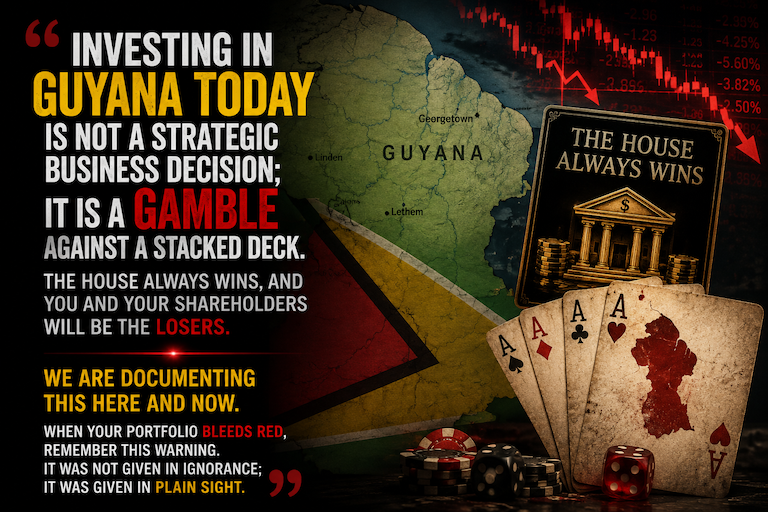
Investing in Guyana today is not a strategic business decision; it is a gamble against a stacked deck. The house always wins, and you and your shareholders will be the losers. We are documenting this here and now. When your portfolio bleeds red, remember this warning. It was not given in ignorance; it was given in plain sight.
Do your due diligence. Read the reports. And then, for the sake of your shareholders, walk away.