The Government’s claim that it is not competing with private bottled water distributors is increasingly difficult to sustain, as its expanding role in the sector places it squarely in direct—and inherently uneven—competition with established private suppliers.
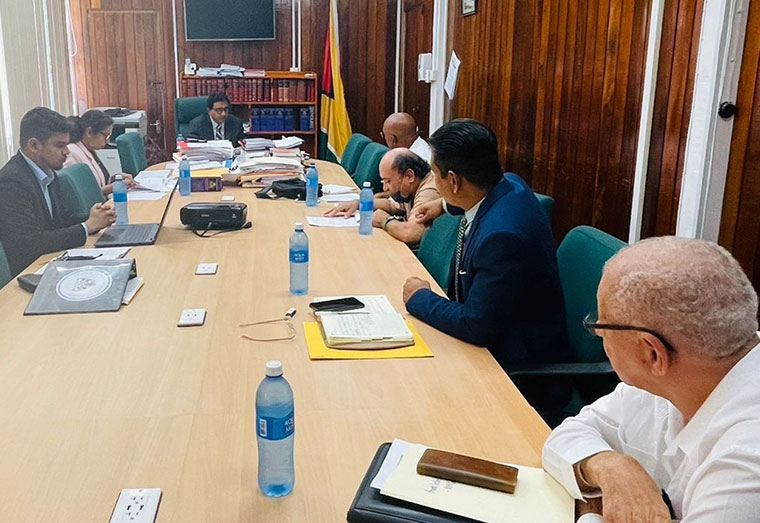
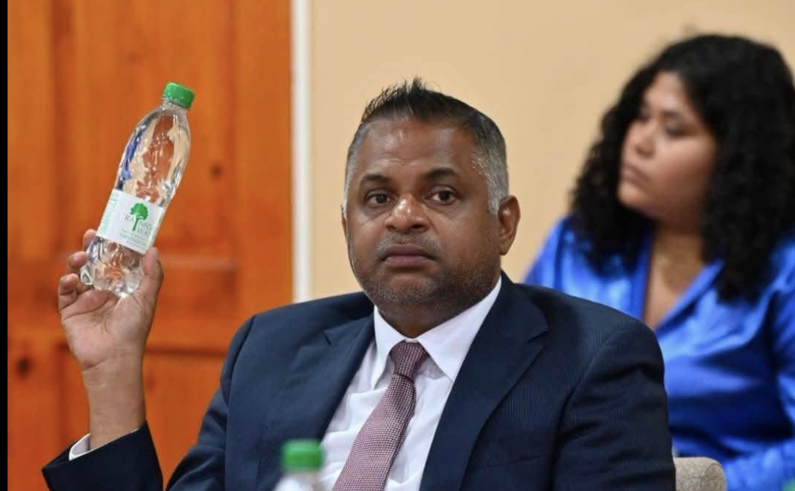
On Friday, Minister of Public Utilities and Aviation, Deodat Indar, met with the Private Sector Commission (PSC) and major industry players—including Banks DIH, Demerara Distillers Limited (DDL), Aquafina, and other manufacturers—seeking to calm growing concern. “We are not producing water to compete with you,” Indar said.
But even as that assurance was offered, the Government was moving in the opposite direction.
The same day, Guyana Water Incorporated (GWI), a state-owned entity, commissioned a new water bottle refilling station in Port Mourant. The facility is designed to supply treated drinking water at lower cost, explicitly reducing reliance on what are described as “costlier alternatives”—the very services provided by private companies. By any standard definition, this is competition.
Competition occurs when multiple providers offer the same or similar goods to the same consumers, influencing price, access, and demand. Through GWI, the Government is now supplying bottled water, targeting households, and positioning itself as a cheaper option within the same market space occupied by private distributors. However, this is not competition on equal terms.

Private companies operate under strict commercial pressures—covering production costs, paying taxes, maintaining distribution networks, and generating profit to survive. The Government, by contrast, enters the market backed by public funding, state infrastructure, and regulatory authority. This allows it to absorb costs, subsidize operations, and set prices at levels private operators cannot realistically match. That imbalance is where the issue of unfairness becomes unavoidable.
GWI’s refilling stations mirror the core function of bottled water businesses—delivering safe, treated water in a convenient form. But when the State uses public resources to undercut market prices, it distorts the competitive environment. Private operators are not just competing with another supplier; they are competing with the State itself—an entity that writes the rules while simultaneously playing the game. This raises a fundamental policy contradiction.
While the Government assures the private sector it is not competing, its actions—expanding infrastructure, supplying an identical product, and positioning itself as a low-cost alternative—demonstrate clear market participation. Stakeholders, including representatives from the Georgetown Chamber of Commerce and the Guyana Manufacturing and Services Association, are left questioning where regulation ends and direct competition begins.
There is no dispute that access to clean, affordable water is essential. But the method being used carries long-term consequences. When the State enters an established market without clear safeguards, it risks crowding out private investment, discouraging innovation, and weakening an industry that has already built capacity to meet demand.
With GWI expanding its footprint, the implications extend across the sector. Pricing structures, consumer behaviour, and investor confidence are all being reshaped by a competitor that does not operate under market constraints. And whether acknowledged or not it is state-backed competition, and it is fundamentally uneven.