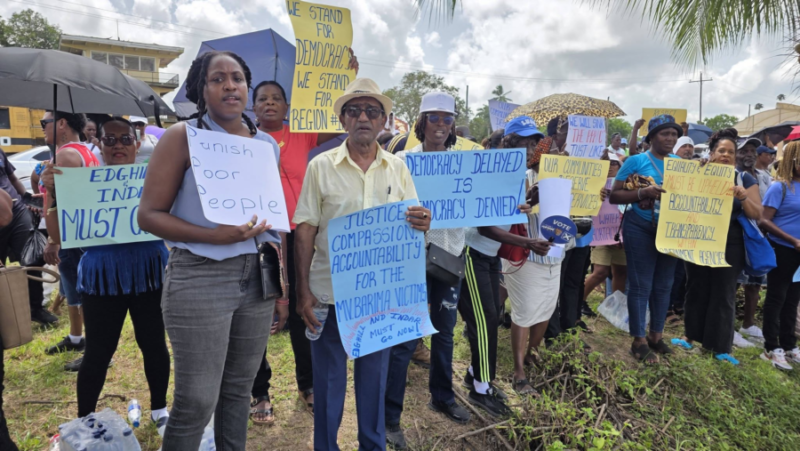
A wave of protests has followed President Irfaan Ali and senior government officials across Guyana this week, stretching from Region One to Linden, Melanie, Essequibo Coast, and outside the Office of the President, as national grief over the MV Barima disaster hardens into organised, nationwide resistance.
What began as outrage over the sinking of the Barima has now evolved into a broad-based national movement, bringing together joint opposition forces inside and outside Parliament, civil society groups, trade unions, and ordinary citizens demanding accountability and a fundamentally different standard of governance.
The protests reflect an early warning from Opposition Leader Azruddin Mohamed, who, in the immediate aftermath of the tragedy, declared that nationwide demonstrations would follow if those responsible were not held accountable. That warning has now materialised across multiple regions with striking coordination.
Barima Tragedy: Catalyst for National Outrage
The sinking of the MV Barima on July 18—an 87-year-old vessel serving the North West District—left dozens dead and devastated families, particularly in Region One (Barima-Waini), a region largely populated by Amerindian communities who depend on river and maritime transport.
The disaster has triggered serious questions about seaworthiness, regulatory oversight and ministerial responsibility, placing Minister of Public Works Juan Edghill and Minister within the Ministry Deodat Indar at the centre of public scrutiny. Across protests, calls for their resignation have been consistent and unrelenting.
Region One: Defiance in the Hinterland
On Wednesday, as President Ali departed Region One in his convoy, residents stood firm in protest, chanting “Amerindian Lives Matter,” “First People’s Lives Matter,” “No Peace, No Justice,” and “PPP is a dictator.”
The demonstration underscored the depth of anger in a region directly impacted by the tragedy.
Mohamed, who attempted to visit the area, was prevented from doing so, further fuelling tensions.
Linden: Ten-Hour Standoff
On Tuesday, Linden (Region 10) became the epicentre of confrontation in what has been described as a ten-hour standoff between government officials inside Watooka House and demonstrators outside.
Protesters maintained pressure throughout the day, refusing to disperse and issuing clear demands:
- The resignation of Ministers Juan Edghill and Deodat Indar
- The election of a Region 10 Chairman and Vice Chairman, positions unresolved since the September 1, 2025 elections
- Immediate relief for residents who reported being without water and electricity for days
The sustained nature of the protest signalled a decisive shift—from isolated demonstrations to prolonged, organised resistance.
Office of the President: APA
Melanie East Coast Demerara: Exclusion Sparks Backlash
In a separate action, activist Melanie also protested on Wednesday, calling for the release of Captain Kevin Price, who has been charged with murder in connection with the MV Barima tragedy, underscoring growing public unease over the legal response to the sinking. Price was charged along side Chief Mate Rondell Dwayne Roberts, 42, of Grove Public Road, East Bank Demerara; and Goods Superintendent Delon Granderson, 33, of Fellowship, West Coast Demerara, with the common law offence of murder.
On the East Coast Demerara (Region Four), protests extended to Melanie, while tensions escalated in Buxton/Foulis on Thursday, when elected NDC Chairman and Councillors were blocked from attending a meeting with President Ali, despite being invited. The move intensified concerns about exclusion and disregard for local democratic authority.
Essequibo: Economic Grievances Erupt
On Friday, truckers on the Essequibo Coast (Region Two) staged protests at the Supenaam Stelling, objecting to sudden restrictions on ferry weight and cargo. They argued that larger operators continued to benefit from preferential access, placing smaller operators at a disadvantage. Protesters said they were awaiting a response from authorities.
Fishermen and market vendors along the Essequibo Coast staged a protest, voicing deep concern over the sharp decline in fish sales in the weeks following the MV Barima tragedy. The downturn comes after the July 18 sinking of the vessel, which resulted in the deaths of at least 73 people, with approximately 30 others still missing and presumed dead.
Berbice: Parliamentary Opposition Collaborate
Georgetown: Silent Protest, Loud Message
Also on Friday, University of Guyana students led a silent protest outside the Office of the President, joined by members of the public, pressing for accountability in the MV Barima tragedy and demanding the resignation of Ministers Juan Edghill and Deodat Indar, underscoring that the call for justice has broadened into a unified, national demand.
A Movement Takes Shape
From hinterland villages to urban centres, the protests have taken on a distinct national character—uniting political actors, organised groups and independent citizens under a common demand: accountable governance and a better Guyana.
The demonstrations are no longer confined to a single issue. They represent a convergence of grievances—the Barima tragedy, unresolved local governance issues, failing public services, economic inequality, and the widening gap between oil wealth and everyday life.
Communities continue to face unreliable electricity, inadequate healthcare, transportation challenges, unemployment and housing pressures, even as Guyana’s oil production and revenues surge.
Yet, even as protests follow the President’s movements across regions, government engagements have continued with little visible adjustment.
The result is a country now defined by two parallel realities—one in the streets, where citizens are mobilising with increasing intensity, and one in official corridors, where governance proceeds largely unchanged.
What began as mourning has become a movement.
And across Guyana, it is no longer a question of whether the protests will continue—but how far they will go.