Saturday, August 29, 2026
Village Voice News
ADVERTISEMENT
  • Home
  • News
  • Sports
  • Editorial
  • Letters
  • Global
  • Columns
    • Eye On Guyana
    • Hindsight
    • Lincoln Lewis Speaks
    • Future Notes
    • Blackout
    • From The Desk of Roysdale Forde SC
    • Diplomatic Speak
    • Mark’s Take
    • In the village
    • Mind Your Business
    • Bad & Bold
    • The Voice of Labour
    • The Herbal Section
    • Politics 101 with Dr. David Hinds
    • Talking Dollars & Making Sense
    • Book Review 
  • Education & Technology
  • E-Paper
  • Contact Us
No Result
View All Result
  • Home
  • News
  • Sports
  • Editorial
  • Letters
  • Global
  • Columns
    • Eye On Guyana
    • Hindsight
    • Lincoln Lewis Speaks
    • Future Notes
    • Blackout
    • From The Desk of Roysdale Forde SC
    • Diplomatic Speak
    • Mark’s Take
    • In the village
    • Mind Your Business
    • Bad & Bold
    • The Voice of Labour
    • The Herbal Section
    • Politics 101 with Dr. David Hinds
    • Talking Dollars & Making Sense
    • Book Review 
  • Education & Technology
  • E-Paper
  • Contact Us
No Result
View All Result
Village Voice News
No Result
View All Result
Home News

Government’s Bottled Water Push Puts It in Direct Competition with Private Suppliers

Admin by Admin
August 8, 2026
in News
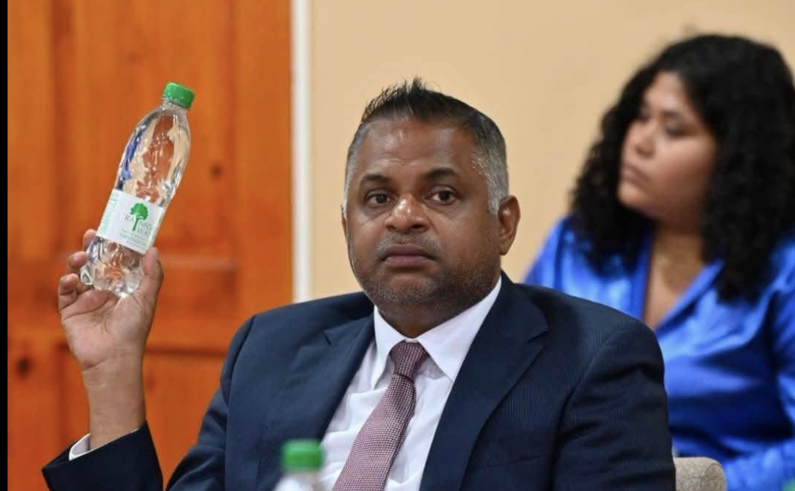
Minister of Public Utilities, Deodat Indar,

Minister of Public Utilities, Deodat Indar,

0
SHARES
0
VIEWS
Share on FacebookShare on Twitter

The Government’s claim that it is not competing with private bottled water distributors is increasingly difficult to sustain, as its expanding role in the sector places it squarely in direct—and inherently uneven—competition with established private suppliers.

On Friday, Minister of Public Utilities and Aviation, Deodat Indar, met with the Private Sector Commission (PSC) and major industry players—including Banks DIH, Demerara Distillers Limited (DDL), Aquafina, and other manufacturers—seeking to calm growing concern. “We are not producing water to compete with you,” Indar said.

READ ALSO

They Bought the Land: How Freed Africans Turned Emancipation Into Economic Freedom in Essequibo

15 Days, No Answers: Mahipaul Turns Up Heat on MV Barima Salvage

But even as that assurance was offered, the Government was moving in the opposite direction.

The same day, Guyana Water Incorporated (GWI), a state-owned entity, commissioned a new water bottle refilling station in Port Mourant. The facility is designed to supply treated drinking water at lower cost, explicitly reducing reliance on what are described as “costlier alternatives”—the very services provided by private companies. By any standard definition, this is competition.

Competition occurs when multiple providers offer the same or similar goods to the same consumers, influencing price, access, and demand. Through GWI, the Government is now supplying bottled water, targeting households, and positioning itself as a cheaper option within the same market space occupied by private distributors. However, this is not competition on equal terms.
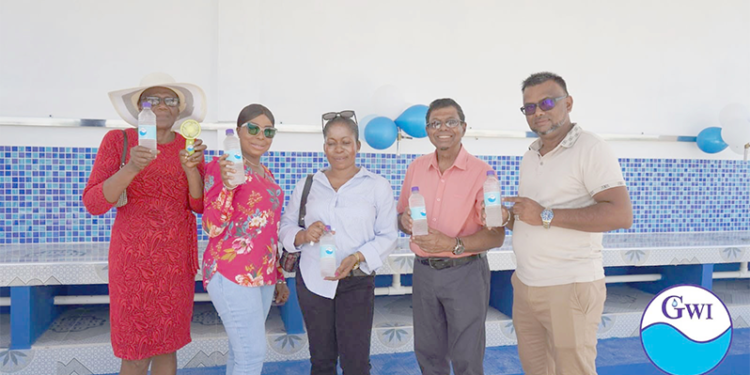
GWI Bottled Water

Private companies operate under strict commercial pressures—covering production costs, paying taxes, maintaining distribution networks, and generating profit to survive. The Government, by contrast, enters the market backed by public funding, state infrastructure, and regulatory authority. This allows it to absorb costs, subsidize operations, and set prices at levels private operators cannot realistically match. That imbalance is where the issue of unfairness becomes unavoidable.

GWI’s refilling stations mirror the core function of bottled water businesses—delivering safe, treated water in a convenient form. But when the State uses public resources to undercut market prices, it distorts the competitive environment. Private operators are not just competing with another supplier; they are competing with the State itself—an entity that writes the rules while simultaneously playing the game. This raises a fundamental policy contradiction.

While the Government assures the private sector it is not competing, its actions—expanding infrastructure, supplying an identical product, and positioning itself as a low-cost alternative—demonstrate clear market participation. Stakeholders, including representatives from the Georgetown Chamber of Commerce and the Guyana Manufacturing and Services Association, are left questioning where regulation ends and direct competition begins.

There is no dispute that access to clean, affordable water is essential. But the method being used carries long-term consequences. When the State enters an established market without clear safeguards, it risks crowding out private investment, discouraging innovation, and weakening an industry that has already built capacity to meet demand.

With GWI expanding its footprint, the implications extend across the sector. Pricing structures, consumer behaviour, and investor confidence are all being reshaped by a competitor that does not operate under market constraints. And whether acknowledged or not it is state-backed competition, and it is fundamentally uneven.


ShareTweetSendShareSend

Related Posts

St. Bartholomew’s Anglican Church was constructed in 1849s, which was originally a coffee logie before it became a place of worship. It was Christened on September 25, 1841 by Queen Victoria (GT photo)
Feature

They Bought the Land: How Freed Africans Turned Emancipation Into Economic Freedom in Essequibo

by Admin
August 29, 2026

When slavery formally ended in British Guiana, freedom did not immediately mean independence. The Emancipation Act took effect in 1834,...

Read moreDetails
87-year-old MV Barima
News

15 Days, No Answers: Mahipaul Turns Up Heat on MV Barima Salvage

by Admin
August 29, 2026

Fifteen days after the Government closed its call for Expressions of Interest from companies seeking to salvage the sunken MV...

Read moreDetails
Inside of Guyana's 65-seat National Assembly
Feature

Four Sittings in 299 Days: Guyana’s 13th Parliament Faces Questions Over Legislative Scrutiny

by Admin
August 29, 2026

Guyana’s 13th Parliament has held just four recorded sittings in its first 299 days, a sharp departure from the pace...

Read moreDetails
Next Post
Joint Opposition Protest in Region 10, August 4, 2026

Protests Trail President as Barima Tragedy Sparks Nationwide Resistance


EDITOR'S PICK

Pope Francis (AP Photo/Andrew Medichini, File)

Pope Francis calls for global ban on surrogacy

January 17, 2024

August 1, 2020
Dr. Mark Devonish

That day will come 

February 5, 2023
His Excellency Mohamed Irfaan Ali and Her Excellency Jennifer Geerlings-Simons

Joint statement from the President of the Co-operative Republic of Guyana and the Republic of Suriname

September 14, 2025

© 2024 Village Voice

No Result
View All Result
  • Home
  • News
  • Sports
  • Editorial
  • Letters
  • Global
  • Columns
    • Eye On Guyana
    • Hindsight
    • Lincoln Lewis Speaks
    • Future Notes
    • Blackout
    • From The Desk of Roysdale Forde SC
    • Diplomatic Speak
    • Mark’s Take
    • In the village
    • Mind Your Business
    • Bad & Bold
    • The Voice of Labour
    • The Herbal Section
    • Politics 101 with Dr. David Hinds
    • Talking Dollars & Making Sense
    • Book Review 
  • Education & Technology
  • E-Paper
  • Contact Us

© 2024 Village Voice