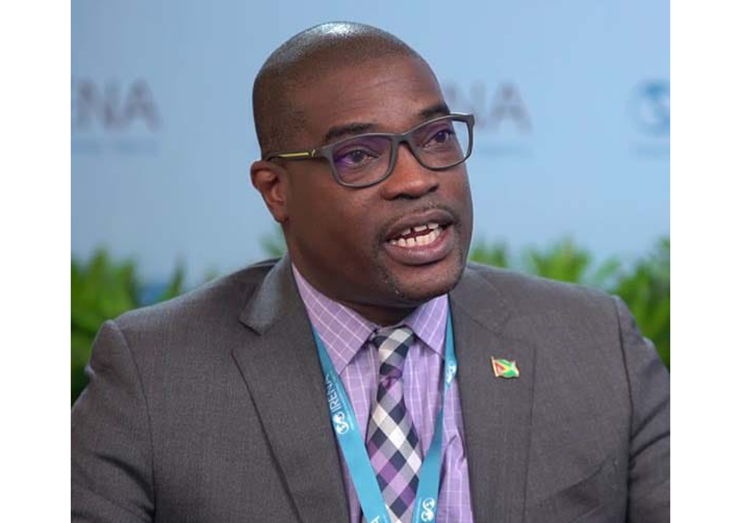
A dispute over Cuba has provided former PPP minister and political scientist Dr. Henry Jeffrey with the backdrop for a sweeping critique of the People’s Progressive Party/Civic, its approach to governance and what he views as the erosion of the democratic and diplomatic principles that once defined the party’s political identity.
In a sharply worded Future Notes column published on June 7 under the headline “What a Shame,“ Jeffrey questioned the government’s recent stance on Cuba amid reports that Guyana supported a hemispheric declaration which critics say could be interpreted as endorsing external pressure on Havana over democracy and governance issues.
The controversy stems from a recent declaration adopted at the General Assembly of the Organisation of American States (OAS), which reaffirmed representative democracy as a prerequisite for participation in the inter-American system and condemned threats to democratic governance. While the declaration did not specifically target Cuba, analysts argued that its language aligned with longstanding United States efforts to isolate the communist-led Caribbean nation.
The PPP government subsequently found itself facing criticism from sections of its own support base, trade unionists, left-leaning activists and regional commentators who questioned why a party with deep historical ties to Cuba would support a position perceived as strengthening pressure on Havana.
Jeffrey was among the most vocal critics. “Individual and collective moral and political wisdom is not plentiful in the People’s Progressive Party (PPP), or, for that matter, in contemporary Guyana,” he wrote.
“Here we have a party that in its darkest hour could have depended on Cuba; that for decades has been unjustifiably obstructing the proper development of democracy in Guyana and in conflict with international law supporting the imposition of democracy in Cuba by the unilateral use of force!“
“What a shame!” he added.
Cuba’s Lifeline to the PPP
Jeffrey’s criticism was rooted not only in ideology but in history.
For decades, Cuba maintained close ties with the PPP and provided political, diplomatic, educational and material support to Guyana. The relationship dates back to the early years of the Cuban Revolution and intensified during the administration of Dr. Cheddi Jagan.
Jeffrey recalled Cuba’s assistance during the 1963 general strike, one of the most dest periods in Guyana’s political history.
Quoting from Jagan’s The West on Trial, he noted:
“Without their help of nearly $100,000 per week for strike relief, the strike would have collapsed in a couple of weeks. And without the help of the Cuban government, which supplied us with kerosene and gasoline, we would have been forced out of office.”
According to Jeffrey, the PPP’s current position is therefore difficult to reconcile with its own historical experience.
Small States and American Power
While acknowledging that Guyana must be mindful of United States foreign policy, Jeffrey argued that the government has mishandled that reality.
“No one in their right mind would argue that the PPP should not be very mindful of the internal and external political positions taken by the United States government,” he wrote.
He noted that Guyana’s relationship with Washington has long influenced its foreign policy calculations. During the Cold War, the United States supported the rise of Forbes Burnham’s People’s National Congress (PNC) government, which took office in 1964 and led Guyana into Independence in 1966.
Jeffrey cited political economist Dr. Tyrone Ferguson’s work, which argued that even when the PNC adopted positions contrary to Washington’s preferences, it carefully assessed the likely reaction of the United States before acting.
One example was Guyana’s decision in 1972, alongside Jamaica, Trinidad and Tobago and Barbados, to establish diplomatic relations with Cuba despite American opposition.
A Self-Inflicted Diplomatic Weakness?
Jeffrey’s central argument, however, is that the PPP has weakened its own international position through its domestic conduct.
He contends that Guyana’s foreign policy vulnerabilities are a reflection of unresolved internal political divisions and what he describes as the PPP’s preference for ethnic dominance over political inclusion.
“The PPP has become extremely vulnerable in the international arena because its backwards internal autocratic behaviour has left it trapped in a racial ethnic context that it has historically sought to exploit rather than resolve,” he wrote.
“This has led to its mindlessly burning important strategic bridges and thus destroying available options.”
Jeffrey linked this directly to the administration of former U.S. President Joe Biden.
He argued that the Biden administration viewed Guyana through the lens of democratic governance and repeatedly encouraged the PPP to become more inclusive, reduce corruption and improve governance practices.
According to Jeffrey, the PPP responded by aligning itself politically with the Republican Party during the 2024 U.S. presidential election campaign, a move he believes damaged Guyana’s long-term diplomatic flexibility.
“Determined upon ethnic dominance, the PPP did not take kindly to such prodding and so encouraged its internal and external cadres to support the Republican Party,” he claimed.
Jeffrey referenced a large billboard erected in Georgetown following Donald Trump’s election victory, congratulating the incoming U.S. President before being removed days later.
Drawing on a recent Foreign Affairs article, Jeffrey argued that small states maximize their influence by maintaining relationships across the American political spectrum rather than tying themselves to one side.
“By hubristically becoming directly involved in U.S. partisan politics, the PPP has quite unnecessarily entrenched itself on one side and thus has seriously undermined its and Guyana’s capacity to ‘play’,” he wrote.
Cuba, Democracy and the Rule of Law
Despite defending Cuba against external pressure, Jeffrey did not argue that the island’s political system should remain unchanged.
“There is no doubt that something needs to be done to address the longstanding issue of autocracy/democracy in Cuba,” he wrote.
“But it should be done within the international rule-based system and not by the use or threat of force and war.“
He warned that geopolitical pressures on Cuba could intensify as U.S. midterm elections approach, particularly given the importance of Florida’s Cuban-American vote to Republican electoral prospects.
Governance at Home
Jeffrey ultimately used the Cuba controversy to revisit a theme that has dominated much of his recent writing: the need for political reform in Guyana.
Contrasting the leadership styles of former Presidents Cheddi Jagan and Janet Jagan, he suggested that Guyana’s current governance model remains excessively centralised and insufficiently inclusive.
He recalled Cheddi Jagan’s willingness during a public service dispute in the early 1990s to open government records to trade unions after they challenged the administration’s claim that wage increases were unaffordable.
“Give them the books,” Jagan famously instructed, according to Jeffrey.
For the former minister, that episode represented a fundamentally different approach to governance from what exists today.
More broadly, Jeffrey argued that Guyana’s immense oil wealth cannot compensate for deep political and social divisions.
“The existence of huge financial resources does not help one to optimally manage a country with the level of socio/political alienation that exists in Guyana,” he wrote.
The Cuba dispute, in Jeffrey’s view, is therefore about much more than foreign policy. It is another symptom of a larger problem: a governing philosophy that he believes prioritizes political control over inclusion, weakens democratic institutions and leaves Guyana increasingly exposed at a time when its growing economic importance demands greater diplomatic sophistication.