The Food and Agriculture Organization of the United Nations (FAO), in partnership with the Ministry of Agriculture (MoA) and the National Agricultural Research and Extension Institute (NAREI), successfully conducted a series of training sessions on Integrated Crop Production Management and Digital Sensor Systems under Protected Cultivation.
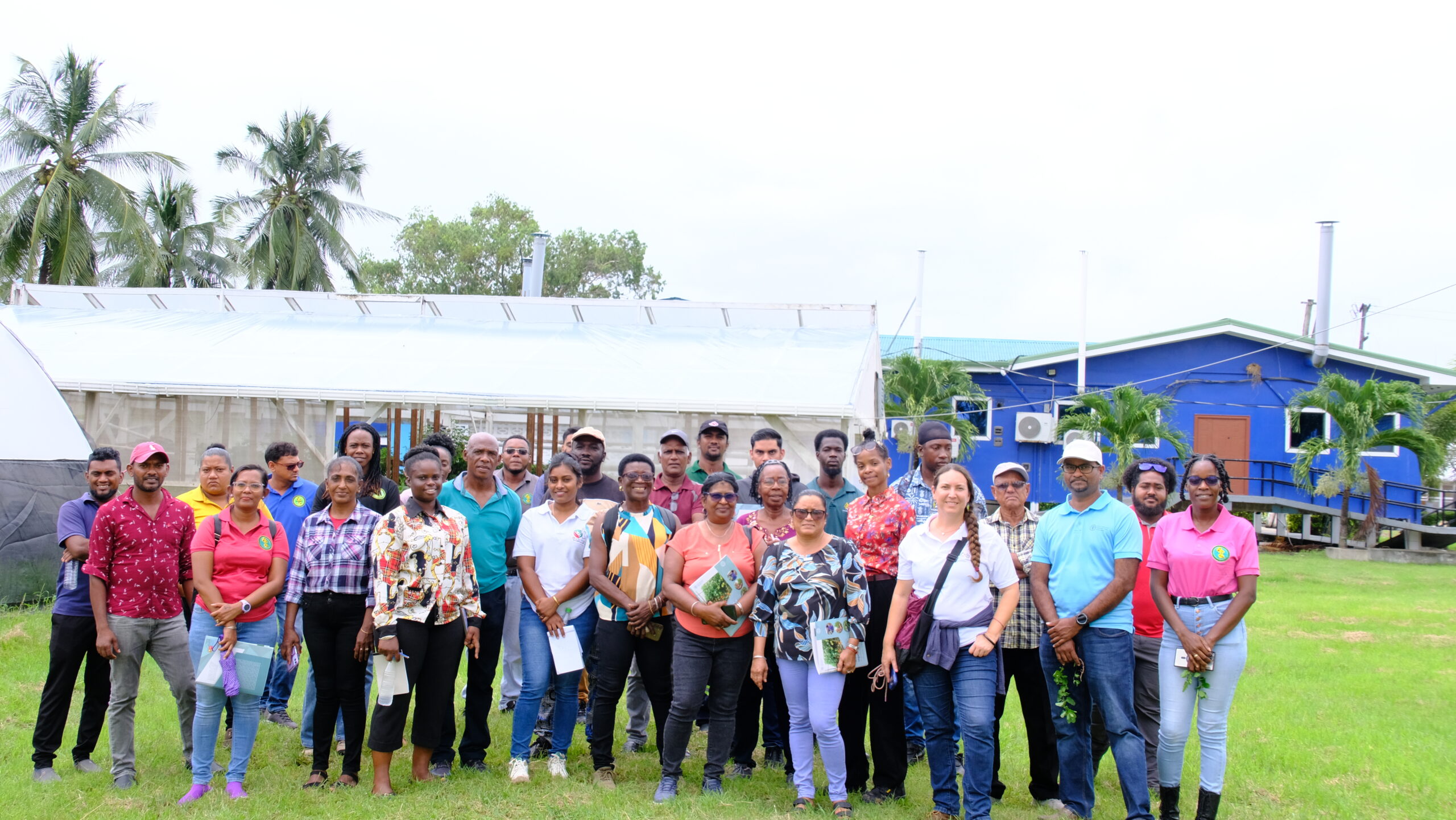
The training commenced at the Mangrove Centre in Mon Repos on 19 May 2026 and continued with practical field sessions in Regions Two, Five and Six. These regional sessions engaged over 90 participants consisting of farmers, academia and extension officers from six regions, strengthening hands-on learning and supporting field-level application.
Dr Ramnarace Sukhna, Head of Special Projects at NAREI, emphasised the long-term value of the initiative, stating, “This collaboration with FAO strengthens the technical capacities of our officers and farmers. The installation of sensors in regional model farms provides a strong foundation for scaling up protected agriculture and digital technologies nationwide.”
Protected cultivation systems, including greenhouses and shade houses play an important role in advancing climate-smart agriculture in Guyana by improving productivity, and crop quality, while helping farmers reduce climate-related risks.
An important feature of the training was the introduction of digital sensor technologies that support real-time monitoring of key environmental parameters such as temperature, humidity, soil moisture, light intensity and nutrient levels. This allows more precise, data-driven crop management. For example, farmers can use soil moisture data to optimize irrigation schedules, reducing water use while maintaining crop health, or adjust ventilation and shading based on temperature and humidity readings to prevent plant stress and disease
Alvin Prabudial, Extension Officer from Region 6 said, “The training was very good, not only the theory but also the practical experience of what is happening in real time as it really relates to our work, giving us new knowledge for us to advance greenhouse and shade house production.”
Participants received training in key areas relating to protected cultivation including; greenhouse climate and crop management, irrigation, fertigation and nutrient management, pest and disease prevention, sensor technologies and data platforms including the installation and operation of monitoring systems.
During the regional practical sessions, participants were introduced to digital sensor technologies and actively engaged in the installation of sensors procured under the project. These sensors were installed on pilot greenhouses at model farms in Regions Two, Five, and Six, helping to ensure that training was directly linked to field level application and practical use by farmers and technical officers.
Debbie Argyle of the Mahaica Women’s Group said, “I am happy to be part of this training which is very impactful and I will be sharing this new knowledge of shade house monitoring with the members of my group and community.”
The training formed part of a broader FAO technical mission that combines capacity development, equipment installation and field-based learning. By integrating classroom instruction with practical demonstrations, the programme ensures that participants are equipped to install, maintain and effectively utilise sensor data.
Assistant FAO Representative for Guyana, Ms Gitanjali Chandarpal, highlighted the significance of the initiative, noting that the integration of sensors and data-driven tools into greenhouse systems enables farmers and technical officers to better monitor conditions and make informed decisions, leading to improved productivity and resilience.
The successful implementation of the sessions contributes to the Government of Guyana’s vision to modernise the agricultural sector. FAO remains committed to supporting collaborative efforts that promote sustainable, efficient, and technology-driven agricultural systems across the country.