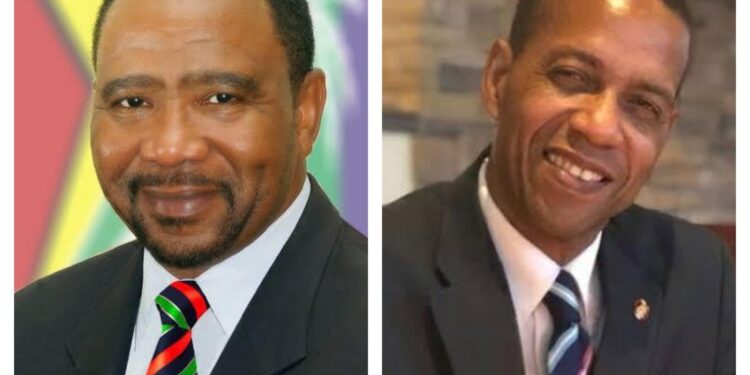
As President Ali prepares for his second inauguration, mounting pressure from opposition leaders and electoral critics threatens to overshadow Guyana’s democratic transition
(WiredJA) The countdown to President Irfaan Ali’s second inauguration this Sunday has become a race against mounting allegations of electoral fraud, institutional failure, and what critics describe as democracy under assault in Guyana.
While the People’s Progressive Party Civic (PPP/C) celebrates a commanding victory with 242,498 votes and 36-37 seats in the 65-seat National Assembly, opposition leaders are launching unprecedented challenges that extend far beyond typical post-election grievances.
The Formal Rebellion
In an extraordinary move that has sent shockwaves through Georgetown’s political establishment, A Partnership for National Unity (APNU) presidential candidate Aubrey Norton has formally demanded that Guyana Elections Commission (GECOM) Chairman Retired Justice Claudette Singh halt the official declaration of results.
His detailed letter, strategically copied to the diplomatic corps including the European Union, CARICOM, OAS, the Carter Center, and embassies from the US, UK, and Canada, calls for either a forensic audit of electoral data or complete annulment with fresh polls.
The timing is deliberate and dramatic. With Ali’s inauguration looming, Norton is essentially asking GECOM to stop a constitutional process already in motion—a move that would plunge Guyana into uncharted political territory.
Norton’s challenge rests on what he describes as “egregious violations” of both the Guyana Constitution and the Representation of the People Act.
His evidence trail is methodical and specific: ballot boxes numbered 40711, 40728, 40792, 41003, and 41005 allegedly featured unsigned Statements of Poll (SoPs), while others—40736, 40835, 40857, 40949, 41048, and 40910—reportedly lacked proper distribution of SoPs to party agents. Several boxes, including 40694, 40697, 40951, and 414037, allegedly contained incomplete documentation.
The opposition leader’s most serious allegations center on reported tampering with ballot boxes EC80004, EC80009, EC80013, EC80022, and EC80019, irregularities flagged during the September 2 tabulation process in Regions 4 and 5 under the watch of local and international observers.
The Institutional Indictment
“ The fact that CARICOM’s 2020 recommendations for electoral reform went largely unimplemented raises uncomfortable questions about the regional body’s ability to enforce its own democratic standards. ”
Norton’s formal legal challenge gains additional weight from a blistering institutional critique delivered by former Georgetown Mayor Pt. Ubraj Narine. Narine’s post-election statement reads like an autopsy of Guyana’s democratic processes, delivering harsh judgment on virtually every aspect of the electoral system.
“It is shameful as a country that every five years we are forced to endure the same nonsense with our General and Regional Elections,” Narine declared, painting a picture of a nation trapped in a destructive cycle of electoral dysfunction.
Particularly damning was Narine’s assessment of GECOM’s observer accreditation process. His accusation that the commission allowed “the Private Sector Commission and other organisations who are PPP supporters to be accredited as observers” struck at the heart of electoral legitimacy.
“This is no different from putting a ‘cat to watch milk,'” he declared, suggesting systematic bias within the supposedly neutral electoral management body.
Yet Narine’s critique extended beyond GECOM to the opposition itself, arguing that political parties “must accept responsibility for failing to put mechanisms in place to confront the PPP’s rigging machinery.”
The International Dimension
Norton’s strategy of copying international observers and diplomatic missions represents more than mere transparency—it’s an appeal to external pressure that could complicate Guyana’s regional relationships.
The European Union Election Observation Mission’s preliminary findings, which criticized the abuse of incumbency by the PPP/C and a politicized media environment, provide crucial ammunition for Norton’s challenge.
The involvement of CARICOM, in particular, adds regional implications to what might otherwise remain a domestic dispute. Caribbean nations have generally prided themselves on peaceful transitions of power, making Guyana’s contested election a potential test case for regional democratic standards.
The Mathematical Reality
“ The current crisis presents CARICOM with a stark choice: continue issuing recommendations that governments can safely ignore, or take more assertive action to ensure institutional reforms are actually implemented. ”
Despite the procedural challenges, the electoral mathematics present a stark reality. The PPP/C’s 242,498 votes dwarf both We Invest in Nationhood’s 109,066 votes and APNU’s distant 77,928 votes.
Even if every disputed ballot were overturned, the margins suggest that procedural irregularities, while potentially serious for institutional integrity, are unlikely to alter the fundamental outcome.
This mathematical reality frames the true nature of the opposition’s challenge: less about changing the result and more about establishing precedent for electoral accountability and institutional reform.
The Silence and the Stakes
GECOM’s refusal to publicly respond to Norton’s demands creates an information vacuum that feeds speculation and conspiracy theories.
As international observers monitor the situation and Ali’s team proceeds with inauguration preparations, the commission’s silence appears increasingly untenable.
Narine’s call to “accept the results with the little dignity left” while simultaneously demanding systemic reform captures the contradiction facing Guyana’s opposition: how to challenge institutional failures without undermining democratic stability.
The broader implications extend far beyond Guyana’s borders. In a region where democratic institutions remain fragile and electoral credibility is essential for stability, Guyana’s repeated electoral crises are becoming a cautionary tale rather than an isolated incident.
The fact that CARICOM’s 2020 recommendations for electoral reform went largely unimplemented raises uncomfortable questions about the regional body’s ability to enforce its own democratic standards.
The current crisis presents CARICOM with a stark choice: continue issuing recommendations that governments can safely ignore, or take more assertive action to ensure institutional reforms are actually implemented.
For Guyana, the cost of inaction has become clear—the very problems identified five years ago have resurged, potentially triggering another prolonged institutional crisis.
As Sunday’s inauguration approaches, Guyana finds itself at a familiar yet dangerous crossroads—trapped between accepting flawed processes for the sake of stability and demanding institutional accountability that might trigger another prolonged crisis.
The question is no longer whether Guyana can avoid electoral controversy, but whether CARICOM will finally insist that its recommendations be more than mere diplomatic suggestions.