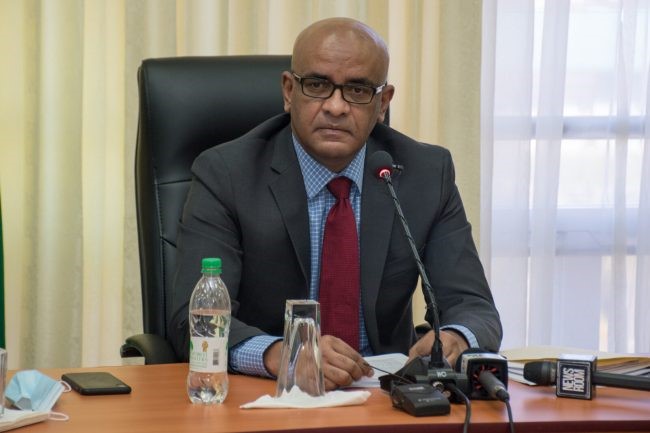
The debate over Bharrat Jagdeo‘s legacy has intensified at a defining moment in Guyana’s history. With unprecedented oil wealth reshaping the nation’s future and the country preparing to mark the 60th anniversary of Independence on May 26, scrutiny has again turned to the politician who has dominated Guyana’s public life for more than three decades. Few figures have exercised comparable influence over the country’s governance, institutions and political discourse.
Nearly 34 years after entering government following the PPP’s return to office in 1992, Jagdeo remains the most influential figure in Guyanese politics. Admirers point to electoral success—whether fairly won or the subject of persistent controversy—political durability and economic stewardship. Political observers, however, argue that his long dominance has coincided with deepening political polarisation, recurring governance controversies, allegations of corruption, extrajudicial killings, contentious public spending decisions and a political culture in which confrontation frequently eclipses consensus. Whether viewed as a transformative strategist or a deeply divisive force, Jagdeo’s imprint on modern Guyana is undeniable—and increasingly central to the national conversation about the country’s future.
For many observers, the contrast with an earlier generation of leaders is stark. Figures such as Forbes Burnham and Cheddi Jagan battled relentlessly over ideas, power and the future of the nation, yet maintained personal respect and a measure of political civility. Political observers argue that modern Guyanese politics has largely lost that tradition. They contend that under Jagdeo’s long influence, public discourse has become increasingly uncivil and confrontational, characterised by insults, public humiliation of opponents and a winner-take-all mentality that has eroded the standards of statesmanship and respectful democratic engagement.
During Jagdeo’s presidency from August 11, 1999, to December 3, 2011, Guyana saw some economic reforms and greater international engagement, but also faced intense controversy. Human rights advocates, opposition figures, and international observers repeatedly raised concerns about the 2002–2006 crime wave that claimed the lives of hundreds, including policemen and businessmen, underscoring the period’s insecurity. This dark period followed the February 23, 2002 Camp Street Prison break.
Allegations linked a shadowy “phantom squad” to state officials, most notably former Home Affairs Minister Ronald Gajraj, who denied any wrongdoing. A subsequent UK-commissioned inquiry raised serious questions about public trust and the rule of law, though no criminal convictions resulted.
In May 2004, Jagdeo established a Presidential Commission of Inquiry to investigate allegations that then Home Affairs Minister Ronald Gajraj was linked to the so-called “phantom squad,” accused of carrying out extra-judicial killings during Guyana’s crime wave. The Report was submitted in 2005.
In a April 12, 2005 statement, U.S. State Department spokesman Richard Boucher noted that a Guyanese commission of inquiry into Gajraj’s alleged links to the so-called “Phantom Death Squad” found serious procedural irregularities in his official conduct. The inquiry raised questions about his interactions with individuals accused of carrying out extrajudicial killings. “The United States believes significant questions remain unanswered regarding his involvement in serious criminal activities,” the statement said. The United States had also expressed deep concern over the Government’s decision to reinstate Gajraj, who proceeded on leave to make way for the Inquiry.
Further, despite calls in 2024 from the United Nations Human Rights Committee for an independent investigation into the era of the “blood bath,” these appeals have gone unheeded.
Questions about Jagdeo’s governance and accountability resurfaced years later through an international Vice News investigation, which reported allegations that Jagdeo had been involved in corrupt dealings with foreign businessmen, including claims related to state contracts. Jagdeo has denied these allegations, stating that the report was flawed and unsupported by evidence. Transparency advocates, including local watchdog groups, publicly called for an independent Commission of Inquiry to examine the claims, but no such inquiry has been convened.
Economic management under Jagdeo’s leadership has also been the subject of debate. In 2013, Kaieteur News ran a series titled “The Heist of Guyana,” highlighting how the country was allegedly parceled out to friends and cronies of former President Jagdeo. The articles detailed rampant corruption, nepotism, and cronyism during his second term, showing how major developmental decisions often served the personal interests of Jagdeo and his associates. According to the newspaper, the national interest was subordinated to this powerful circle, with deals interlinked to consolidate control, leaving an economy dominated by a small group closely tied to the administration.
The Transparency International report ranked Guyana as the most corrupt country in the English-speaking Caribbean under Jagdeo’s presidency. Corruption and mismanagement of projects such as the Skeldon Sugar Factory project and Amaila Falls. The factory, which cost hundreds of millions of U.S. dollars, failed to meet production targets and added further strain to the state-owned Guyana Sugar Corporation (GuySuCo). Government officials at the time attributed the project’s difficulties to technical and contractual issues rather than corruption.
Beyond individual projects, analysts critical of Jagdeo’s record argue that prolonged executive dominance contributed to the erosion of institutional checks and balances, including weakened regulatory bodies and diminished autonomy for state agencies. They contend that economic opportunities increasingly flowed to individuals and companies perceived as politically connected, fostering what some commentators describe as a politically enabled wealthy class. These views circulate widely in public discourse, including on social media, where one influencer recently referred to Jagdeo as “a blight on the nation” — a characterisation that reflects opinion rather than established fact.
Social commentators also argue that Guyana’s political culture shifted during this period, moving away from collective organising toward individual advancement, with trade unions and civic organisations losing influence. Supporters of the PPP reject this narrative, maintaining that social and economic changes reflected global trends rather than deliberate political design.
Despite leaving the presidency in 2011 due to constitutional term limits, Jagdeo remained politically influential. He later served as Leader of the Opposition and, following the PPP/C’s return to power in 2020, assumed the post of Vice President while retaining his role as PPP General Secretary. Political analysts note that this dual position grants him substantial influence over both party machinery and state policy.
In 2022, VICE News aired an undercover investigative report examining allegations of corruption involving Vice President Bharrat Jagdeo and a Chinese businessman, Su Zhi Rong, who claimed to have access to senior government officials and state contracts. While the report did not show Jagdeo accepting bribes, it raised questions about access, influence, and governance, prompting local transparency advocates and opposition figures to call for a Commission of Inquiry to fully examine the allegations. Jagdeo denied any wrongdoing, and later filed a defamation lawsuit against Su. Despite repeated public calls from civil society groups, the government has not convened a Commission of Inquiry into the VICE News exposé, and no formal criminal investigation has been launched.
Online commentators, columnists and social media influencers have become increasingly vocal in their assessment of Jagdeo’s legacy. Some describe his prolonged influence as a “blight on the nation,” arguing that it entrenched a political culture in which loyalty often outweighed merit, political connections yielded advantages unavailable to ordinary citizens, and public discourse descended into confrontation and division. They contend that the result has been the rise of a politically connected elite and a weakening of the ideals of collective advancement, national cohesion and accountable governance that inspired earlier generations of Guyanese. Whether that judgment endures will be left to history, but the debate itself has become inseparable from the national conversation about Guyana’s future.
As Guyana commemorates six decades of Independence, the discussion surrounding Jagdeo has evolved beyond the legacy of a single politician. It has become a broader debate about the kind of society and political culture the nation wishes to cultivate in the oil era. Whether history ultimately judges his influence as transformative or divisive remains to be seen. What is clear is that an increasing number of Guyanese are asking whether national renewal requires not only economic transformation, but also a new generation of leadership, a restoration of civility and stronger democratic institutions capable of carrying the country into its next chapter.