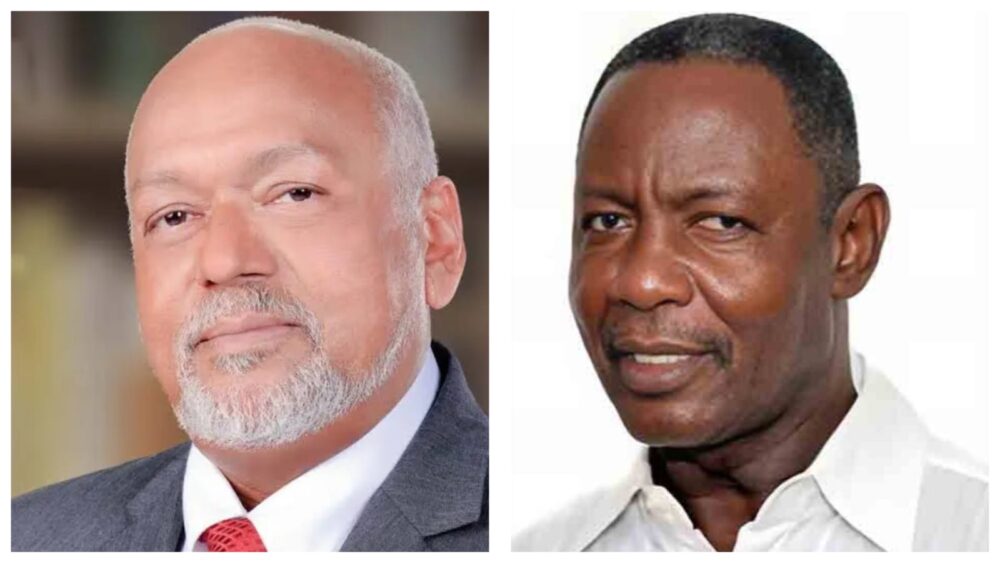
General Secretary of the Guyana Trades Union Congress (GTUC) Lincoln Lewis has launched a sweeping rebuttal of former President Donald Ramotar’s recent account of Guyana’s labour history, contending that it amounts to “political revisionism” and seeks to diminish the historical role of organised labour in the country’s democratic development.
The dispute follows remarks made by Ramotar during a TEDxTurkeyen discussion in which he traced the evolution of trade unionism from the early 20th century and argued that while organised labour secured important economic gains for workers, those achievements could ultimately be undermined by the political system. He contrasted the approach of labour pioneer, Hubert Nathaniel Critchlow with that of Dr. Cheddi Jagan, contending that Jagan sought not only improvements in wages and working conditions but political power for the working class in order to secure lasting change.
Ramotar also accused the GTUC of siding with British colonial authorities following the suspension of British Guiana’s constitution in 1953 and claimed the organisation was reconstituted to oppose the People’s Progressive Party (PPP) government and weaken its working-class support base. He further argued that the GTUC remains undemocratic and requires significant reform if it is to effectively represent workers and regain its influence in national affairs.
Lewis, however, contends that Ramotar’s interpretation distorts both labour history and the relationship between trade unionism and politics.
“Donald Ramotar’s recent conversation on TedxTurkeyen was not merely disappointing; it was dangerous in the way propaganda becomes dangerous — wrapped in selective history, repeated distortions, and calculated attempts to reshape public memory,” Lewis wrote in his Sunday Eye on Guyana column.
“What Guyanese heard was not an honest engagement with the history of labour or democracy. It was political revisionism, where repetition is mistaken for truth and distortion presented as fact.”
At the centre of the disagreement is the historical role of organised labour before the emergence of modern political parties.
While Ramotar suggested trade unionism experienced a period of decline before re-emerging through the British Guiana Labour Union in the 1920s and later gaining momentum during the labour uprisings of the 1930s, Lewis insists there was no interruption in labour activism after Critchlow established the movement in 1905.
Hubert Nathaniel Critchlow, regarded as the Father of Trade Unionism in British Guiana and the British Empire, is Guyana’s second National Hero.
“There was never a ‘lull’ in trade unionism after Critchlow founded the movement in 1905,” Lewis argued, maintaining that workers continuously resisted exploitation, poor wages and political exclusion throughout the colonial period.
Both men point to the British-appointed Moyne Commission of the 1930s as evidence of the harsh conditions confronting workers across the Caribbean. Ramotar cited the commission’s findings to illustrate the economic hardships that fuelled labour unrest, while Lewis argued the commission itself demonstrated the sustained effectiveness of labour agitation and worker mobilisation.
The GTUC leader also challenged what he described as efforts to minimise labour’s political role before the founding of the PPP.
“The trade union movement began advocating for one man, one vote and internal self-government as early as 1926 — almost a quarter century before the first mass-based political party, the People’s Progressive Party (PPP), was formed in 1950,” Lewis wrote.
He noted that Critchlow was himself a co-founding member of the PPP, arguing that this fact alone undermines any narrative suggesting that trade unionism and politics developed along separate paths.
“The labour movement was never apolitical because politics determines the social and economic conditions under which working people live,” Lewis stated.
The sharpest disagreement concerns the divisions that emerged between sections of the labour movement and the PPP during the 1950s and 1960s.
Ramotar argued that after the British suspended the constitution in 1953 and removed the PPP government from office, the TUC was dismantled and later re-established as an instrument aligned with colonial interests. According to him, the organisation subsequently became a vehicle through which British authorities and later foreign actors weakened the PPP’s support among workers, with racial divisions playing a major role in that process.
Lewis rejected that interpretation, arguing that Ramotar ignores the ideological disputes that divided the nationalist movement.
“Ramotar conveniently ignores another critical historical truth,” he wrote. “The tensions that emerged between sections of the labour movement and the PPP/Cheddi Jagan government in the 1950s did not arise out of racism. They arose out of competing political ideologies.”
According to Lewis, many labour leaders and workers supported Western parliamentary democracy and capitalist economic structures at a time when the PPP was increasingly viewed through the lens of socialism and communism. Those ideological differences, he argued, later contributed to racial divisions but were not initially driven by race.
“That history matters because too many people today attempt to reduce every disagreement in Guyana to race while ignoring the serious ideological struggles that shaped this nation,” Lewis stated.
Lewis also defended labour’s opposition to the Jagan administration during disputes over the Labour Relations Bill and the Kaldor Budget, which culminated in the 80-day strike of 1963.
“So for Ramotar now to suggest that the trade union movement was merely a British or CIA tool deployed against the PPP is not only false, it insults generations of trade unionists who sacrificed for workers’ rights long before and long after Independence,” he wrote.
The disagreement extends beyond history into contemporary debates about the state of organised labour.
Ramotar argued that structures inherited from the colonial era continue to weaken the labour movement and described the GTUC as one of the country’s least democratic institutions. He maintained that democratisation is necessary if organised labour is to reclaim the influence it once exercised and counter the growing power of private-sector interests.
Lewis dismissed that criticism, noting that Ramotar himself participated in labour leadership through the Federation of Independent Trade Unions of Guyana (FITUG) and helped shape some of the rules governing the GTUC.
He also pointed to what he described as an inconsistency in Ramotar’s criticism of the labour movement’s independence.
“The nation must also be reminded that the only union in Guyana constitutionally aligned to a political party is the Guyana Agricultural and General Workers Union (GAWU), which is aligned to the PPP. Every other union has no such control,” Lewis wrote.
Questioning Ramotar’s criticism of the GTUC’s democratic credentials, Lewis asked: “Are those rules democratic only when the People’s Progressive Party controls the outcome? Is democracy legitimate only when it serves one political interest? Are institutions independent only when they submit to party control?”
Lewis further argued that administrations associated with the PPP contributed to weakening organised labour by withdrawing state subventions to the GTUC and the Critchlow Labour College and limiting engagement with independent trade unions.
The controversy, he argued, is about more than differing interpretations of the past. In Lewis’ view, efforts to recast labour’s role in Guyana’s development risk obscuring the sacrifices that helped secure workers’ rights, constitutional reform, democratic representation and self-government.
“Labour’s history, sacrifices, and contributions to this nation will not be rewritten, distorted, or politically sanitised without challenge,” Lewis declared.
He concluded with a warning about the consequences of historical revisionism: “The greatest threat to any democracy is not disagreement. It is the normalisation of dishonesty.”