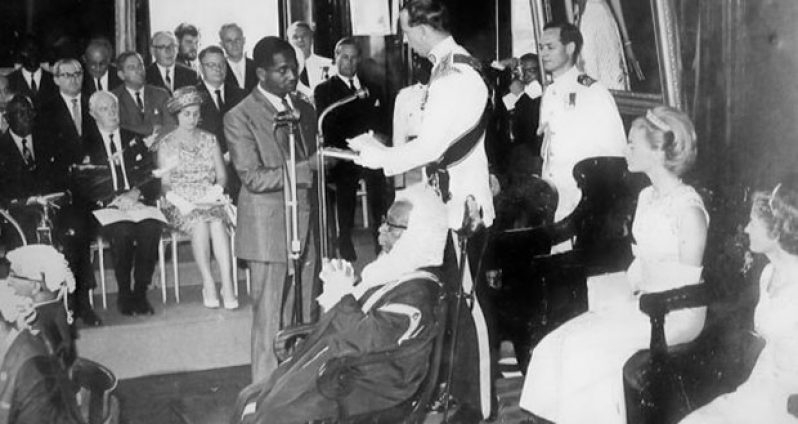
Historical records show that May 26, 1966 was settled during the British Guiana Independence Conference held in London, which concluded on November 19, 1965 with agreement that May 26, 1966 would be the date on which the new state of Guyana would attain independence.
The conference involved:
- The British Government
- The British Colonial Office
- Representatives of the British Guiana Government
- Opposition political representatives
The independence date formed part of wider constitutional negotiations governing Guyana’s transition from colony to independent state. Official records from both the British and United States governments confirm that the date was agreed upon during those constitutional talks, not through unilateral action by Forbes Burnham.
At the conference, agreement was reached not only on the independence date, but also on:
- Guyana’s Independence Constitution
- The parliamentary structure
- Commonwealth membership
- Transitional governance arrangements
The British Parliament subsequently passed the Guyana Independence Act 1966, which legally brought Guyana’s independence into effect on May 26, 1966. British Governor Sir Richard Luyt remained in office until independence and then transitioned into the post-independence constitutional structure.

Photo Credit: People’s National Congress Reform (PNCR)
There is therefore no documented evidence showing Burnham alone selected the date as a symbolic act against Indo-Guyanese.
The Wismar/Linden violence of May 1964 remains one of the darkest and most painful episodes in Guyana’s history, involving attacks, displacement, destruction of property, and loss of life among Indo-Guyanese residents.
But acknowledging the horror and trauma of Wismar does not automatically validate the claim that Independence Day itself was selected as an ethnic insult.
The disturbances unfolded within a wider context that included:
- Cold War tensions
- British colonial intervention
- Political instability
- Ethnic polarisation
- Ideological conflict between socialism/communism and Western parliamentary democracy
Historical evidence shows Guyana’s independence timetable was shaped through constitutional negotiations and British decolonisation procedures, not through personal symbolism or unilateral political decision-making by Burnham.
Turning political interpretation into unquestioned historical “fact” risks deepening ethnic division while obscuring the actual constitutional and diplomatic process that led to independence.
The tragedy of Wismar deserves honest remembrance, national reflection, and historical accuracy. But mature engagement with Guyana’s history requires distinguishing between documented evidence and narratives shaped by political grievance, hate and repetition over time. Independence Day emerged from negotiations involving Britain and Guyanese political representatives within the formal decolonisation process. To suggest otherwise without evidence risks replacing history with mythology while further entrenching suspicion and division in a society that continues to grapple with the wounds of its past.