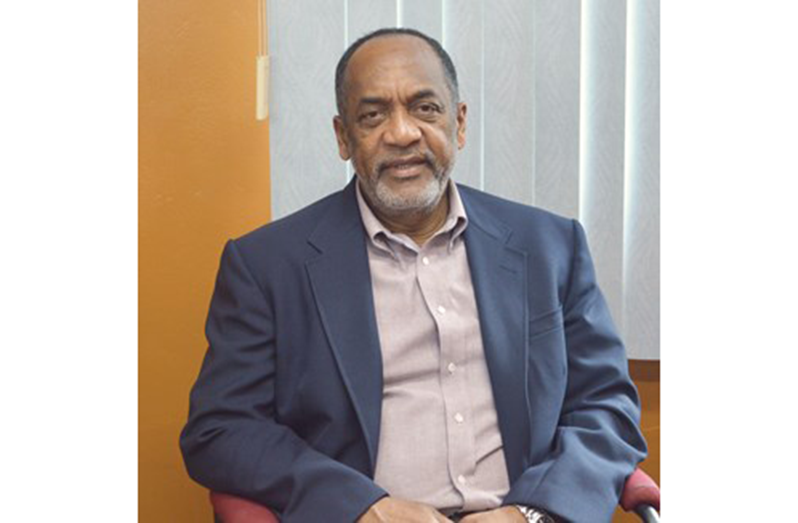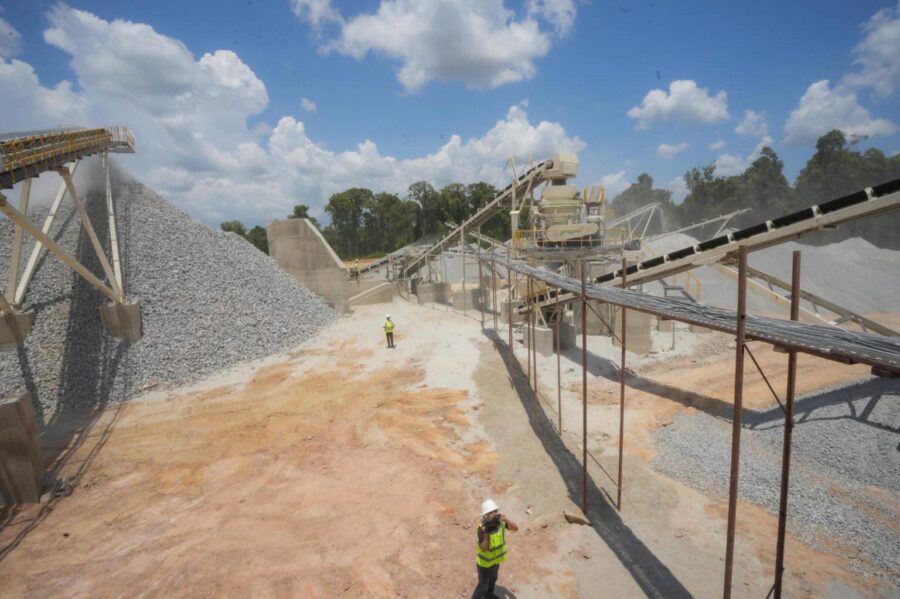
Allegations of labour abuse, passport confiscation, withheld wages, and inhumane living conditions have erupted at the US$20 million EKAA HRIM Earth Resources quarry in Batavia, Region Seven, following the death of an Indian national at the site and the intervention of We Invest in Nationhood (WIN) leader and Opposition Leader Azruddin Mohamed.
The controversy has placed renewed scrutiny on the treatment of foreign labourers within Guyana’s rapidly expanding extractive sector and raised uncomfortable questions about oversight, worker protections, and the human cost of the country’s aggressive investment drive.
In a statement released on May 16, Mohamed said more than 38 Indian nationals requested assistance after he visited the quarry owned by businessman Sarju Bhaskar.
According to the statement, the workers asked to be transported to Georgetown to meet with the Indian High Commissioner in order “to clear their grievances.”
The allegations outlined were severe.
The workers reportedly complained of “seizure of their passports,” “detention for perceived wrong doings,” absence of health and safety facilities, partial withholding of wages and salaries, denial of meals, water and communication, and “poor living accommodation and generally inhumane conditions.”
The statement also alleged that one worker “died under suspicious circumstances.”
“It must be noted that the grievances mentioned constitute a breach of the labour law and health and safety act,” the statement said.
Mohamed further escalated the issue politically by noting that President Irfaan Ali attended the commissioning of the quarry and is “closely associated” with Bhaskar, who also owns Texila University.
“This state of affairs is an embarrassment to Guyana, an insult and inhumane treatment meted out to the Indian nationals,” the statement added.
The Opposition Leader demanded that the workers be given back their passports, paid all outstanding wages and salaries, and provided airfare to return to India, “which the people are sadly demanding to go back.”
The allegations became public one day before EKAA HRIM Earth Resources Management Inc issued its own statement confirming the death of an Indian employee at the quarry.
According to the company, the worker died from a heart attack.
“Based on the medical findings and post-mortem examination, the cause of death was confirmed to be a heart attack,” the company stated in a May 17 press release.
The company said management and staff were “deeply saddened” by the death and that their immediate focus had been supporting the employee’s family and coordinating with the relevant authorities.
“It has come to our attention that certain misleading and inaccurate information regarding this unfortunate incident has been circulated publicly and on social media platforms,” the company stated.
“We are concerned that these statements may create unnecessary fear, confusion, and misunderstanding among the public and stakeholders.”
EKAA HRIM said it was working closely with the Indian High Commission in Guyana, the Ministry of Labour, and other authorities to ensure the matter is handled “with the utmost transparency and responsibility.”
The company also urged the public to avoid spreading “unverified information” while investigations and official processes continue.
But the allegations surfacing from Batavia are likely to deepen concerns over labour oversight in Guyana’s booming mining, quarrying, and construction sectors, particularly in remote interior regions where foreign workers often remain isolated and heavily dependent on employers for transportation, housing, wages, and immigration documentation.
The reported confiscation of passports is especially troubling. International labour and human rights bodies have repeatedly identified the seizure or withholding of workers’ travel documents as a recognised indicator associated with forced labour and worker exploitation.
The allegations also raise broader questions about whether Guyana’s regulatory institutions are adequately equipped — or sufficiently willing — to monitor labour conditions amid the country’s rapid economic expansion.
The Batavia quarry forms part of the growing wave of large-scale industrial and infrastructure projects reshaping Guyana’s economy following the oil boom. Yet while billions of dollars in investment continue flowing into the country, concerns persist that labour protections, workplace safety enforcement, and human rights monitoring are failing to keep pace.
To date, neither the Ministry of Labour nor other state regulatory agencies have publicly addressed the specific allegations raised by the workers or announced whether a formal investigation has been launched into the reported conditions at the quarry site.