The Demerara Harbour Bridge was more than a bridge linking Regions Three and Four. It was one of the most enduring symbols of Guyana’s post-Independence ambition, self-belief, and engineering ingenuity — a national project conceived during an era when newly independent Guyana sought to prove that its people possessed the talent, vision, and determination to build world-class infrastructure.
Commissioned on July 2, 1978, under the leadership of Forbes Burnham, the bridge emerged during a defining period of nation-building when the country was aggressively pursuing economic self-reliance, industrialization, and national development following Independence in 1966 and Republican status in 1970.
At the time of its opening, the Demerara Harbour Bridge was recognised as the longest floating bridge in the world, instantly placing Guyana on the international engineering map. Stretching approximately 1.85 kilometres across the Demerara River, the structure became a source of immense national pride and a visible statement that Guyana was capable of producing infrastructure of global significance. Were it not dismantled, today it would be the longest all-steel floating bridge globally and ranks as the fourth longest overall.
Importantly, the bridge was not merely imported infrastructure dropped into Guyana by foreign interests. It reflected substantial local involvement and the utilisation of Guyanese talent and expertise, including the contribution of renowned Guyanese engineer Joe Holder and other local professionals who helped shape one of the country’s most iconic national projects.
The bridge’s innovative design reflected deep strategic thinking about Guyana’s geography and economic future. Unlike conventional fixed-span bridges that obstruct waterways, the Demerara Harbour Bridge was specifically engineered with a retractable retractor span system that allowed ships and large vessels to pass freely along the Demerara River.
That capability was critical because the river has historically functioned as one of Guyana’s most important commercial arteries, supporting trade, agriculture, timber, bauxite, shipping, and industrial transport. The bridge acknowledged a central reality of Guyana’s development: that river commerce had to coexist with road transportation, not be sacrificed for it.
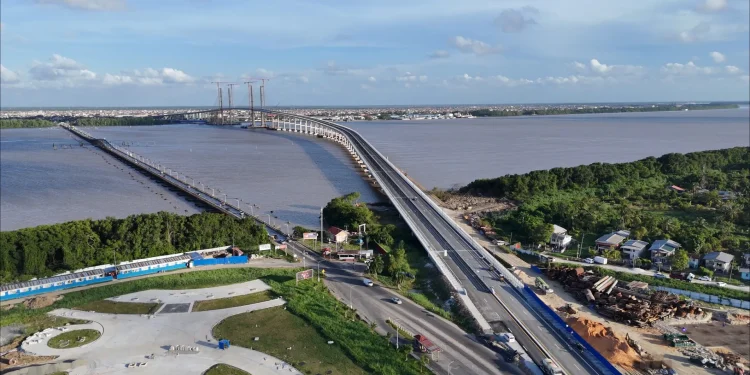
Its retractable design therefore became more than an engineering feature. It symbolised foresight, balance, and practicality — an understanding that infrastructure must facilitate commerce in all forms rather than create barriers to future economic expansion.
Over the decades, entire communities, transportation systems, small businesses, vendors, and commercial activities developed around the bridge corridor. The bridge became woven into the social and economic fabric of national life and evolved into one of the most recognisable symbols of modern Guyana. This historic legacy is now being systematically diminished and erased.
In dismantling the bridge, the government has shown little appreciation for the historical, cultural, and engineering significance of one of Guyana’s most important post-Independence achievements. Rather than preserving and integrating the original structure, alongside the new bridge, into a broader national development vision, the approach appears focused on discarding a powerful symbol of an earlier era of Guyanese nation-building.
For many observers, this reflects a wider pattern in which several projects, institutions, and achievements associated with Guyana’s Independence-era development are increasingly overlooked, marginalised, or stripped of their historical context.
Questions are also being raised about the shortsighted nature of current transportation planning. At a time when vehicle ownership, commerce, and population pressures are rapidly expanding because of oil-driven economic growth, many argue that the country should be increasing transportation arteries and preserving multiple access routes rather than shutting down strategically important corridors and creating new bottlenecks.
Additionally, there are concerns that aspects of newer bridge infrastructure may ultimately hinder river traffic rather than enhance it, undermining the very commercial flexibility that made the original Demerara Harbour Bridge so strategically important.
To many Guyanese, the issue is no longer simply about replacing aging infrastructure. It is about whether Guyana values and preserves the legacy of a generation that sought to build a nation through local talent, bold thinking, and independent vision.
The Demerara Harbour Bridge was not just steel, pontoons, and concrete. It was an Independence-era declaration that Guyanese could dream big, build boldly, and create infrastructure recognized around the world. Its historical significance lies not only in what it connected physically, but in what it represented nationally — confidence, ingenuity, and the spirit of nation-building.
![Haitians deported from the US land in Cap-Haitien, Haiti, on August 27 [Ketlain Difficile/AP Photo]](https://villagevoicenews.com/wp-content/uploads/2026/09/haiti-750x375.webp)