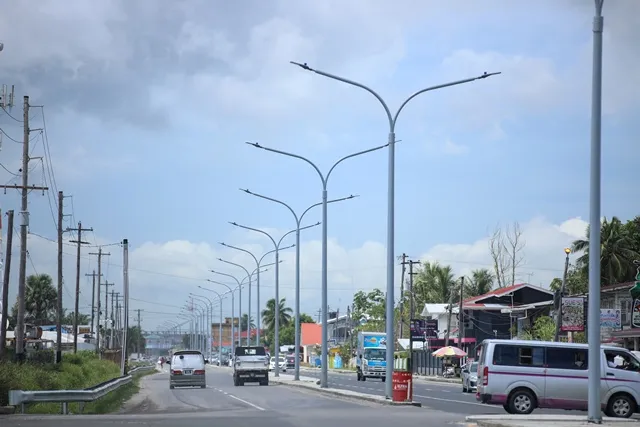
The Government’s announcement that it will install 90,000 streetlights and 2,000 CCTV cameras nationwide in the coming months is drawing renewed scrutiny over public spending, project durability, accountability, and whether Guyanese taxpayers are receiving value for money from large-scale infrastructure initiatives.
Vice President Bharrat Jagdeo on Monday confirmed that the streetlights are already in the country and will soon be installed across communities as part of the government’s public safety and community enhancement agenda.
According to the government, the streetlight programme is intended to improve visibility for motorists, cyclists, and pedestrians and reduce road accidents, while the CCTV cameras form part of the “Safe Country” initiative aimed at strengthening surveillance and intelligence-driven policing.
The projects also align with promises contained in the government’s 2025 manifesto and are reportedly being complemented by investments in concrete drains and recreational facilities.
However, questions continue to surface about the long-term quality, maintenance, and cost effectiveness of many government infrastructure programmes, particularly amid complaints that several publicly funded projects deteriorate rapidly after installation.
Across the country, concerns have repeatedly been raised about streetlights failing within short periods, damaged fixtures remaining unrepaired for extended durations, and public works showing signs of wear and deterioration long before their expected lifespan.
There is also growing public unease over whether some of the materials and equipment being procured for state projects are substandard, particularly given the frequency with which newly completed infrastructure appears to require repairs, replacement, or rehabilitation.
Critics and public observers argue that while large figures and ambitious announcements dominate government messaging, the real issue is whether Guyanese are receiving durable infrastructure capable of standing the test of time or simply expensive projects designed for political optics and short-term publicity.
The concerns are compounded by the current absence of parliamentary scrutiny, with the National Assembly of Guyana not having convened for more than 90 days. The prolonged inactivity of Parliament has fueled criticism that billions of dollars in public spending and procurement decisions are proceeding without robust legislative oversight, debate, or accountability.
Questions are therefore being raised about procurement standards, contract monitoring, maintenance frameworks, and whether sufficient safeguards exist to ensure taxpayers are receiving quality products and services commensurate with the enormous sums being spent.
The issue is no longer whether projects are being announced, but whether the country is obtaining infrastructure that is durable, transparent in cost, properly supervised, and genuinely beneficial to the public rather than projects that quickly deteriorate and require repeated spending cycles funded by taxpayers.