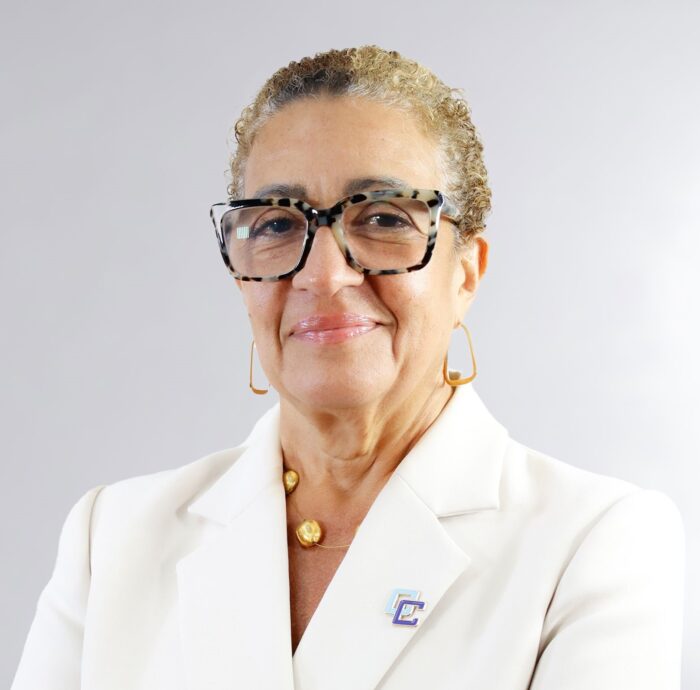
The Caribbean Community (CARICOM) is aggressively diversifying its international relationships and expanding South-South cooperation in response to mounting global instability, geopolitical conflict, and economic uncertainty, Assistant Secretary-General for Foreign and Community Relations Elizabeth Solomon said Thursday.
Speaking at the Navigating the Future: Guyana, the Caribbean and Latin America in a Changing Global Environment conference hosted by the Centre for International and Border Studies (CIBS) at Herdmanston Lodge in Georgetown, Solomon warned that the Caribbean is operating in an increasingly volatile international environment shaped by conflicts in Eastern Europe and the Middle East, supply chain disruptions, shifting power blocs, and policy changes across the hemisphere.
“To navigate this environment, CARICOM has embarked on a deliberate strategy of diversifying external relations, anchored in the principles of South-South cooperation,” Solomon stated.
Founded in 1973 through the Treaty of Chaguaramas, CARICOM was established to promote regional integration, economic cooperation, coordinated foreign policy, and collective development among Caribbean states. Its founding leaders were Prime Minister Forbes Burnham of Guyana, Prime Minister Errol Barrow of Barbados, Prime Minister Michael Manley of Jamaica, and Prime Minister Dr. Eric Williams of Trinidad and Tobago.
More than five decades later, Solomon argued that the regional bloc is again being forced to redefine its strategic position in a rapidly changing world order.
“We are witnessing a historic deepening of ties with the African Union and individual African countries,” she said, pointing to growing cooperation in health, business, and reparatory justice following the CARICOM-African Union Summit and a Memorandum of Understanding between the two sides.
She also highlighted CARICOM’s efforts to broaden relations with countries in Asia and the Middle East while strengthening ties with Latin America.
“Closer to home, the enhancement of our relationship with our continental neighbours in Latin America and the Caribbean is paramount,” Solomon said, adding that such engagement is critical for trade, regional security, and the development of sustainable transport and energy corridors.
The Assistant Secretary-General warned that small states like those in CARICOM remain vulnerable to external shocks and global instability.
“These resulting crises — ranging from supply chain disruptions to energy market fluctuations — test the principles of international law that serve as the primary shield for small states,” she stated.
The remarks come at a time when Guyana, host of the CARICOM Secretariat headquarters, prepares to celebrate its 60th Independence Anniversary later this month while simultaneously confronting heightened tensions with Venezuela over the Essequibo controversy.
Reaffirming CARICOM’s support for Guyana, Solomon declared: “CARICOM remains firm in its support for the judicial process before the International Court of Justice and continues to advocate for a peaceful, legal resolution that respects Guyana’s territorial integrity and maintains our region as a Zone of Peace.”
She welcomed recent statements by Colombia supporting peaceful resolution of disputes and rejecting the use or threat of force within the region.
Beyond border security, Solomon also addressed instability in Haiti, describing the humanitarian and security crisis there as a major regional concern.
“The Community remains fully and strategically engaged in coordinating with international partners to restore security and democratic governance in our sister-nation of Haiti,” she said.
She also reiterated CARICOM’s solidarity with Cuba amid ongoing economic and humanitarian challenges.
At the economic level, Solomon stressed that CARICOM’s long-term survival depends on deeper regional integration through the CARICOM Single Market and Economy (CSME), climate resilience, and energy security.
She disclosed that CARICOM is receiving a “record number” of applications for Associate and Full Membership, underscoring growing international interest in the regional bloc.
“Given the geopolitical significance of this region, the shifting global dynamics puts us in the position to be far more than just observers,” Solomon said.
“As we keep hearing, ‘if you are not at the table, you are on the menu.’ What is required of us is to look to the future and to become the architects of a modern, diversified, and integrated Caribbean.”