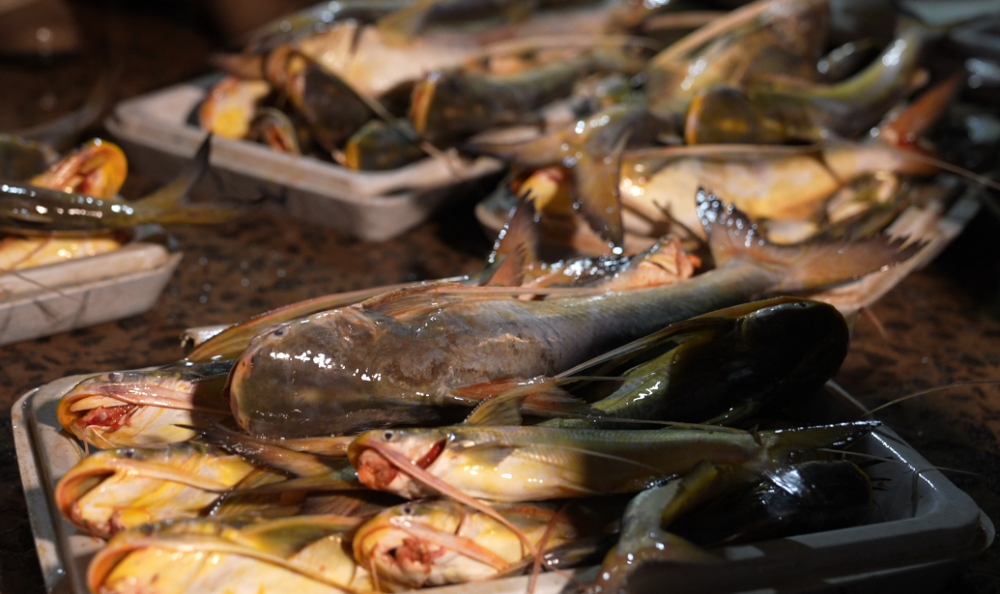
Social activist and broadcaster Mark Benschop is challenging the government’s account of efforts to restore catfish exports to the United States, declaring bluntly that “US ent want Guyana’s catfish” and suggesting the full story behind the prolonged ban may not be fully disclosed to the public.
Speaking on his programme “Straight Up With Mark Benschop” on 107.1 FM, Benschop said the nearly decade-long delay in regaining access to the U.S. market raises serious questions about official claims that Guyana has met all requirements.
“The reality is, the United States does not want Guyana’s catfish,” he said, adding pointedly, “US ent want Guyana’s catfish.”

Guyana’s catfish exports to the United States have been suspended since 2017, when U.S. regulators determined that the country’s fish inspection and food safety systems were not equivalent to American standards.
The restriction, enforced by the U.S. Department of Agriculture through its Food Safety and Inspection Service (FSIS), requires exporting countries to demonstrate compliance with stringent rules governing sanitation, traceability, and inspection.
In 2018, Dr. Ozaye Dodson, Director of Veterinary Public Health, disclosed that the FSIS had requested Guyana to submit documentation to verify that its inspection system met U.S. standards or provided an equivalent level of public health protection.
While Guyana complied, Dodson indicated that the country fell short in three key areas: an inadequate presence of inspectors, insufficient documentation verifying each stage of sanitation and Hazard Analysis and Critical Control Point (HACCP) processes, and a lack of detailed procedures outlining how the industry manages adulterated catfish products.
Since then, government officials have maintained that those deficiencies were addressed. Agriculture Minister Zulfikar Mustapha has expressed confidence that Guyana is now compliant, while U.S. Ambassador Nicole Theriot said in 2025 that Guyana had taken the necessary steps and that a resolution appeared likely.
Yet, years later, approval has not been granted.
Benschop questioned whether the continued delay reflects unresolved shortcomings or a narrative that does not fully capture the situation.
“If everything has been satisfied, why is Guyana still waiting?” he asked, arguing that repeated assurances of progress are difficult to reconcile with the absence of a final decision.
Before the ban, Guyana’s catfish exports—particularly gilbaka—were valued at approximately G$1.8 billion annually, supplying a strong diaspora market in the United States.
The prolonged restriction has kept that sector effectively locked out of a key export market. But Benschop’s intervention shifts the focus beyond economic loss to the credibility of the explanation being presented.
For him, the timeline itself raises doubts.
“The reality is, the United States does not want Guyana’s catfish,” he reiterated.
While U.S. authorities have not publicly stated that Guyana is being excluded for non-technical reasons, approval remains contingent on a determination that Guyana’s regulatory systems are fully equivalent to U.S. standards.
The government continues to express optimism that the ban will be lifted.
However, with earlier identified deficiencies, years of corrective efforts, and no definitive outcome, Benschop’s assertion—that “US ent want Guyana’s catfish”—adds a sharper dimension to the issue, raising questions not only about compliance, but about whether the full circumstances behind the continued denial have been clearly communicated.