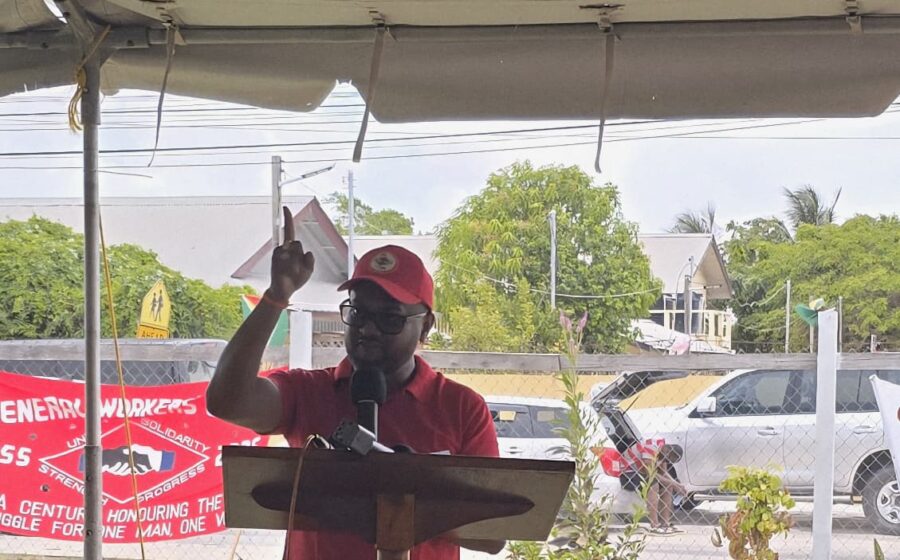
Former Ubraj Narine delivered a forceful Labour Day address on Friday, calling out the exploitation of Guyanese workers by foreign companies and accusing the government of failing to adequately protect the working class.
Speaking at the Guyana Trades Union Congress (GTUC) Labour Day rally, Narine said the annual observance must be more than a commemoration of past struggles and instead serve as a platform to confront the present realities facing workers.
Labour Day in Guyana carries deep historical significance, tracing back to the struggles led by Hubert Nathaniel Critchlow, widely recognised as the father of trade unionism in Guyana and the British Empire. Critchlow’s organising of waterfront workers from 1905 and the establishment of the British Guiana Labour Union in 1919 laid the foundation for workers’ rights, universal adult suffrage, and internal self-government—rights that shaped Guyana’s democratic and political development.
Against that backdrop, Narine said today’s workers are confronting a different but equally urgent struggle.
“Today, on Labour Day, we gather not only to commemorate the historic struggles of working people, but to confront the harsh realities facing Guyanese workers right now. This is a political moment, and we must speak the truth plainly and without fear,” he said.
Narine’s criticism focused heavily on foreign-owned companies operating in Guyana, particularly at a time when the country is experiencing unprecedented economic growth fueled by oil production and natural resources.
He argued that while foreign companies continue to benefit from Guyana’s wealth, workers are not receiving fair treatment.
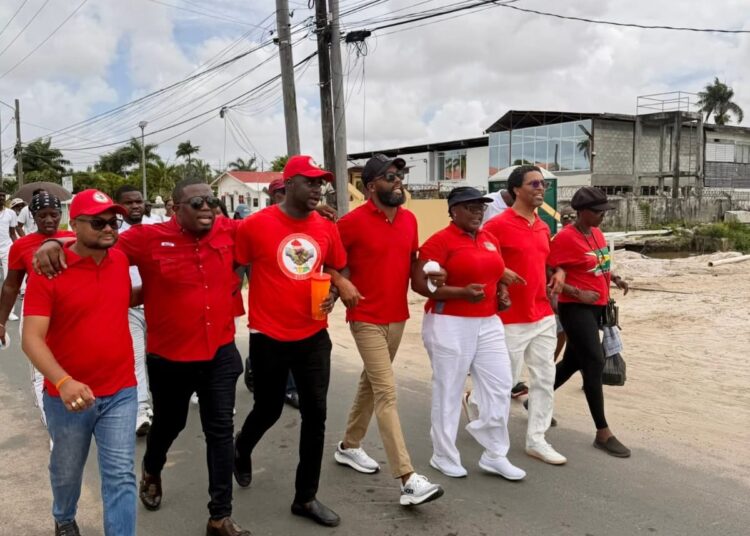
“Across this country, foreign companies are operating on our soil, benefiting from our resources and our labour, yet too many of them are taking advantage of Guyanese workers. Our people are underpaid, overworked, disrespected, and in some cases treated brutally, as though their dignity does not matter,” Narine declared.
Calling the situation “unacceptable in a sovereign nation,” he also directed criticism at the government, saying labour laws are not being properly enforced and oversight remains weak.
“The laws exist, but enforcement is weak. Oversight is lacking. Too often, profits are protected while workers are left exposed. A government that claims to serve the people must do more to protect its working class,” he said.
He warned that failing to act against exploitation amounts to complicity.
“Silence and inaction in the face of exploitation are not neutrality—they are complicity.”
Narine called on workers to push back against exploitation through organised and united action, rejecting violence but insisting on courage and solidarity.
“We say today: enough is enough. We must rise up against this nonsense. Not with violence, not with hatred, but with unity, courage, and collective action. We must stamp out exploitation wherever it exists. We must demand fair wages, safe working conditions, respect, and dignity. These are not favours. These are our rights as Guyanese.”
In one of the strongest moments of his address, Narine reminded workers of their equality and humanity.
“We must remember that the white men don’t controlled us anymore, we not slaves but we humans just like them.”
He also warned against political, racial, and religious division, arguing that disunity weakens workers while others benefit.
“Let us be clear—our strength is in our unity. We must not allow division by politics, race, religion, or personal interest. We must not turn against each other while others profit from our disunity.”
He urged workers to stand together, “shoulder to shoulder, speaking with one voice and moving with one purpose.”
Before his address, Narine led a universal Labour Day prayer, offering gratitude for workers and honouring those who fought before for fairness, dignity, and justice in the workplace.
The prayer also called on national leaders to act justly and protect the rights of workers.
“Guide our leaders to act with justice and compassion, and protect the rights and wellbeing of all working people,” he prayed.
To Narine, Labour Day represents far more than an annual observance. Rooted in the sacrifices of workers who fought to secure rights and political representation, he said the occasion must remind Guyanese that those gains were earned through struggle and must be defended with the same resolve.
“Labour Day is not just a celebration; it is a call to action. A call to defend our rights, protect our workers, and secure a just future for the next generation.”
Narine ended by saluting workers and the labour movement, declaring: “Long live the workers of Guyana. Long live unity among the working class. Long live the GTUC.”