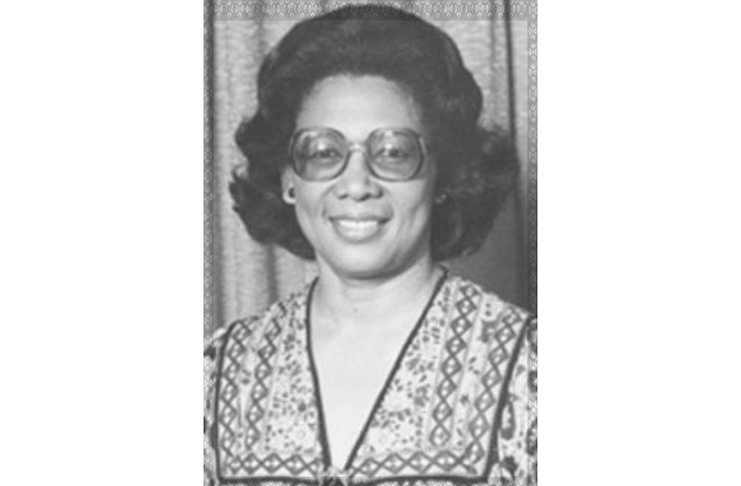
As we celebrate Women’s History Month, it is fitting to acknowledge the remarkable life and legacy of Viola Burnham, a pioneering figure in Guyana’s education, social development, and political spheres. Born Viola Victorine Harper in New Amsterdam in 1930, she rose from humble beginnings to become one of the country’s most influential leaders, championing education, women’s rights, and community development throughout her life.
A gifted scholar from early on, Burnham earned scholarships that took her from Bishops’ High School in Georgetown to the University of Leicester in England and later to the University of Chicago, United States of America where she completed a Master’s in Education. Her academic excellence laid the foundation for a career that blended intellectual leadership with a deep commitment to public service.
In February 1967, Viola married Forbes Burnham, who at the time was serving as Prime Minister of Guyana and later became the country’s first executive President. From this union, they had three children: daughters Melanie and Ulele, and their son Kimani. Together, the Burnhams became one of the most prominent families in Guyana, with Viola carving out her own legacy as a leader and advocate.
Burnham’s influence expanded far beyond the classroom. As Vice‑Chairperson and later Chair of the Women’s Revolutionary Socialist Movement (WRSM), she led initiatives that advanced women’s employment, education, and economic empowerment across Guyana and the wider Caribbean. She spearheaded projects that created training and work opportunities for women, and her leadership helped reform laws affecting women’s rights, aligning national legislation with international standards on gender equality.
On the international stage, Burnham represented Guyana at multiple United Nations World Conferences on Women, advocating for gender equity and global cooperation at a time when women’s voices were often marginalized.
Her impact also reached the highest echelons of national governance. Following the death of her husband, she served as Vice President and Deputy Prime Minister under President Desmond Hoyte, overseeing education, social development, and culture — becoming one of the first women in the region to hold such senior governmental roles. During this time, she performed the duties of President on at least one occasion when both President Hoyte and Prime Minister Hamilton Green were out of the country on state visits. In doing so, she became acting President of Guyana, marking the first time a woman had exercised the functions of the presidency, even if temporarily and constitutionally.
Perhaps most emblematic of her leadership was her role in driving policy that strengthened opportunities for Guyanese women and children. Her work on the Guyana National Commission for the Year of the Child underscores her lifelong devotion to nurturing future generations.
During this Women’s History Month, we honour Viola Burnham not only as an educator, feminist pioneer, and national leader but as a trailblazer whose legacy continues to inspire women across Guyana and beyond. Her dedication to education, equity, and public service reminds us that women’s leadership transforms societies.