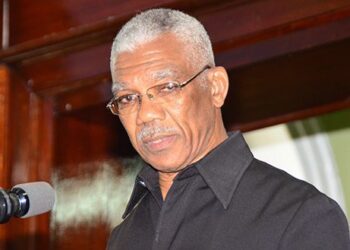
By Mark DaCosta- In his recent commentary, Lincoln Lewis, a seasoned trade unionist and advocate for workers’ rights, has issued a stern warning about the ongoing challenges facing citizens in an oil-rich Guyana. His analysis highlights the pressing need for accountable governance, which he argues is essential for fostering a safe and empowered workforce amidst the prevailing inequalities.
Lewis, General Secretary of the Guyana Trades Union Congress (GTUC) and the Guyana Bauxite General and Workers Union (GB&GWU), delivers a stark warning about the continued erosion of workers’ rights in an economy increasingly shaped by foreign interests. He argues that the surge of oil wealth has failed to translate into real improvements for many citizens, with large segments of the population still trapped in poverty — a troubling contradiction for a resource-rich nation. His declaration that “accountable governance is indispensable to building a safe and productive labour force” emerges as a powerful call for urgent reform and justice for Guyanese workers.
The respected trade unionist urges that the principles of good governance must be enshrined in practices that invite meaningful citizen participation, particularly in light of Article 13 of the Guyanese Constitution. This article obligates the government to establish an inclusive democracy that ensures citizens can partake in the decisions that directly affect their lives. Lewis contends that a constitutional right cannot be respected only in theory; it must be actively upheld.
Quoting Lewis, “Guyanese must insist that both Government and Opposition pass the relevant legislation to give effect to Article 13,” he underscores the crucial role of citizens in demanding inclusivity in governance and the need for concerted collaboration between the government and opposition for the collective good of our nation. The current political dynamic, according to Lewis, is stifling progress, as leaders behave as if they own the nation’s resources, neglecting the well-being of the very workers who keep the economy afloat.
The plight of workers in the oil and gas sector, as highlighted by Lewis, is particularly troubling. He reveals that foreign supervisors often exploit local workers, creating a disparity where Guyanese are not compensated equally for their labour. Retaliation against those who voice concerns about their working conditions has become commonplace — a symptom of a system that prioritises profit over people. Lewis firmly states, “Whatever the limitations of the oil contract, nothing prevents stronger enforcement of worker protections.“
In an incisive critique of the Irfaan Ali administration, Lewis points out that the government shows little inclination to engage meaningfully with trade unions and opposition members to craft policies that protect workers’ rights. This lack of collaboration is reminiscent of previous administrations, perpetuating a cycle of neglect that has disenfranchised the workforce. He notes, “The contempt now evident in the oil and gas sector did not begin there. It traces back more than a decade.”
The history of labour rights abuse in our country is illustrated through the lens of past failures within companies like Bauxite Company Guyana Incorporated (BCGI). Lewis reminds us how foreign management disregarded the laws of our nation, rendering local workers as second-class citizens in their own land. He recounts the promises made to reopen BCGI despite workers previously being denied their lawful termination benefits, stating, “If the government — part owner of BCGI — would not rein in those excesses, why would it restrain others?”
Lewis’s commentary raises pertinent questions about the integrity of governance under the current PPP/C regime, especially in light of previous criticisms of the oil contract signed by the prior administration. He challenges the government’s reluctance to negotiate a better deal, despite the support from opposition members for such discussions. “Campaign promises must not dissolve once office is attained,” he warns, urging citizens to demand accountability from their leaders.
As citizens of our nation, the responsibility falls on us to ensure that our leaders are held accountable — not just for their promises but for actionable outcomes. Lewis implores, “When leaders promise renegotiation and the creation of thousands of jobs, they must present credible pathways and measurable outcomes.” Transparency in governance should be a prerequisite, rather than an afterthought.
In times where accountability is paramount, Lewis’s assertion resonates strongly: “History shows that when governments are not held accountable, they grow indifferent to the very people who placed them in office.” This serves as a crucial reminder that the fight for workers’ rights and accountable governance is not just a union struggle but a national imperative.
Lincoln Lewis posits that a future where every worker’s rights are respected is only attainable through an unwavering commitment to active participation and accountability in governance. It is a call for all citizens to unite and advocate for a system that respects and uplifts every member of our society. Solidarity is indeed our strength in this crucial endeavour.